
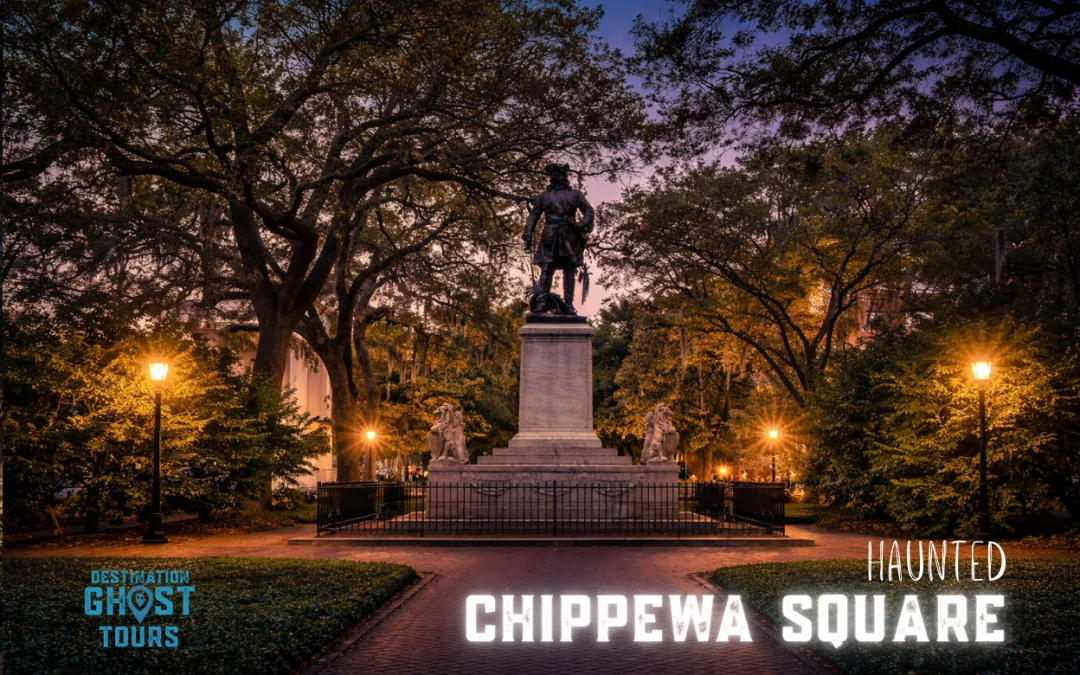
Savannah’s Chippewa Square takes on a different personality after dark. Spanish moss drapes low from the ancient oaks, stirring gently in the midnight breeze, and the gas lanterns around the square flicker against brick facades, casting dancing shadows along the walkways.
In the hush, one might catch the faint echo of laughter or the distant clapping of hands — yet at this late hour, the park benches sit empty. By day, Chippewa Square is known for its Hollywood cameo and historic charm. But by night, locals whisper that this elegant green space in the heart of Savannah belongs to the ghosts.

The Storied History Beneath the Oaks
Chippewa Square was laid out in 1815 and named to honor the American soldiers who fought in the Battle of Chippewa during the War of 1812, a nod to a hard-won victory over British forces. Long before the square’s creation, however, this part of Savannah lay at the embattled southern edge of the colonial town.
In October 1779, during the Revolutionary War, American and French forces launched a massive assault to retake Savannah from the British. The bloodiest fighting centered on the Spring Hill Redoubt, a short distance to the west, where the doomed charge was cut down and hundreds of soldiers fell — among them the Polish cavalry commander Casimir Pulaski and Sergeant William Jasper. The British defensive lines ran just to the south of here, near what is now Madison Square. So while the heaviest carnage was nearby rather than on this exact spot, the ground around Chippewa Square knew the sounds of war long before it knew the laughter of theatergoers — and some say those restless spirits set the stage for the hauntings to come.
When the city laid out the square after the War of 1812, it quickly became a focal point of Savannah’s social life. In 1818, just steps from the oak-shaded lawns, the Savannah Theatre opened on the square’s northeastern corner. Designed by the renowned British architect William Jay, the theater soon shone as a beacon of culture and nightlife; carriages lined the streets as finely dressed ladies and gentlemen arrived for evening performances, their chatter filling the balmy night air. It’s hard to imagine that only decades earlier, this ground had been part of a battlefield.

At the center of the square stands a bronze statue of General James Oglethorpe, the founder of Georgia, atop a marble pedestal. Erected in 1910 and sculpted by Daniel Chester French — the same artist who would later create the seated Lincoln for the Lincoln Memorial — Oglethorpe faces due south, as if still guarding his colony against long-ago threats from Spanish Florida. Many visitors admire the monument without realizing that his stern gaze watches over a square full of secrets.
In modern times, Chippewa Square may be most famous for a quiet little park bench that once sat on its north side. Forrest Gump fans flock here to stand where Tom Hanks’ character mused that “life is like a box of chocolates.” The movie bench was actually a prop (now preserved in a Savannah museum), but that hasn’t stopped countless visitors from reliving the scene under these moss-laden trees. That pop-culture fame is just one layer of the square’s story. Beneath the Hollywood sheen lies a darker lore — and as the tourist crowds thin, Savannah’s haunted history begins to stir among the dimly lit paths.
Ghosts and Legends of Chippewa Square
Nearly every corner of Savannah has a ghost tale to tell, and Chippewa Square is no exception. Ghost tours often include this picturesque square precisely because of its rich tapestry of legends — after all, Savannah isn’t called America’s most haunted city for nothing. The very ground of the Historic District is layered with memories of war, tragedy, and romance, and here the past lingers palpably.
Some locals swear that late at night you can glimpse shadowy figures gliding between the oaks, or hear the muffled sound of marching boots on the old cobblestones — echoes, perhaps, of Revolutionary War soldiers still carrying on their doomed 1779 assault. While such sightings are anecdotal, the area’s genuine history certainly fuels the imagination. And there are more specific ghostly encounters tied to the square’s venerable buildings.
The Haunted Savannah Theatre
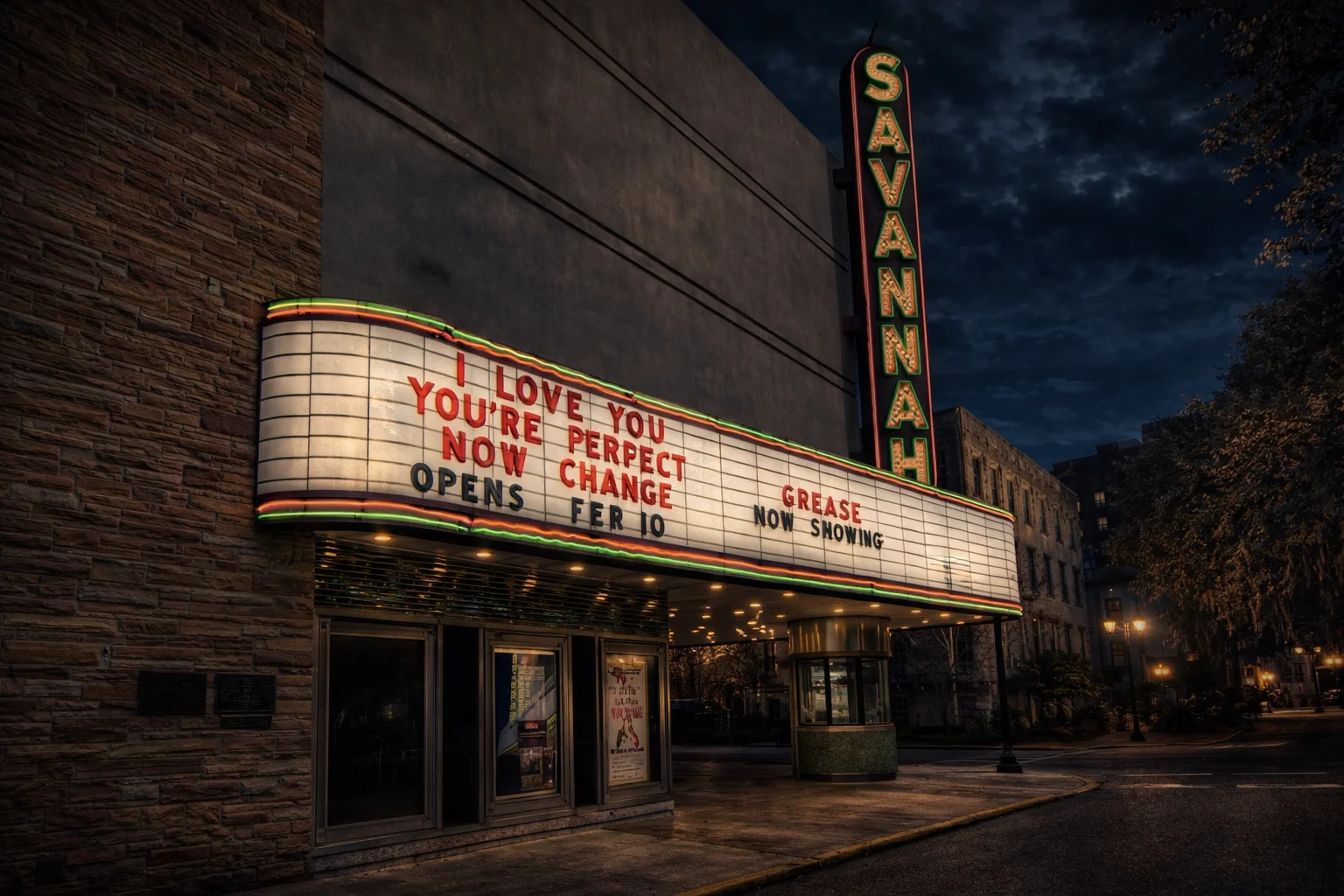
One of Chippewa Square’s grandest old structures is the Savannah Theatre, and it happens to be one of the city’s most famously haunted venues. Having stood on the square since 1818, the theater has weathered fires, hurricanes, and countless performances — and, according to many, it has also accumulated a small company of resident ghosts. Late at night, when the stage is dark and the seats are empty, people have reported phantom applause echoing from the auditorium, as if an invisible audience is still enjoying a show from decades past. An 1895 newspaper account even told of police repeatedly investigating noises in the locked theater, only to find it empty — so often that the officers eventually grew reluctant to respond.
There are persistent stories of a female apparition known as Betty, said to be a 19th-century actress who loved the stage too much to leave; she has been seen in the wings in period costume, only to vanish when anyone gets too close. Equally renowned is Ben, the ghost of a mischievous little boy said to haunt the balcony, tugging playfully at the shirts of the stage crew and giggling in the empty seats. Many speculate he perished in one of the theater’s long-ago fires, but today he seems quite content as an eternal prankster. The Savannah Theatre’s ghosts have become so much a part of its identity that no Savannah ghost tour would feel complete without a stop by this historic stage.
The Foley House Inn
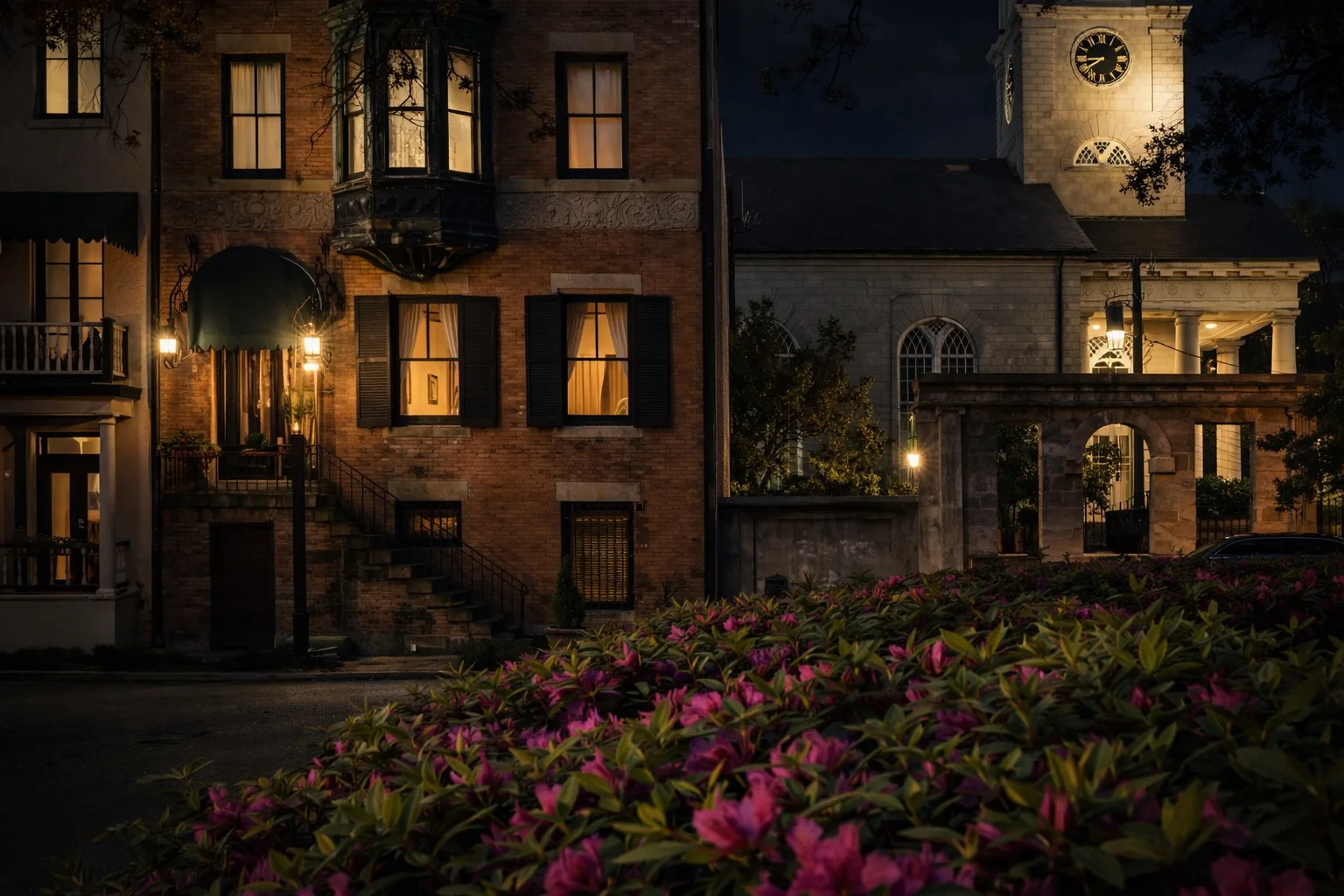
Just across the square, on the western side, looms the stately Foley House Inn, another elegant property with a sinister secret. It was built in 1896 by a widow named Honoria Foley — on the ashes of a home lost to the Great Savannah Fire of 1889 — and for decades it was simply a charming Victorian residence. Then, during renovation work in 1987, contractors removing a wall made a grisly find: a human skeleton bricked up inside it, tucked away as if to hide a long-forgotten crime.
Savannah gasped, and speculation ran wild. The popular legend tells of Mrs. Foley taking in a male boarder who became dangerously infatuated with her. One night, the story goes, he tried to attack the widow in her own bedroom; in desperation, Honoria struck him with a heavy candlestick, killing him, and then enlisted a trusted friend to seal his body inside the wall, where it remained undiscovered for nearly a century. She is even said to have confessed on her deathbed in 1914 — a tale so wild that many dismissed it, until 1987 proved there was something to it. You can read the full, complicated story in Who Put the Bones in the Walls?
Whether the legend is true or not, the skeleton in the wall is a matter of record.
Whether the tale is completely accurate or not, the skeleton is a matter of record — and it has spawned a host of ghostly accounts. Guests report the apparition of a courteous gentleman in old-fashioned attire (the staff have nicknamed him “Wally”), sometimes seen by the fireplace or in the garden, or felt as a friendly touch on the shoulder when no one is there. Others describe phantom footsteps on the stairs and a presence passing through the rooms in the quiet hours before dawn. Fortunately, this resident spirit seems more mischievous than menacing — though knowing a body was once hidden in the walls adds an extra chill to any overnight stay.
The Savannah Theatre and the Foley House are the best-known ghostly landmarks on Chippewa Square, but they are not the only ones. Many of the historic homes ringing the square have their own whispered hauntings, and on a moonlit night, even the moss-draped oaks seem to hold memories. Visitors sometimes feel a sudden chill under the branches, or catch a glimpse of something just beyond the corner of their eye.
Visiting Chippewa Square Today
Chippewa Square beautifully blends its pleasant daytime atmosphere with an unmistakable after-dark mystique. By daylight, it’s a charming oasis: squirrels dart across manicured lawns, sunlight filters through the oak canopy, and tourists snap photos by Oglethorpe’s statue or the Forrest Gump bench location. It sits at a bustling crossroads of downtown, ringed by cafes, historic churches, and theaters, and it’s a popular stop for film buffs, history lovers, and anyone strolling the city’s 22 squares.
As evening approaches, the square takes on a different energy. The glow of the old street lamps gives the live oaks an eerie beauty, and the chatter from nearby restaurants mixes with the clip-clop of horse-drawn carriages carrying ghost-tour groups. Join a Destination Ghost Tours walk and chances are you’ll find yourself standing here under the moonlight, listening to chilling tales about the very buildings in front of you. The spirits of Chippewa Square, if they do roam, seem to do so not out of vengeance but out of attachment: an actress who loved the stage too dearly to exit, a soldier still answering a call to duty, a lonely boarder who found a home he never left. Perhaps the faint laughter drifting through the moss is just a nearby tavern — or perhaps it’s something unearthly.
Walk With the Ghosts of Chippewa Square
From the haunted Savannah Theatre to the skeleton in the Foley House walls, Chippewa Square is a highlight of our walk through haunted Savannah. Come hear its stories after dark.
Book a Savannah Ghost Tour
Chris Allen is the founder of Destination Ghost Tours, a historian and storyteller with a lifelong fascination for the darker corners of history. He spends his time uncovering the true stories behind haunted legends, guiding guests through historic cities, and chasing down details that refuse to stay buried. When he is not working, he can usually be found with his partner Arissa, their dog Bear, and their two cats, Trouble and Covu, photographing old places, digging through archives, or disappearing into historical rabbit holes. He believes the best history is honest, atmospheric, and just unsettling enough to linger.