
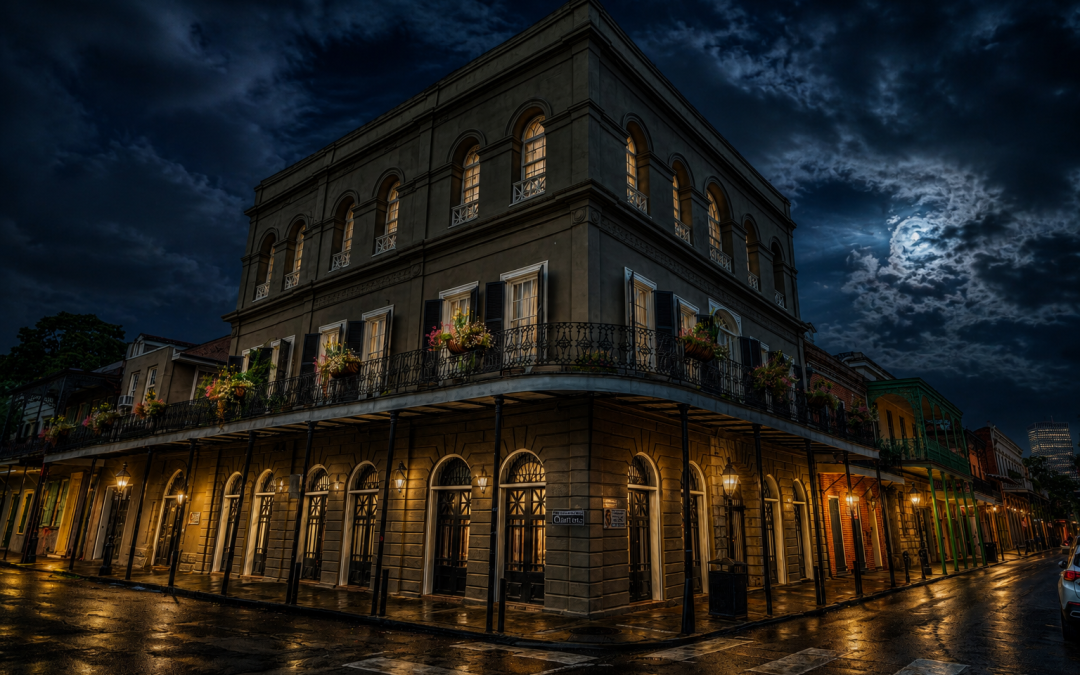
The History and Hauntings of the LaLaurie Mansion
On the corner of Royal and Governor Nicholls Streets, in the heart of the French Quarter, stands a gray three-story mansion that people cross the street to photograph and, sometimes, to avoid. It has been called the most haunted house in New Orleans. That reputation is not built on invention. It is built on something that actually happened here, and on the people it happened to.
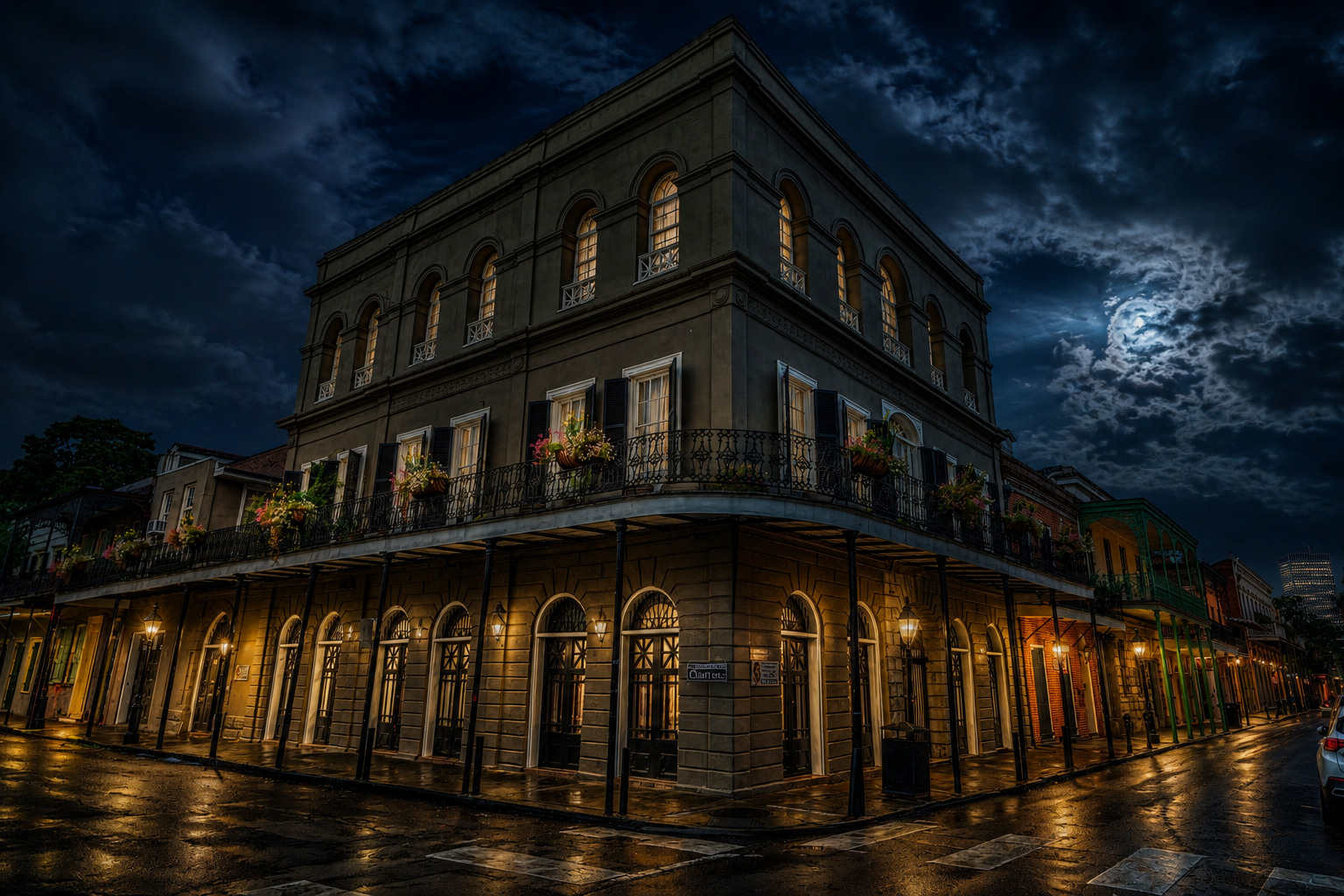
Before we go any further, a word about how this story should be told. The LaLaurie house is famous for horror, and over nearly two hundred years the horror has been stretched, embroidered, and turned into entertainment until the real people at the center of it nearly vanished. We are going to try not to do that. The genuinely frightening thing about this house is not some invented dungeon of impossible tortures. It is the documented truth of what was done to enslaved human beings behind a respectable Creole family's front door, in plain view of a whole city that looked away for years. Keep that in mind as we climb the stairs.
The Macarty Name
She was born Marie Delphine Macarty, around 1787, into one of the most powerful families in New Orleans. The Macartys were Creole, of French and Irish descent, and they were rich in the way that mattered in that city: land, connections, and social weight. Delphine grew up at the top of society and stayed there. By the time she was middle-aged she had been widowed twice, which in that era only added to her mystique. Her first husband, a Spanish royal officer, died young. Her second, a banker and merchant named Jean Blanque, left her wealthy and connected. Then came her third, a physician named Dr. Leonard Louis Nicolas LaLaurie, a younger man, and the one whose name the house would carry into infamy.
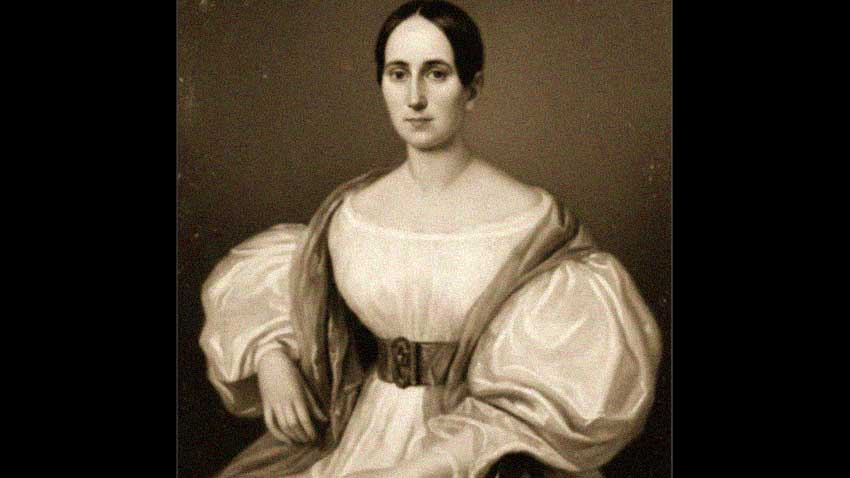
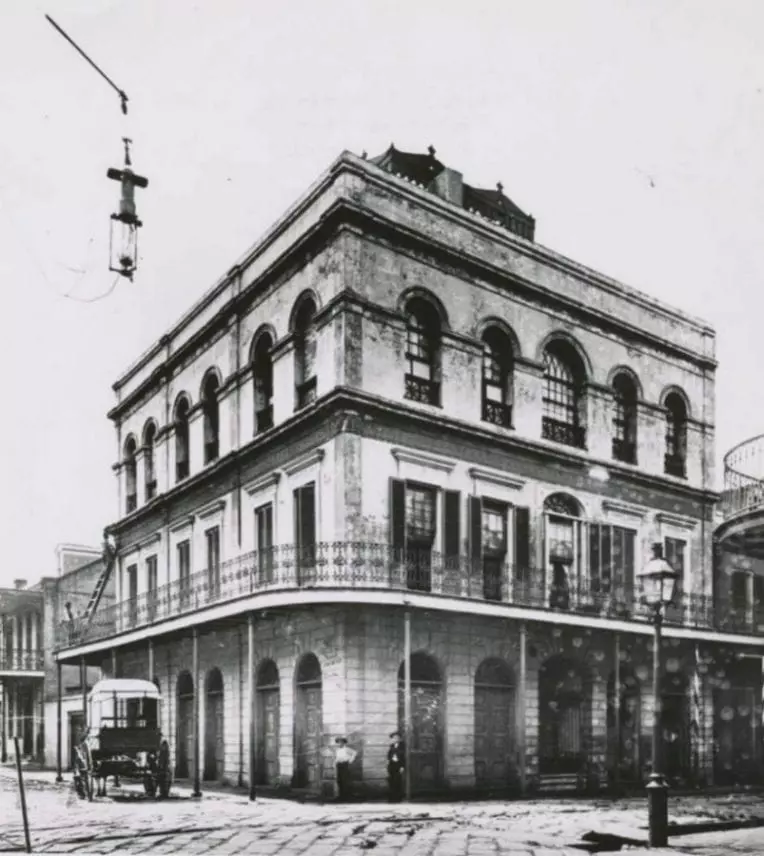
Around 1831 and 1832, Delphine had the three-story mansion built at 1140 Royal Street, on what was then the corner of Royal and Hospital Street. It was elegant, and she filled it with elegant things and elegant people. She threw the kind of parties the whole Quarter talked about. To the guests who came and went beneath the chandeliers, Madame LaLaurie was gracious, cultured, the picture of a New Orleans grande dame. That was the face she showed the street. Like the house itself, she had rooms the guests never saw.
What the Neighbors Whispered
The rumors did not start with the fire. They had been circulating for years. As historian Carolyn Morrow Long has documented, Delphine LaLaurie was investigated as early as 1828 over the cruel treatment of the people she enslaved. The court records from that inquiry have not survived, but the paper trail around it did. There is documentation that she paid for legal help and then sold off a number of enslaved people afterward, which is what someone does when they are trying to make a problem disappear.
A British writer named Harriet Martineau, who visited New Orleans in 1836, wrote down what locals told her. The enslaved people in the LaLaurie household, they said, looked singularly haggard and wretched compared to others in the city, even by the grim standards of a slaveholding society that had normalized enormous suffering. In public, Madame LaLaurie was described as polite. Behind the walls, something was very wrong, and enough people sensed it that the talk never quite died down.
There is a story, told at the time and repeated ever since, of a young enslaved girl on the roof of the house in 1833. The account, passed along by Martineau and others, holds that Madame LaLaurie pursued the child with a whip until the girl fell, or leapt, from the rooftop to her death. Whatever the exact truth of that day, it drew official attention. Authorities are said to have penalized LaLaurie and ordered some of her enslaved people sold. She got around it, the way the powerful often did, by having relatives quietly buy them back and return them to her. And there is a colder, documented fact underneath the folklore. Funeral registers from the years the family lived on Royal Street record the deaths of around a dozen enslaved people at that address, causes unlisted, among them a woman named Bonne and several of her children. The house was already a place where the enslaved went in and did not always come out.
The Fire on Royal Street
It ended, as these things sometimes do, by accident. On the morning of April 10, 1834, a fire broke out in the kitchen of the mansion. When people rushed to help, they found an elderly enslaved woman, the cook, said to be around seventy years old, chained in place near the hearth. She had not been able to flee because she was fastened there. Later it was said she had started the fire herself, that after everything, death by burning had seemed better to her than another day in that house.
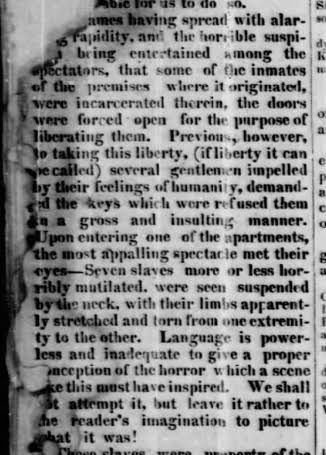
As the fire drew a crowd, bystanders tried to reach anyone still trapped inside. They forced their way past Madame LaLaurie and her husband, into the burning service wing, and there they found seven enslaved people. The word the records use is that they were starved, chained, and mutilated. Contemporary newspapers, including the New Orleans Bee, reported the discovery to a stunned city. The specifics were bad enough that some papers would not print them in full.
Here is where honesty matters most. Over the decades that followed, and especially in a 1946 collection of New Orleans ghost stories, the tale grew monstrous new limbs. Stories spread of a secret torture chamber, of grotesque medical experiments, of victims with their bones broken and reset, of horrors so baroque they read like a horror film, and eventually one was made. Careful historians, Carolyn Morrow Long chief among them, have gone back to the actual 1834 evidence and shown that most of those lurid embellishments cannot be supported. We repeat that not to soften what happened. Seven human beings found starved and chained and wounded in a burning house is not a story that needs exaggeration. It is a story that needs witnesses.
The Mob and the Flight
Word went through the Quarter fast, and the mood on Royal Street curdled. The crowd that had gathered out of concern turned, quickly, into a crowd out of fury. People assumed, not unreasonably, that the LaLauries would have let those enslaved people burn rather than have the state of them discovered. The day wore on. The sheriff did not make an arrest. And an angry, growing mass of New Orleanians pressed in around the elegant house, waiting for something to happen.
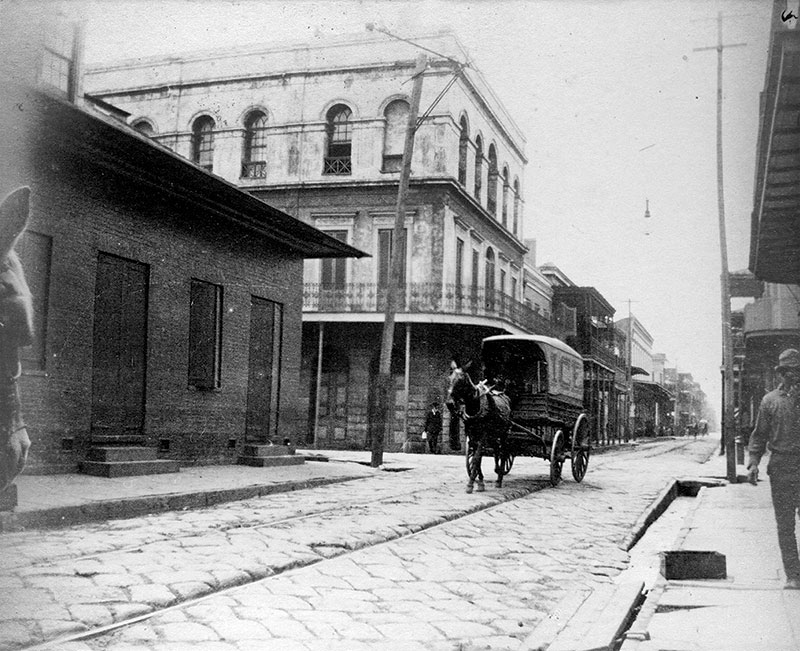
What happened was that the LaLauries ran. Delphine's carriage burst out through the gate and raced away toward Lake Pontchartrain, where she is said to have boarded a schooner and slipped out of the city for good. The mob, cheated of her, turned on the house instead. They broke in and nearly demolished it, gutting the interior, hurling out the fine furnishings, venting on the walls a rage they could not spend on the woman who had fled. When it was over, the mansion stood ruined and empty, and Madame LaLaurie was gone. No charge was ever filed against her. No trial was ever held. Her guilt was simply assumed, then and now, and she was never made to answer for any of it.
Exile and a Grave in Paris
She surfaced, eventually, in Paris. And here the record gets slippery, the way it does around famous villains. The most careful biography of her life, Carolyn Morrow Long's, places her death in Paris in 1849. She died abroad, comfortable, unpunished, an ocean away from the city that would never forgive her, and she was buried in France.
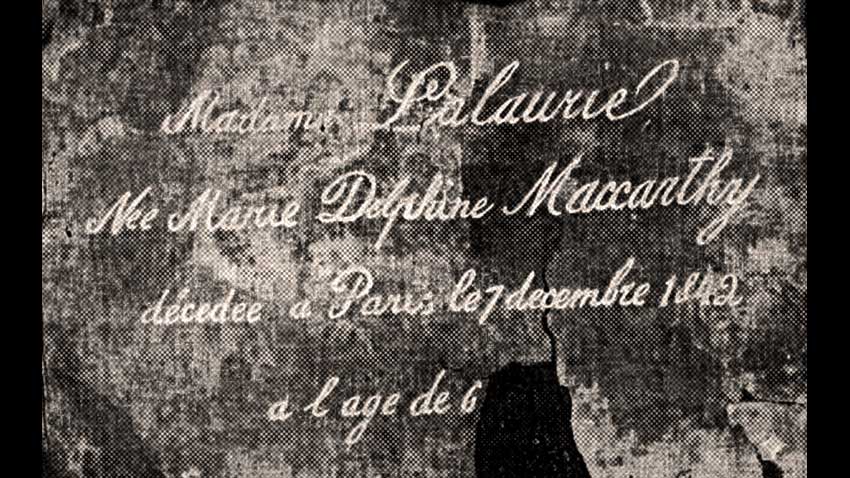
There is a strange coda, though. Years later a cracked copper plate turned up in St. Louis Cemetery No. 1, back in New Orleans, engraved with her name and a death date, suggesting that her remains had been quietly shipped home and slipped into the city's oldest cemetery without ceremony. Whether her bones truly made that last voyage back to New Orleans, nobody can say for certain. It is a fittingly restless ending for a woman whose house has never been allowed to sleep. Even her grave comes with a question mark and two possible cities.
The House That Would Not Rest
The mansion did not stay a ruin. New Orleans is too practical and too crowded to leave prime French Quarter real estate to the ghosts. Over the years it was rebuilt and put back to use, again and again, for the most ordinary purposes imaginable. At various points it served as a public high school, a music venue, a furniture store, and apartments. People lived there. People worked there. Life kept trying to move back in, and the stories kept following it around.
In more recent times the house has changed hands among owners who could afford its price and its reputation. The actor Nicolas Cage bought it in 2007, drawn, he said, to its dark history, and lost it to foreclosure roughly two years later. Popular culture kept the legend burning brighter than any documentary would have, most famously when a heavily fictionalized Madame LaLaurie became a character on national television, her real crimes flattened into camp. Today the mansion is private property. You can stand on the public sidewalk and look up at it. You cannot go in. Most people, if they are honest, are relieved about that.
The Hauntings
Given everything the walls of this place absorbed, it is no surprise that it became the most told ghost story in a city full of them. The reports go back generations, and they tend to circle the same handful of things.
Sounds in the Dark
The oldest and most persistent reports are of sound. Screams and moans said to come from the upper floors and the old service wing, heard by residents and passersby over the years, always seeming to originate from empty rooms. Some have described the rattle or drag of chains. In the decades after 1834, when the house sat damaged and unloved, neighbors traded stories of cries in the night that no living throat could be found to explain.
The Figures on the Stairs
People have reported apparitions of enslaved men, women, and children throughout the house, on the staircases and in the halls, sometimes appearing in distress before they vanish. And there are sightings of a woman, elegant and cold, taken to be the mistress of the house herself, still moving through the rooms she once ruled. Whether or not you believe any of it, notice who the stories say lingers here. Both the ones who suffered and the one who made them suffer, still sharing the same address.
What Visitors Feel
Even people who see and hear nothing often report the same thing standing outside: a heaviness, a reluctance, a sense that the building is watching the street more than the street is watching it. Guides and guests describe cold spots and a mood that settles over a group as they approach. It may be the power of the story doing the work. It may be something else. In a place with this history, the line between the two gets very thin after dark.
The Names We Owe
It would be easy to end on a shiver and leave it there. But this house asks something more honest of us than a cheap chill, and it is worth saying plainly. The people who were tortured in the LaLaurie mansion were not plot devices. They were human beings with names, most of which the records never bothered to keep, which is its own quiet horror. We know a woman named Bonne died there, and several of her children. We know an old cook chose fire over another morning of that house. The seven found in the wing in 1834 had lives and losses and fear, and they were failed by a city that heard the rumors for years and did nothing until a fire forced its hand.
Historians who study this kind of place have warned, rightly, about turning the suffering of the enslaved into a spooky souvenir. We take that seriously. If the LaLaurie mansion haunts New Orleans, it is not really because of one wicked woman in a portrait. It is because the house stands as a permanent, gray, three-story reminder of what was done to people the powerful treated as property, and of how long polite society managed to look the other way. That is the true ghost story here, and it does not require a single invented detail to keep you up at night.
Stand across from it some evening when the Quarter goes quiet. The story you feel pressing back at you is real. So were the people in it.
Walk the French Quarter After Dark
The LaLaurie mansion is one address on a street full of them, in a city where history and hauntings are impossible to tell apart. Come walk the lamplit corners of the Vieux Carré with a storyteller who honors the history beneath the hauntings. Join Destination Ghost Tours and let New Orleans tell you its secrets in its own voice.
Book a New Orleans Ghost TourSources & Further Reading
- Long, Carolyn Morrow. Madame LaLaurie, Mistress of the Haunted House. University Press of Florida, 2012 (the definitive biography, separating documented fact from later legend).
- Long, Carolyn Morrow. "Delphine Lalaurie." 64 Parishes, Louisiana Endowment for the Humanities (the 1828 investigation, the April 10, 1834 fire, and the flight from the city).
- "The Lalaurie Mansion." New Orleans Historical (public history project covering the mansion, the fire, and the aftermath).
- "The LaLaurie Mansion, 1832." BlackPast.org (the enslaved people held at 1140 Royal Street and the events of the fire).
- "Delphine LaLaurie." Wikipedia (Macarty family background, funeral-register deaths of enslaved people, Harriet Martineau's 1836 account).
- Miles, Tiya. Tales from the Haunted South. University of North Carolina Press (on the ethics of dark tourism and the memory of slavery).
- The New Orleans Bee (L'Abeille de la Nouvelle-Orleans), April 1834 (primary newspaper coverage of the discovery).
This article prioritizes documented history over folklore. The most graphic "torture chamber" claims commonly attached to this house derive from later, sensationalized retellings and are presented here as legend, not fact. The documented cruelty required no embellishment.