
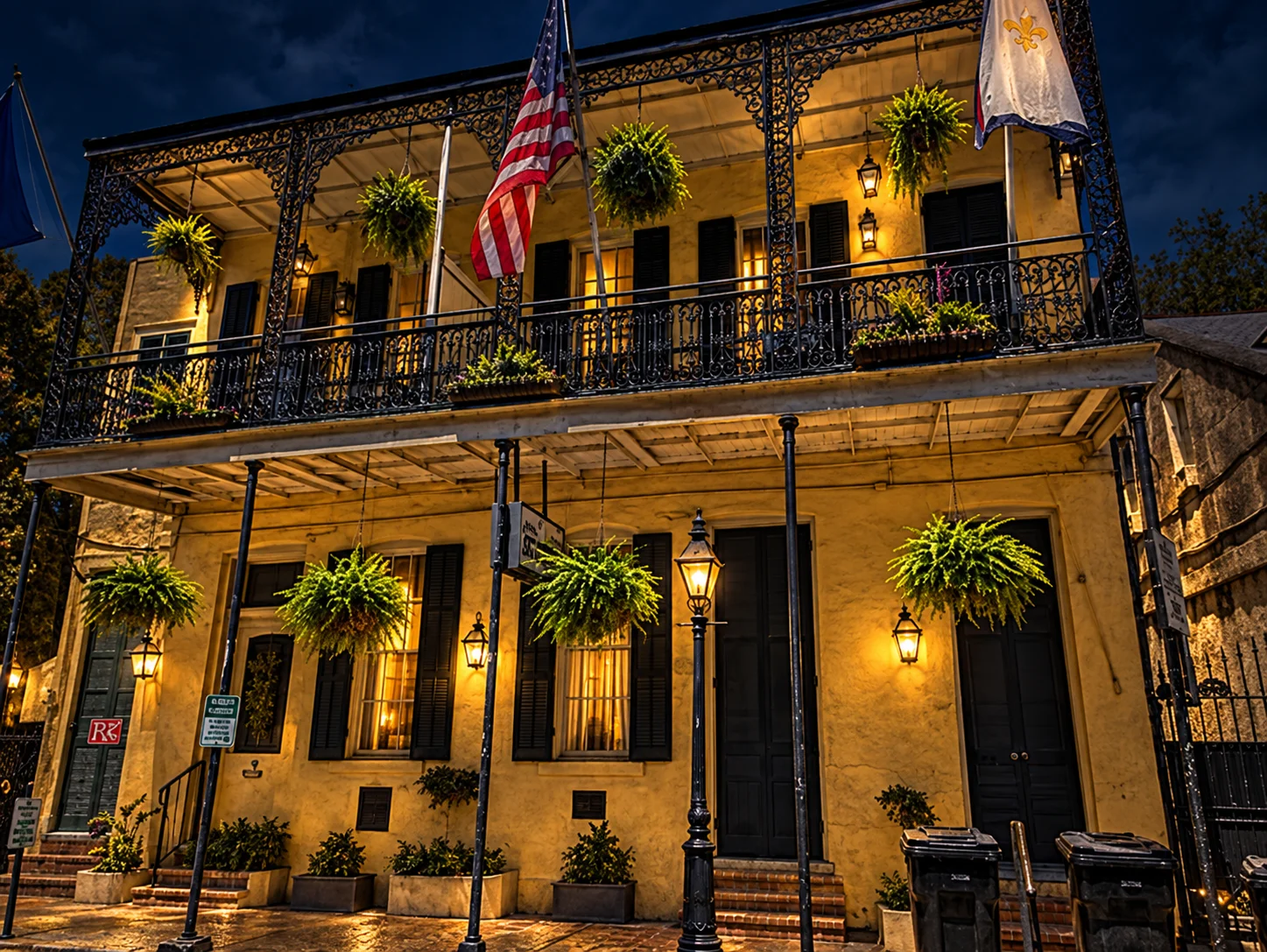

919 Royal Street, French Quarter, New Orleans
The Andrew Jackson Hotel
A haunted history of 919 Royal Street: a Spanish school, a federal courthouse, and the children still heard in the courtyard after dark.

The Andrew Jackson Hotel has the sort of appearance that makes people slow down on Royal Street.
Iron balconies overlook the sidewalk, while a courtyard offers somewhere to sit away from the surrounding streets. At 919 Royal, the hotel’s appeal is easy to understand. So is the curiosity about what guests claim happens after they settle in for the night.
Children are said to laugh where no children can be found. A boy called Armand has become associated with one upstairs room. Other accounts describe a woman attending to rooms as though her work has never ended. These stories have given the Andrew Jackson a place among New Orleans’s familiar haunted hotels, although the history beneath them is more complicated than the usual telling suggests.
The Spanish School on Royal Street
Before the present hotel building, this property was associated with a Spanish public school. The Historic New Orleans Collection’s Vieux Carré Survey preserves references to that earlier use, including an 1809 appeal to President Thomas Jefferson concerning the Royal Street building erected for a school. An 1820 city council record likewise identifies the building then occupied by the federal court as a former Spanish school.
Those records establish an educational history. They do not, by themselves, establish the orphanage described in modern ghost stories, or the claim that its pupils had all lost their parents to yellow fever. The distinction matters because the school provides the historical foundation for the hotel’s best-known legend.
New Orleans suffered major fires in 1788 and 1794. The second occurred on December 8, 1794, destroying much of an area that had been rebuilt after the earlier disaster. Fire was a genuine threat to the colonial city, and its consequences helped shape the French Quarter that survives today.
The hotel’s published story connects that second fire to five orphaned boys said to have died on this property. It is a widely repeated account, but the historical material reviewed for this article does not establish those five deaths. The real fires should not be treated as proof of every tragedy later attached to them.
The Courthouse and Andrew Jackson
The property’s connection to Andrew Jackson rests on firmer ground. The United States District Court for the Eastern District of Louisiana identifies 919 Royal Street as the location of its federal courthouse between 1812 and 1823. The courthouse itself has been demolished.
Jackson arrived in New Orleans in December 1814 to prepare for a British attack and imposed martial law. His forces defeated the British the following January, but he continued exercising military authority after the immediate invasion threat had passed. Resistance to that authority brought him into conflict with the courts.
When Louisiana legislator Louis Louaillier criticized Jackson’s policies, Jackson had him arrested. Judge Dominick Hall intervened, and Jackson ordered the judge detained as well. Hall was subsequently banished from the city. After martial law ended, the judge returned and fined Jackson $1,000 for contempt of court, which Jackson paid.
The episode gives this address a significance beyond its ghost stories. A general celebrated for defending New Orleans was required to answer to civilian judicial authority. The hotel’s name recalls a connection to the site, although the building occupied by its guests came much later.
The Vieux Carré Survey records the old courthouse’s demolition in 1888 and dates the existing two-story brick building to approximately 1890. An 1888 newspaper account preserved in the survey describes its replacement as a building intended for a store and residence. Dating the structure to that period does not establish that it opened as the Andrew Jackson Hotel in 1890.

The Children in the Courtyard
In the hotel’s haunting tradition, the five boys associated with the fire never entirely left. Published accounts describe guests hearing children playing and laughing in the courtyard when no children were visible. Footsteps and small disturbances have also been attributed to them.
These are reported experiences, rather than verified evidence of the boys’ presence. The identification comes from the legend: an unexplained sound is interpreted through the story already attached to the property. A witness may sincerely describe hearing a child without being able to establish who made the sound, or where it originated.
There is something unsettling about the account even without an elaborate reconstruction of the fire. The disturbance is ordinary enough to recognize. Children playing outside would scarcely deserve attention in a busy hotel, until someone goes looking and finds no children there.
Children playing outside would scarcely deserve attention in a busy hotel, until someone goes looking and finds no children there.
Armand and Room 208
Room 208 is particularly associated with a child spirit called Armand, sometimes spelled Armond. The hotel’s own published haunting account describes guests reporting laughter, a cold touch, and bedcovers being pulled. Some accounts go further, claiming an unseen force pushed a sleeper out of bed. Objects are also said to move or disappear.
Armand’s supposed history is less consistent. Published versions disagree about how he died, including conflicting stories involving a balcony. Without a reliable historical identification, those explanations remain folklore. Giving the boy a precise age, family history, or final moments would add certainty the available evidence does not support.
The Room 208 stories belong to the hotel’s established paranormal reputation. Whether their cause is supernatural remains unresolved. An account of disturbed bedding or an unexpected touch during sleep does not, on its own, identify a spirit.

The Woman Who Keeps Working
Another recurring story concerns a woman described as a former housekeeper or a caretaker of the children. The hotel publishes accounts of an apparition apparently straightening rooms and fluffing pillows, with sightings associated with the lobby and guest rooms.
Her identity is uncertain. The housekeeping explanation fits the activity attributed to her; the caretaker explanation connects her to the children’s legend. Neither establishes who the figure might have been in life.
This is one of the quieter stories attached to the Andrew Jackson. Its unease comes from the familiar task, someone tending a room, continuing under circumstances that witnesses cannot explain.
Does Andrew Jackson Haunt the Hotel?
The hotel also repeats claims that Andrew Jackson’s ghost walks its halls. His historical connection to the property makes that identification tempting, but a connection to an address cannot establish the identity of an apparition. The responsible description is therefore an apparition attributed to Jackson, rather than Jackson himself returning as an established fact.
A Haunted Reputation That Continues
Interest in the hotel’s hauntings is still active. In a September 2026 article, New Orleans Mom contributor Devan Orellana described participating in a paranormal investigation there with Southern Ghost Girls. Her account included equipment responses and activities such as table tipping, alongside stories shared by a hotel manager.
It documents a contemporary investigation and the participants’ impressions. It does not resolve the identities of the reported spirits or confirm the orphanage tragedy. That distinction leaves room to take witnesses seriously while examining the explanations offered for their experiences.
The Andrew Jackson Hotel has enough documented history to deserve attention without additions. A Spanish school once served this site. A federal court occupied it, and Jackson’s confrontation with that court became part of the city’s history. The present building belongs to a later chapter, with ghost stories of its own.
For those drawn to haunted New Orleans, the courtyard remains the most affecting part of the legend. A place meant for rest has become associated with children heard playing after dark. Their identities remain uncertain, but the story has people listening.
Research sources
- The Historic New Orleans Collection, Vieux Carré Survey, 919–923 Royal Street
- United States District Court, Eastern District of Louisiana, 1812–1823 courthouse
- The Historic New Orleans Collection, How the Fires of 1788 and 1794 Changed New Orleans
- National Park Service, Andrew Jackson declares martial law in New Orleans
- The Historic New Orleans Collection, The Hero in Twilight
- Andrew Jackson Hotel, About Us
- Andrew Jackson Hotel, Haunted Happenings
- New Orleans Mom, Ghost Hunting at the Andrew Jackson Hotel
Hear the story of Andrew Jackson Hotel after dark
Self-guided tour · New Orleans
Haunted New Orleans Self-Guided Tour
AnytimeAll ages
A phone-guided route through the French Quarter with narration on haunted locations, tragedies, voodoo and local folklore. Start any time.
Questions people ask
Is the Andrew Jackson Hotel haunted?
Guests report unexplained laughter, touches, and apparitions, but supernatural causes remain unproven.
Which room is associated with Armand?
Room 208, where accounts describe disturbed bedding, laughter, and cold touches.
Was the property an orphanage?
Historical records establish a Spanish school; the orphanage claim remains unverified.
Did five boys die there in a fire?
Hotel folklore connects five boys to the 1794 fire, but their deaths are not established by the reviewed records.
Did Andrew Jackson stay in the current building?
The current building dates to around 1890; his connection concerns the earlier courthouse.
Link to or cite this story
Writers, bloggers, teachers and travel guides are welcome to link to this page. Copy a ready-made link, citation or story card below.
Page address
HTML link for your website
Citations (APA, MLA, Chicago)
Paste this HTML to show a story card that links back here
More haunted stories
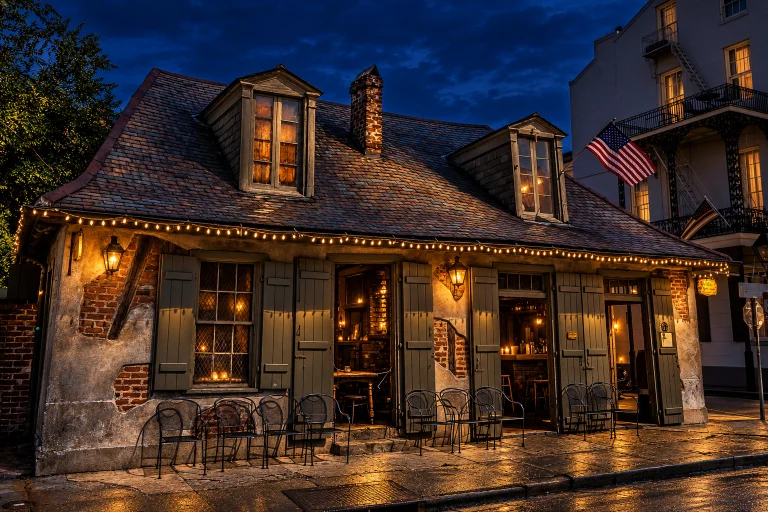
New Orleans
The Haunting and History of Lafitte’s Blacksmith Shop Bar
Lafitte’s Blacksmith Shop Bar at 941 Bourbon Street in New Orleans’s French Quarter occupies a colonial cottage known for candlelit interiors and…
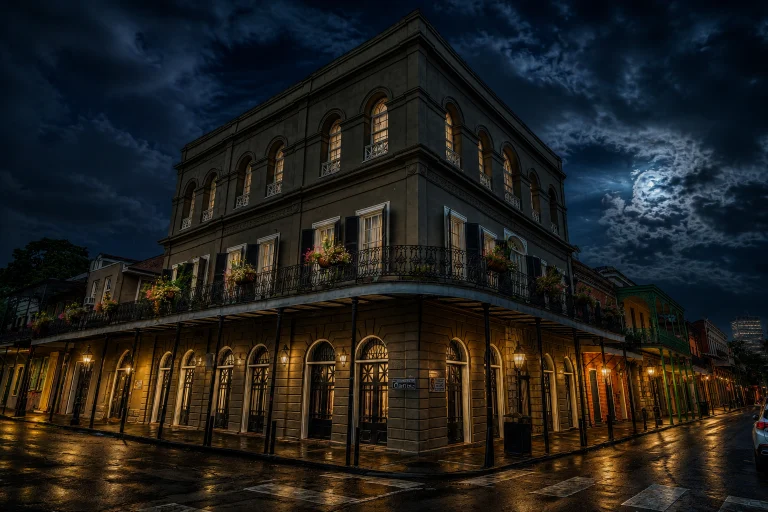
New Orleans
The History and Hauntings of the LaLaurie Mansion
The LaLaurie Mansion at 1140 Royal Street in New Orleans’s French Quarter is known for ghost stories involving screams, rattling chains, and…
St. Augustine
The History and Hauntings of the St. Augustine Lighthouse
The St. Augustine Lighthouse on Anastasia Island, Florida, is a historic maritime landmark known for reports of children’s laughter, apparitions, and unexplained…