
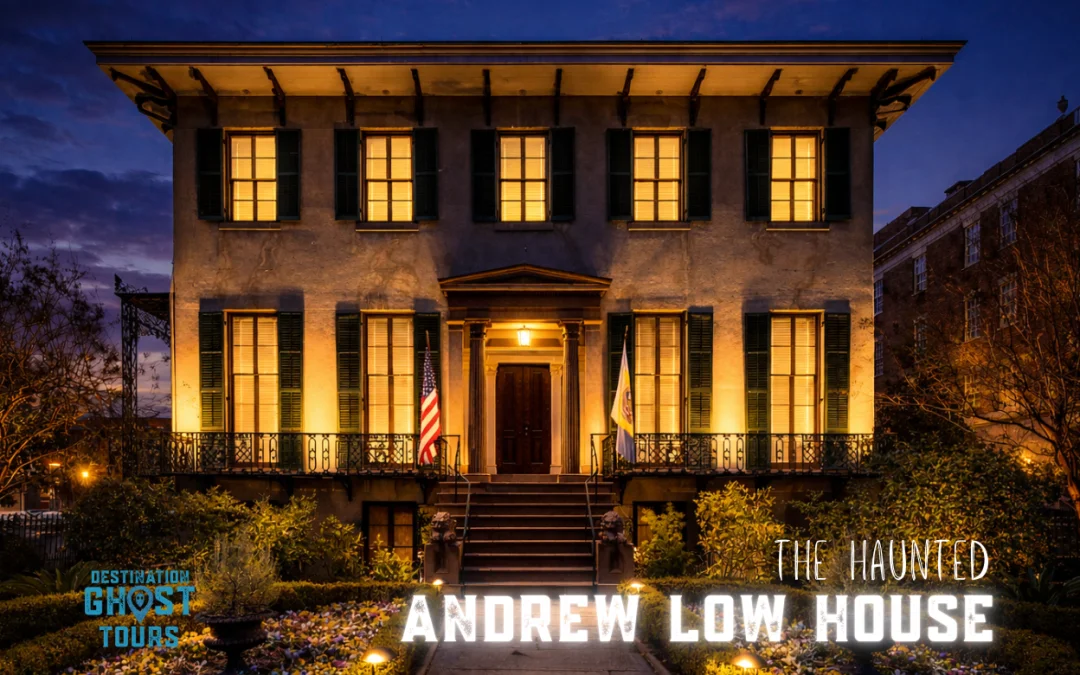
In the heart of Savannah’s Historic District, overlooking the stately calm of Lafayette Square, stands one of the city’s most refined and quietly unsettling homes. The Andrew Low House is not a place of theatrical hauntings or sudden shocks — it is a mansion steeped in layered history, personal tragedy, and subtle phenomena that surface when the house is at its quietest.
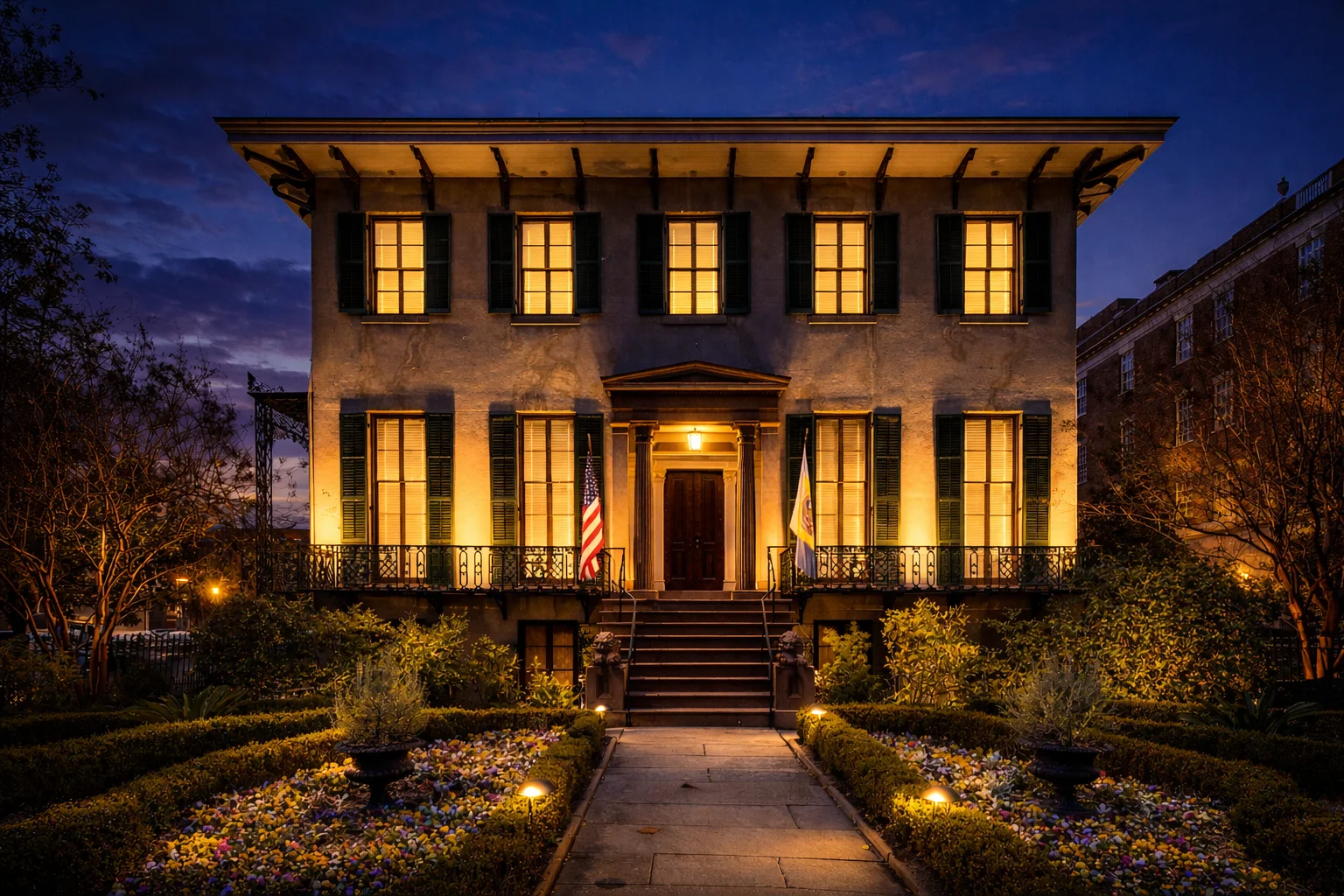
Here, elegance and sorrow exist side by side, woven into the walls as thoroughly as the decorative plasterwork and iron railings that have defined the property for more than a century and a half. While many Savannah homes carry ghost stories, this one stands apart for the sheer weight of real history that anchors every whispered account. The hauntings here are not loud or violent. They are intimate, familiar, and often described as strangely peaceful — as though the past never truly learned how to leave.
The Making of a Savannah Powerhouse

Andrew Low arrived in Savannah as a young immigrant from Scotland, entering a city that was rapidly growing into one of the South’s most prosperous ports. Through dedication and shrewd business sense, he rose within his uncle’s cotton enterprise, eventually becoming a partner and then a prominent figure in Savannah’s commercial and social circles. His success allowed him to envision a home that would reflect not only his wealth, but his place within Savannah’s elite society.
Construction began in the late 1840s, with architectural choices that reflected contemporary tastes while still standing out among the surrounding homes. The residence embraced the Italianate style — balanced proportions, ornate ironwork, and a refined exterior that suggested restraint rather than excess. Lafayette Square itself was one of Savannah’s most desirable addresses, offering both prestige and proximity to the cultural heart of the city.
Yet while the house was meant to be a celebration of achievement, tragedy arrived before its promise could be fully realized. Andrew Low’s wife, Sarah Cecil Hunter, fell ill and died around the time the family should have been settling into the completed home. Their young son soon followed. The loss reshaped Low’s life and the emotional landscape of the house itself, casting a long shadow that many believe still lingers.
A Home Defined by Absence

Despite his grief, Andrew Low moved forward, raising his daughters within the mansion and continuing his work and public life. The house became a place of both mourning and continuity, where daily routines carried on beneath the weight of what had been lost. Later, Low remarried, bringing Mary Cowper Stiles into the home, and for a time the house again echoed with social gatherings, conversations, and the rhythms of upper-class Savannah life.
The mansion was never merely a private residence. It functioned as a social hub — a place where ideas, politics, and culture intersected, and where notable figures passed through, drawn by Andrew Low’s reputation and hospitality. Among his guests was General Robert E. Lee, a friend of the family who visited and stayed in the home. Even after the Civil War, when Savannah’s fortunes shifted and old hierarchies were tested, the Andrew Low House remained a site of significance.
One of the most enduring chapters of the house’s legacy came through Juliette Gordon Low, Andrew Low’s daughter-in-law. It was within these walls that she gathered the earliest members of what would become the Girl Scouts of the USA, forever linking the house to a movement rooted in empowerment and community — and transforming the mansion from a symbol of personal success into a landmark of national importance. Yet even as the house gained new meaning, it continued to carry the emotional residue of those who had lived and died within it.
Subtle Signs and Unexplained Moments
Reports of unusual activity at the Andrew Low House began long before modern ghost tourism. Early caretakers and family members spoke quietly of strange sounds and moments that defied easy explanation. Footsteps were heard in rooms where no one stood. Doors seemed to open or close without cause. Objects were occasionally found moved from their usual places — not violently displaced, but subtly altered, as though adjusted by a familiar hand.
One of the most frequently mentioned features is a rocking chair that has been known to sway on its own. Witnesses describe the motion as gentle and deliberate, not the result of drafts or uneven floors. It often moves when the house is otherwise still, creating the impression of someone pausing to rest, or watching from just beyond sight. These moments are rarely accompanied by fear. Instead, many who experience them describe a sense of calm, even comfort — as if the presence behind the activity is not hostile, but deeply attached to the space.
The Figures Said to Remain
Several spirits are commonly associated with the Andrew Low House, though none appear consistently or dramatically. Among them is Andrew Low himself, believed by some to still walk the halls of the home he built. Rather than an imposing figure, his presence is said to be quiet and observant — lingering near familiar rooms, content to remain among the legacy he created. The rocking chair that moves on its own is often attributed to him, said to have been a favorite of his.
Another recurring figure is Tom, said to be the ghost of a long-serving butler. Descriptions depict him in period clothing, moving through the house as though performing his routine duties — never speaking, never acknowledging visitors, seemingly locked in the rhythms of his former life, his footsteps heard on the stairs long after they should have fallen silent.
There are also accounts of a woman near the staircase, accompanied by the faint, fleeting scent of perfume that vanishes as soon as it is noticed. Many associate her with one of the women closely tied to the house — possibly Andrew Low’s second wife, Mary Cowper Stiles, or Juliette “Daisy” Gordon Low herself, whose spirit some believe rests in the bedroom where she died in 1927.
Finally, there is the dignified apparition many identify as General Robert E. Lee — glimpsed as an older gentleman in a gray suit and hat, gliding silently through the rooms without acknowledging the living, before fading when approached. Given that Lee genuinely visited and stayed in the home during his lifetime, it is perhaps the most fitting apparition of all.
Why the Andrew Low House Endures
Not all hauntings announce themselves loudly. Some exist in the quiet creak of a floorboard, or the feeling of being gently observed.
What makes the Andrew Low House especially compelling is not the intensity of its ghost stories, but their restraint. There are no tales of violent apparitions or malevolent forces. Instead, the hauntings align closely with the emotional truths of the house itself — a place shaped by ambition, loss, duty, and quiet resilience. The spirits associated with it seem to reflect those same qualities.
Today the house stands preserved as a museum, offering visitors a chance to experience Savannah’s layered past firsthand. Its rooms remain carefully maintained, its furnishings arranged with respect for the eras they represent. Yet beneath that careful preservation lies something less tangible — a sense that the house is not merely displaying history, but still participating in it. For those exploring Savannah’s haunted reputation, the Andrew Low House is a reminder that not all hauntings announce themselves loudly. Some exist in subtle shifts of air, in the quiet creak of a floorboard, or in the feeling of being gently observed by those who never truly left.
On evenings when Lafayette Square grows quiet and the city’s energy settles into stillness, the mansion seems to listen. And for those willing to listen in return, the Andrew Low House may reveal that Savannah’s past is not just remembered here — it is still present.
Listen for the Whispers of Lafayette Square
The Andrew Low House is one of the quietly powerful stops on our walk through haunted Savannah. Hear its history — and its gentle ghosts — with Destination Ghost Tours.
Book a Savannah Ghost Tour
Chris Allen is the founder of Destination Ghost Tours, a historian and storyteller with a lifelong fascination for the darker corners of history. He spends his time uncovering the true stories behind haunted legends, guiding guests through historic cities, and chasing down details that refuse to stay buried. When he is not working, he can usually be found with his partner Arissa, their dog Bear, and their two cats, Trouble and Covu, photographing old places, digging through archives, or disappearing into historical rabbit holes. He believes the best history is honest, atmospheric, and just unsettling enough to linger.