
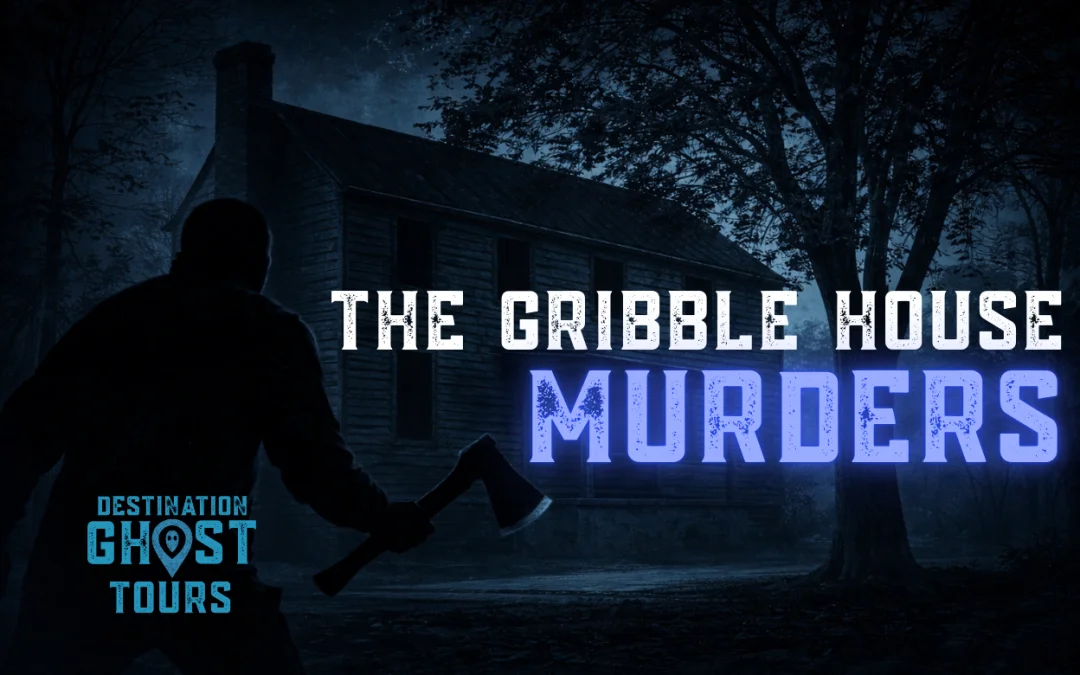
In the heart of Savannah, a city steeped in history and shadowed by legend, stands a tale as chilling as any ghost story. On certain nights, in a quiet warehouse near Martin Luther King Jr. Boulevard, the past seems to stir — faint moans in the darkness, cold spots in the sultry Southern air, and dark stains that some swear appear on the old brick, as if the very building were bleeding with memory.
To those who know Savannah’s secrets, this comes as no surprise. The ground beneath that warehouse was once the site of the Gribble House, where, over a century ago, three women met a violent and tragic end. Their story — the Gribble House murders of 1909 — shocked the city, stoked its fears and prejudices, and became the stuff of both historical record and spectral lore. Contemporary newspapers called it “the most diabolical crime in the history of Savannah,” a reputation it holds to this day. To understand why these spirits might still linger, we have to step back in time and meet the women who lived here.

The House on the Outskirts of Town
In 1909, the Gribble House stood in a neighborhood locals called “Frogtown,” on Savannah’s western fringe. West Broad Street (today’s Martin Luther King Jr. Boulevard) marked the boundary of the city’s more genteel districts; beyond it lay a grittier part of town, carved up by railroad tracks and industrial yards. Frogtown was a patchwork of modest homes and boarding houses, many of them leaning with age and coated in the soot of passing locomotives — home to those of meager means and hard lives, where the clatter of train wheels was a constant soundtrack, day and night.
The Gribble House itself was a simple, unadorned dwelling with peeling paint and murky windows — a small one-story home with a shallow front porch and a walled yard out back, at 401 West Perry Street, a short side street just off West Broad. It was close enough to the city center to be convenient, but far enough into Frogtown that respectable society tended to overlook it. The house was owned by Mrs. Eliza Gribble, a quiet older widow who took in boarders to make ends meet. Nothing about the place outwardly signaled the horror that would one day occur within — though, perhaps, there was already a subtle sadness clinging to it. The people living under its roof each carried their own sorrows, and understanding who they were gives crucial context to that terrible afternoon.
The Residents of Gribble House
By late 1909, the Gribble House had three occupants, each a woman seeking a semblance of stability in a world that had not been kind to them.
Eliza Gribble, the matriarch, was 70 years old and the owner of the house. Born in Cornwall, England, she had come to America as a young woman before the Civil War, and still carried a trace of her Cornish accent. Widowed and of limited means, she had turned her home into a boarding house to earn a modest income — a common path for widows of the era. Frail in health and described by neighbors as having difficulty getting around, she maintained her independence as best she could, with the help of her daughter.
Carrie Ohlander, 36, was Eliza’s only child. Born with a partial hearing loss that worsened over time, she had become profoundly deaf. She had married a man named Andrew J. Ohlander and moved with him to Memphis, Tennessee, but the union did not last; by 1909, Carrie had separated from him and returned home to Savannah to help her mother run the boarding house. Neighbors would remember her as a devoted daughter, finding a familiar harbor after the storm of a failed marriage.


Maggie Hunter, 34, was the newest face under Eliza’s roof, having arrived only a day or two before the tragedy. She had just separated from her third husband and was seeking shelter and a fresh start. In an era when most women married once and stayed married, Maggie’s history was uncommon — scandalous to some, a mark of resilience to others. Her most recent husband was J.C. Hunter, a Civil War veteran some thirty years her senior with a checkered past, including allegations of theft and a stint in prison (rumor held that “J.C. Hunter” was itself an alias). By 1909, the unhappy marriage had run its course, and Maggie did something bold for a woman of her time: she left him, packing up her belongings — including a prized new sewing machine she intended to use to earn a living — and renting a room from Mrs. Gribble. In the first days of December 1909, she must have felt a mix of trepidation and hope. She could not have known she was stepping into the final chapter of her life.
The women had at least a little support in Frogtown. Eliza sometimes hired a local handyman named Bingham Bryan for odd jobs, and Maggie had a family friend named Willie Walls — possibly an admirer — who had kindly paid her first month’s rent in advance, concerned for her welfare after she left her husband.
The Crime of December 1909

It was just after three o’clock on a gray December afternoon when the horror came to light. A passerby on Perry Street — accounts vary as to whether it was a neighbor or a patrolman — heard a faint, agonized moan coming from inside the house. The front door was slightly ajar but resisted opening, as though something heavy lay behind it. With a firm shove, he slipped inside.
Lying across the threshold was a woman, gravely wounded and barely conscious, one hand reaching weakly toward the open doorway as if she had been trying to crawl to safety. This was Maggie Hunter, though the man did not know her name. He ran for help, and within minutes police and neighbors converged on the house.
Inside, the officers found a scene that would be recounted in shocked voices for years. Further down the hall lay Carrie Ohlander, already dead. The position of her body and the disorder around her suggested she had fought fiercely and tried to reach the back door before she fell. Investigators concluded that Carrie had been sexually assaulted before she was killed — a detail that made the crime all the more monstrous to those who discovered it. In the back bedroom they found Eliza Gribble near her chair, her reading glasses and a newspaper on the floor at her feet — a poignant sign that she had been reading when the killer struck her from behind. At 70, and with her limited mobility, she likely never saw it coming.
The murder weapon was soon found: a blood-stained axe, presumably a household tool for chopping kindling, now turned against the household itself. Maggie, still clinging to life, was rushed to the hospital under police escort. Carrie and Eliza were carried out beneath sheets as a horrified crowd gathered. One detail struck the investigators: just beyond the warehouses across the way loomed the Central of Georgia rail yards, where a switch-engine coupling cars could produce a thunderous din. It dawned on them that the noise of industry might well have masked the noise of murder in broad daylight.
By nightfall, nearly every citizen in Savannah had heard of the “triple murder on Perry Street.” Fear and outrage blossomed in equal measure. A killer was loose — and until he was caught, no one felt safe.
The Frenzied Investigation and Public Outrage
News of the atrocity hit the streets that very evening, and within days the story spread up and down the East Coast. But in Savannah it was an urgent, daily reality: a killer had to be found, fast — and the search took a dark and shameful turn.
As panic took hold, many citizens leaped to a conclusion that was tragically common in the Deep South of that era, assuming the killer must be a Black man. Fueled by the racist stereotypes of the time and a vague report of “a Black man running” near the scene, law enforcement began rounding up African American men en masse. Within a day, at least 150 Black men had been detained and interrogated — snatched off the streets or from their homes in an indiscriminate dragnet — while mobs of angry white citizens gathered outside the jail, some openly speaking of lynching. Vigilantes tore through Frogtown and adjacent Black neighborhoods. It was a wave of racial terror set loose by the crime, and every one of those 150 men was innocent. It stands today as a stark reminder of how prejudice and fear can compound one tragedy with another.
To their credit, the more seasoned detectives did not settle for the easiest scapegoat. The sheer brutality of the crime suggested a personal motive, and they pursued other leads — the most important of which came from the surviving victim herself. Maggie Hunter clung to life for a few days, and at her bedside sat a local Baptist minister, the Reverend John S. Wilder, who prayed with her and gently asked if she could name her attacker. In a moment of clarity, Wilder later said, Maggie gave a name: J.C. Hunter — her estranged husband.

The accusation changed everything. J.C. Hunter lived nearby, and officers arrested him the same day. He protested his innocence — but a search of his home turned up what looked like damning evidence: a bloody rag stuffed into the fireplace and a bundle of bloodstained clothes. His explanations (something about killing a chicken, or cutting himself shaving) rang hollow, and a cane found at the murder scene was said to match one missing from his home. Crucially, his arrest defused the racial powder keg: with a white suspect in custody, the furious focus on the Black community subsided, and the 150 detained men were released — terrorized and jailed for nothing but prejudice.
Other men drifted through the web of suspicion. Willie Walls, Maggie’s friend who had paid her rent, was questioned and briefly held, but nothing tied him to the scene and he was released. Bingham Bryan, the Gribbles’ African American yardman, was arrested weeks later on a theory that the women had been killed during a robbery — there was a rumor of a trunk of valuables — but again, nothing placed him there, and he was let go. In their determination to build a case, police even resorted to unorthodox tactics, confronting suspects with the victims’ bodies and, by some accounts, staging grim reenactments with blood-smeared mannequins in hopes of shocking a confession loose. None came. In February 1910, a grand jury indicted J.C. Hunter, Willie Walls, and a third man, but the cases against the others quickly fell apart. Only one man would stand trial.
The Trial of J.C. Hunter
The trial began in mid-August 1910 to packed galleries. Frail-looking, one-eyed, and leaning on a cane, J.C. Hunter cut a strange figure — could this aging Civil War veteran truly be the killer? The prosecution argued that he was: enraged that his much-younger wife had left him, he had come to the Gribble House for revenge, attacked Maggie, and then killed Eliza and Carrie to eliminate witnesses. They presented Maggie’s dying declaration, the bloody clothes, and the matching cane, and painted Hunter as a man of bad character with a violent streak.
The defense poked at the gaps: no eyewitness placed Hunter at the scene; coworkers testified he had been at a painting job across town around midday; and they questioned whether a delirious, dying woman’s words had been accurately relayed by Reverend Wilder. They also raised a genuine puzzle — if revenge on Maggie was the motive, why was she the one who initially survived, while Eliza and Carrie were killed outright? Still, after days of testimony (including the display of the blood-stained axe itself), the jury deliberated only briefly. On August 17, 1910, they returned a verdict of guilty, and the judge sentenced J.C. Hunter to death by hanging, the execution set for December 1911.
Twists of Fate and Lingering Doubts
Savannah breathed easier — but the story was far from over. Appeals failed, and by late 1911 the gallows were being prepared. Then, on December 21, 1911, literally the day before the scheduled hanging, the Governor of Georgia commuted Hunter’s sentence to life imprisonment.
The reprieve owed much to Reverend Wilder — the same minister who had relayed Maggie’s accusation. Over the year since the trial, Wilder had visited Hunter often, and had come to believe the old man’s insistent claims of innocence. When Wilder urged him to confess before meeting God, Hunter reportedly wept and said, “I am innocent. I did not kill Maggie.” Moved, Wilder lobbied the governor for clemency, and the governor — perhaps sharing an uneasy sense that the case was not ironclad — granted it.
Hunter served his time quietly. Then, on October 27, 1923, at the age of 77, he was granted a full pardon by Governor Clifford Walker and walked free. He returned to Savannah a curiosity, lived out his final years quietly, and died in the late 1920s — maintaining to the end that he was innocent.
The only man ever convicted had been freed — and no one else was ever held to account.
That left Savannah in an eerie predicament, and the doubts have never fully settled. Over the years, several theories have circulated. The revengeful-husband theory led to Hunter’s conviction, but is troubled by the fact that Maggie, his supposed main target, was the one who initially survived. The lover’s-triangle theory pointed at Willie Walls, though no evidence ever supported it. The robbery-gone-wrong theory centered on the rumored trunk of valuables, but the sheer, gratuitous violence didn’t fit a simple burglary — and in 1917, a man named J.B. Garvin actually confessed to the killings, only to be dismissed as a crank. And the random-drifter theory suggests a transient attacker — perhaps a coal-dusted rail worker who slipped from a nearby train, which could even account for the “Black man running” sighting — who then vanished on a departing locomotive. With no forensic science to speak of in 1909, such a killer would have been a ghost to investigators. The truth was never conclusively established.
Ghosts of the Gribble House
After the trial, no one much wanted to live in a house soaked in tragedy. The property changed hands and fell into decline, and before long neighbors began whispering that it was haunted — that lights flickered in empty windows, that faint cries could be heard within, and that bloodstains reappeared on the floors no matter how often they were scrubbed. A 1975 interview with a woman who grew up nearby recalled her elders swearing that on the anniversaries of the murders, red stains would seep back onto the very spots where the women had fallen.
The Gribble House was finally torn down in 1941, and a large warehouse rose on the site a few years later. In time it became a maintenance facility for a local trolley-tour company — and, as Savannah embraced its haunted reputation, the site earned a place on the city’s roster of ghostly locales. Workers reported uneasy feelings, whispered names, tools that moved on their own, and the sound of a woman softly sobbing near the back of the building. One section, built over much older brickwork, developed an especially heavy reputation.
By the 2010s, the warehouse operated by night as the Gribble House Paranormal Experience, where visitors explored the dark with ghost-hunting equipment. Many reported startling encounters: sudden scratches, tugs at clothing, a stroke through the hair when no one was near. Investigators’ recorders captured a wealth of EVPs — faint responses that some heard as “Maggie,” a sobbed “help me,” or a gruff “get out.” Photographs turned up misty shapes and shadowy figures, including a “Shadow Man” often seen where the back door once stood, and a “Lady in White” drifting across the floor. The activity drew enough attention that the Travel Channel’s Ghost Adventures featured the Gribble House site in a 2014 investigation, with the crew reporting EVPs, unexplained figures on their equipment, and physical sensations — and declaring it one of the more active places they had explored.
Echoes That Never Die
The Gribble House murders have become two stories, forever intertwined: one of history, one of hauntings. It is a tale with all the ingredients of a Southern Gothic tragedy — vulnerable women, a brutal crime, questionable justice, and a mystery never truly solved. And beneath the ghost stories lies a profound sadness. Three women who sought only safety and a fresh start met a fate they did not deserve: Eliza Gribble, who had survived immigration, war, and widowhood; Carrie Ohlander, who had overcome deafness and a failed marriage; and Maggie Hunter, striving to build a life on her own terms. Their lives were cut short in the most horrific way — a wound history cannot heal, only record.
Perhaps that is why the story endures. Every time a guide recounts it, they keep these three women in memory, ensuring their names and their stories are not lost to time. In a very real sense, telling the tale is an act of remembrance — a form of acknowledgment for women the city failed in life. As we conclude, spare a thought for Eliza, Carrie, and Maggie. May they find the peace that eluded them on that tragic December day. And should you ever walk down West Perry Street on a quiet night, know that in Savannah, the past always walks with you.
Explore Savannah’s Darkest True Crime
The Gribble House is one of the most chilling stories in Savannah’s true-crime history. Hear it — and the city’s other dark tales — on a walk with Destination Ghost Tours.
Book a Savannah Ghost Tour
Chris Allen is the founder of Destination Ghost Tours, a historian and storyteller with a lifelong fascination for the darker corners of history. He spends his time uncovering the true stories behind haunted legends, guiding guests through historic cities, and chasing down details that refuse to stay buried. When he is not working, he can usually be found with his partner Arissa, their dog Bear, and their two cats, Trouble and Covu, photographing old places, digging through archives, or disappearing into historical rabbit holes. He believes the best history is honest, atmospheric, and just unsettling enough to linger.