
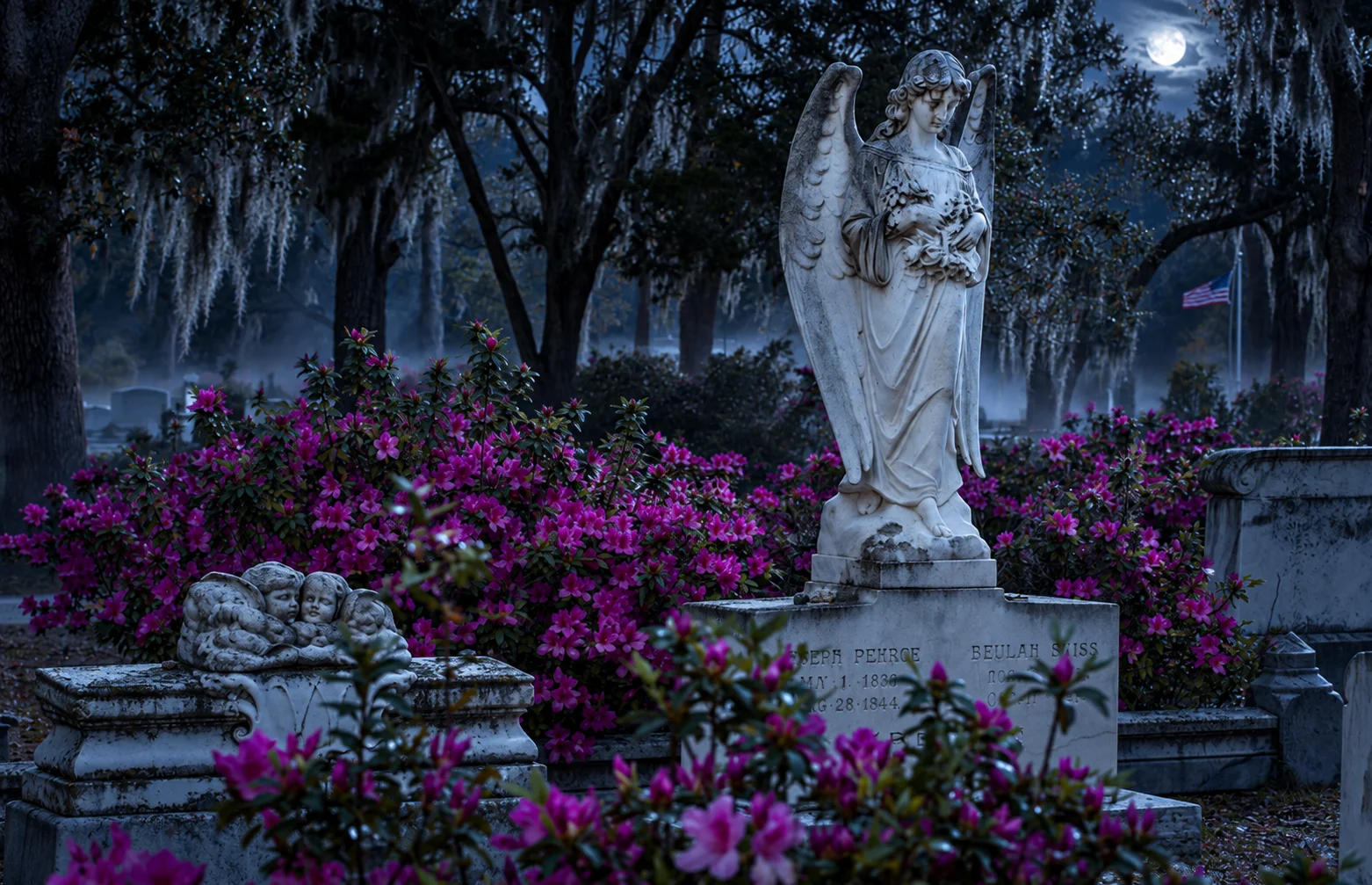

Savannah, Georgia
Mourning in Old Savannah
The funeral that began at home, the sign on the door, the clothes worn into the street, and the small objects grief left behind.

There is a particular kind of silence in an old cemetery. You can hear traffic beyond the wall, a bird in the branches, someone walking a little farther down the path. The city has not gone quiet. The silence belongs to the names in front of you, to people whose voices have disappeared while a few words cut into stone remain.
Savannah has plenty of places where that feeling settles over you. Colonial Park, Laurel Grove, Bonaventure. Their names have become familiar to visitors, but familiarity can make it easy to overlook what these places actually hold. Before a cemetery became a stop on somebody’s itinerary, a family had to come there for the worst reason imaginable. Someone had to decide what would be written on a marker. Someone had to leave when the burial was over.
The stone was only one part of the mourning that followed. Grief also appeared in the house, at the front door, in a newspaper notice, and in the clothes worn out into the street. It could be carried in a small brooch containing braided hair or in a photograph kept inside a case. A death changed the appearance of ordinary things. An accessory became a public announcement. A room used for receiving visitors became a place where people came to say goodbye.
To understand mourning in old Savannah, we have to look beyond the image of a woman dressed in black. That image belongs to a larger history of family responsibilities, religious observance, money, illness, and social expectations. Some customs offered protection when a household could barely manage its own sorrow. Others placed another burden on people who were already struggling. The difference was not always obvious from the street.
The surviving evidence is enough to bring the subject close without inventing a funeral, a conversation, or a grieving person. Period newspapers, municipal reports, cemetery records, historic-house research, and preserved objects reveal a city in which mourning had a visible place in daily life. The details are sometimes uncomfortable. They are also deeply familiar. People were trying to hold on to those they loved, using whatever remained within reach.
A city that knew recurring loss
Savannah’s beauty can soften the way we think about its past. The houses are handsome. The squares offer shade. The surviving streets invite an unhurried walk. It takes more effort to picture those same surroundings during an epidemic, when the worry inside a household was whether another person would become ill before the first had recovered.
Yellow fever repeatedly disrupted nineteenth-century Savannah. The New Georgia Encyclopedia records more than 700 deaths in the epidemic of 1820 and slightly more than 1,000 in 1854. Another major epidemic struck in 1876. These dates belong to separate disasters, not one long outbreak, and they affected different generations of families.1, 2
The municipal report associated with the 1876 epidemic makes the losses more specific. It names people, identifies locations, and lists ages and recorded causes of death. It moves from the city’s first reported cases to a much longer accounting of mortality. The language is administrative because the document had administrative work to do. For a reader now, that formality can make the individual entries more difficult to pass over.
A number does not tell us who had been expected home for dinner or who was learning to speak. An age does not describe a personality. Yet an age gives the imagination a limit that a general statement about suffering does not. A person recorded as a few months old had scarcely begun a life. A person in their thirties might have left dependents. Those possibilities must remain possibilities unless the family record provides more, but even the limited information changes the way we read the page.
Epidemic deaths also sat beside deaths from other recorded causes. The city did not stop experiencing ordinary bereavement while yellow fever was present. Its lists include infants, children, adults, and older residents. Some entries provide a recognizable name. Others identify a baby through a family surname. The unevenness of the record is part of the history, too.2
This is the setting in which funeral customs mattered. A household could face the practical arrangements of a death while also worrying about illness, work, and money. The forms of mourning provided something that could be done: send a notice, arrange a service, prepare clothing, accompany the dead to a grave. They could not make the loss understandable. They could make the next necessary action a little clearer.
We should resist the idea that repeated exposure made people indifferent. Frequency tells us how often a community confronted loss; it does not tell us that parents loved their children less or that a bereaved spouse recovered quickly. The objects they preserved and the memorials they created give us reason to take their attachments seriously. Their world made death harder to avoid. It did not make absence easier to bear.
When the funeral began at home
One of the clearest differences between nineteenth-century mourning and many present-day arrangements is the place of the household. The funeral could begin in the same building where the person had lived. This was not simply an atmospheric detail. It put the body, the arrangements, the visitors, and the family’s private distress close together.
John H. Young’s Our Deportment, in the 1881 edition consulted here, includes detailed instructions for a funeral held at home. It describes receiving guests, allowing a final viewing, conducting the service, closing the coffin, and carrying the remains to the hearse. These are recommendations for American society at that date, rather than proof that every Savannah family followed them.3
Savannah’s newspapers supply local evidence of services connected to residences. On December 23, 1875, the Savannah Morning News printed a funeral invitation for Alexander Johnston. It directed friends and acquaintances to attend services from his late residence at 15 Lincoln Street. A nearby notice called on members of the St. Andrew’s Society to pay their respects to their deceased fellow member.4

Those brief announcements bring the geography of death into the city. Lincoln Street was not only an address where someone had lived. For the readers who knew Johnston, it was now the place they were being asked to go. The notice needed no description of the family’s sorrow. Its practical information carried the news.
Young’s instructions reveal how complicated that setting could be. He describes close relatives taking their final view before the guests arrived. He also discusses reserving an adjoining room for the immediate family, with the clergyman standing at the doorway between the rooms. That arrangement allowed relatives to remain near the service without being exposed to every visitor’s attention.3
There is something recognizable in that concern. A grieving household might need help and company while having little capacity to greet people, answer questions, or accept repeated expressions of sympathy. Architecture could provide a modest boundary. A doorway separated those who had come to honor the dead from those who had to continue living in the house afterward.
The domestic setting also meant that the funeral did not occur in a space reserved only for funerals. The rooms retained their ordinary uses. Once visitors departed, the household still had to occupy them. We do not need to invent the exact arrangement of a Savannah parlor to understand that difficulty. The same walls could contain both the public ceremony and the quieter work of adjusting to an absence.
That is one reason historic houses can feel so emotionally charged when their history is understood. Their furnishings tell us how people received company and organized daily life. A documented death adds another use to those rooms. The building may survive in good condition while the person who once made it a home has become an entry in a record.
The signal on the front door
Before a visitor crossed the threshold, the outside of a mourning household could carry a warning to behave differently. Young describes a door handle or bell knob draped with black crape. His instructions distinguish between a black ribbon for someone married or advanced in years and a white ribbon for someone young or unmarried.3
The detail is small enough to overlook in a general history, but it explains how mourning could become part of a street. The object did not need to be large. Its purpose was to make the household’s changed circumstances visible before an ordinary call became an intrusion.
Crape, also spelled crepe in discussions of the period, was associated with mourning dress and accessories. At a door, the material moved from the body of the mourner to the body of the house. That is an interpretation of the custom, rather than a period explanation, but it helps us understand how much meaning could be placed in a familiar object.
A person approaching a house might have intended to discuss business or pay a social visit. The sign asked that person to reconsider the manner of arrival. Young’s accompanying instructions emphasized quiet, respect, and the suspension of quarrels. Even enemies meeting at a funeral were supposed to behave with dignity. The death had created an occasion whose demands came before an existing disagreement.3
The ribbon distinctions also show the danger of treating all mourning symbols as interchangeable. In the convention Young recorded, the appearance of the doorway could communicate something about the deceased. White was not automatically the opposite of mourning. It could have a place within it.
What the convention does reveal is a concern with the behavior of the living. The sign was useful because people could be careless. They might knock loudly, speak too freely, or arrive expecting attention that the family could not give. Mourning symbols supplied information without requiring a bereaved person to repeat the news.
It is tempting to see black fabric at an old doorway as something sinister. Its practical meaning was gentler. Someone inside had died, and someone else inside was trying to get through the day. The cloth asked the street to recognize that fact. Its darkness belonged to loss, not to evidence that something supernatural had entered the house.
A death notice among the ordinary news
The newspaper offered another way for private loss to become public knowledge. Young recommended city newspapers as a customary means of announcing a death and a funeral. For distant friends and relatives, he discussed sending the information by letter or telegraph so that they could have an opportunity to arrive before the service.3
The Johnston notice shows this clearly. It addressed the friends and acquaintances of the couple and their family, then gave the location of the funeral services. The society notice widened that circle through a shared organization. Family relationships and civic relationships appeared beside one another.4
The same newspaper page also contained business notices, transportation information, and holiday advertising. That proximity can be unsettling when we read it now. A death had occurred, but the steamer still had a departure to announce. Businesses still wanted payment. Christmas poultry was still offered for sale. The newspaper could not stop being a newspaper because one household’s world had changed.
For those affected, that ordinary continuation is one of the hardest features of bereavement. Other people still need schedules, prices, and directions. The public page preserves the mismatch without trying to explain it. One notice asks readers to attend a funeral. Another asks them to buy something. Both belonged to the same day.
These notices are also valuable because they preserve relationships that a cemetery marker may not mention. A funeral announcement can identify a residence, connect a spouse to the deceased, or show that an organization expected its members to attend. It records the people being called into the act of mourning, even when it gives little information about their private experiences.
There is a particular finality in a phrase such as late residence. The address survives. The person is already described as belonging to it in the past. In the space of a notice, a home becomes the place from which somebody’s last journey will begin. It is an ordinary use of language, but it carries more weight when we stop long enough to hear it.
The work someone else had to do
Funeral customs are often described through their visible results: the clothes, the flowers, the procession. Behind those results were decisions and tasks. Someone had to make arrangements at a moment when the immediate family might be least able to manage them.
Young advised entrusting the details to a relative or friend. If no suitable person could help, he considered the undertaker an appropriate person to take charge. He also advised setting an expense limit according to the family’s means. The recommendation puts practical restraint inside a chapter otherwise concerned with solemnity and respect.3
That is an important corrective to the idea that a proper nineteenth-century funeral always meant elaborate display. Young explicitly warned against pomp. His description of good conduct did not require a family to spend without limit. The instructions acknowledge that arrangements could become a financial burden and that an outside person could shield the bereaved from some of the immediate work.
He also wrote that a woman friend could make necessary purchases and engage seamstresses while the immediate family remained at home before the funeral. The clothing associated with mourning did not simply appear. It had to be obtained or prepared, and somebody had to take responsibility for that process.3
Practical help could also create uncomfortable dependence. Accepting it means allowing another person into practical matters that are usually private. A friend might need to know how much money was available or what arrangements the household could afford. The ideal helper had to combine competence with discretion. The task was not simply to make the funeral happen, but to avoid adding humiliation to grief.
This is where the social machinery of mourning becomes less distant. Many present-day families still need someone who can handle a phone call, communicate a decision, or remember an appointment. The available services have changed. The inability to concentrate after a death has not become difficult to recognize.
In a history concerned with old Savannah, it is worth giving this labor space. The family member who carried out the arrangements may never have received a monument for doing so. The friend who made a necessary purchase may remain unnamed. Their work nevertheless helped turn an overwhelming event into a sequence of things that could be completed. A funeral depended on the living doing that work for one another.
From the household to the cemetery
The procession carried mourning out of the house and into public space. Young’s recommended order placed the clergyman and pallbearers before the hearse, followed by close relatives, more distant relatives, and friends. When societies or Masonic bodies participated, his instructions gave them a place before the hearse.3
The order expressed relationships. It did not merely solve the problem of how carriages should move. A person watching could see that the deceased belonged to a family and perhaps to an organization. The procession made those connections visible at the moment of separation.
Young usually called for six pallbearers, with eight possible for a person of particular prominence. He preferred them to be intimate acquaintances of the deceased and of approximately the same age. These details show how even the handling of the coffin could be understood through a social relationship rather than assigned without thought.3
The bodily work remained unavoidable. The coffin had to be carried. The family had to travel. People had to enter and leave carriages. In Young’s account, the person directing the arrangements helped mourners at those moments. Guests stood with heads uncovered as the family left to enter its carriage. The rules gave attention to small transitions, where confusion or awkwardness might otherwise intrude.
Savannah’s own municipal history contains an unexpectedly practical detail about funeral travel. Thomas Gamble’s history of city government records that, in February 1852, the city subscribed $5,000 in bonds to the Ogeechee Plank Road Company on the condition that vehicles traveling to or returning from funerals at Laurel Grove would not be charged tolls.5
That provision brings the journey down to the level of a road and a fee. Mourning was not only a matter of belief and feeling. It had to move through infrastructure. A cemetery beyond the older burial ground required access, and the city made funeral traffic part of the terms of its investment.
Visitors now often arrive at a historic cemetery in their own vehicle, with time to look around. A funeral procession had a different purpose. Its destination was already chosen. The people traveling did not arrive to explore the place; they arrived to leave someone there. Remembering that changes the meaning of the road into the cemetery, as well as the meaning of the paths inside it.
What black clothing could say
Black is so closely associated with nineteenth-century mourning that it can seem to explain itself. It does not. A color worn as an ordinary fashion choice is different from a color worn because a household has suffered a death. The context gives the garment its message.

Young distinguished degrees of mourning through material, finish, trimming, and color. For deepest mourning, his instructions emphasized plain black clothing and restrained decoration. Later stages allowed changes in fabric and accessories. Further lightening could introduce combinations of black and white, gray, purple, violet, and lilac.3
The wardrobe was therefore more complicated than a single black dress. Surface mattered. Gloss mattered. The amount and kind of trimming mattered. A person familiar with the convention might read those differences as signs of where the wearer stood within a socially recognized period of mourning.
Preserved garments support the broader history of mourning fashion. The Metropolitan Museum of Art’s exhibition Death Becomes Her examined American and European mourning attire from 1815 to 1915. Its labels describe mourning crape as a crimped, dull silk gauze associated with early bereavement. These objects establish the material culture of the convention; they should not be mistaken for garments documented as belonging to Savannah residents.6
The distinction between dull and lustrous cloth may sound fussy until we consider what the clothing was expected to do. It had to make the mourner recognizable while avoiding an appearance judged festive. The garment carried an instruction to other people: remember what has happened before speaking or behaving as though nothing has changed.
That could provide a kind of protection. A bereaved person did not have to explain the loss anew at every encounter. Yet the same visibility could invite scrutiny. If others believed they knew the correct clothing for a particular stage, they might judge a change in appearance as a change in feeling. Fabric became evidence in a social argument it could never actually settle.
The clothes could not show whether a person had slept, whether a memory had become unbearable that morning, or whether the wearer had put on the garment without noticing it. Public signs are efficient because they simplify. Private grief refuses to remain simple.
This is why a mourning dress deserves more than a description of its darkness. It stood between the wearer and the public. It could create distance, communicate respect, satisfy an expectation, or make ordinary movement through the city more difficult. The surviving dress tells us what could be worn. It cannot give us the entire experience of the person who wore it.
The timetable of grief
Many accounts of Victorian mourning present a neat schedule as though it were a law enforced everywhere. The period evidence is less tidy. Young begins his discussion by acknowledging that people in the United States had not settled on prescribed periods for wearing mourning garments. He then supplies recommended periods drawn from an authority he considered competent.3
That apparent contradiction is revealing. The author recognized variation while still offering rules to readers who wanted guidance. The schedule was a model of conduct, not a complete description of what every family actually did.
In the recommendations he reproduced, a widow’s mourning for her husband could last two years or longer. The clothing changed during that period. The first year called for plain black woolen goods, crape accessories, and a long veil. The second allowed different materials and a shorter veil, with lighter colors permitted toward the end. Mourning for a parent or child was assigned one year. A brother or sister was assigned six months, with shorter periods for some other relatives.3
These distinctions made kinship visible through time. They placed different relationships into categories and attached different outward obligations to them. A reader could learn what society might expect, but no schedule could measure the actual force of a particular loss.
A person might have depended more closely on an aunt than on a parent. An estranged spouse could still require the longest prescribed mourning. A friend might have occupied a place in daily life that no category adequately expressed. Formal arrangements make relationships legible to other people; they do not always describe them faithfully.
The schedule also assumed that a person could obtain appropriate garments and change them as the period advanced. That required resources. A wardrobe organized into stages was easier to maintain if someone had money, access to goods, and time. A person living with narrow means might have had to make a small number of garments serve many purposes.
It would be unfair to read that limitation as indifference. The ability to follow a dress convention says something about circumstances as well as intention. A black sleeve can be documented. The affection behind it cannot be measured by how expensive the cloth was or how precisely the wearer observed a published timetable.
There is another unsettling feature in the system: it gave other people a date on which they might expect a mourner to look different. The outward stages could suggest progress even when the private experience remained unsettled. A change to gray or violet might make sense within etiquette while doing little to alter the feeling of arriving home to a person who was no longer there.
Widows under observation
The strongest association between mourning and women’s clothing was not accidental. Young’s instructions for widows reach beyond the color of a dress. They address the veil, bonnet, hair, collar, cuffs, and the materials appropriate to different stages. The result was a detailed public appearance organized around the death of a husband.3
Those recommendations placed a widow in an exposed position. Her bereavement was visible whenever she followed them. Her decisions about clothing could also become decisions that other people believed they were entitled to interpret. A change in trimming or veil length might have appeared minor to the wearer and significant to an observer.
The social burden existed alongside practical consequences. A death could alter the household’s income, responsibilities, and future. It is easy to study a widow’s dress as an object and forget that the person inside it might also be making urgent financial decisions. The visible form of mourning did not suspend the need to support a family.
Savannah offers a documented example in the Davenport household. Museum research records that Isaiah Davenport died of yellow fever in 1827. The house museum’s history explains that Sarah Davenport subsequently operated the home as a boarding house until she sold it in 1840. Those facts show a widow adapting the use of a household after her husband’s death.7, 8
They do not tell us exactly what Sarah wore at the funeral, how long she observed a particular mourning stage, or what she said in private. Assigning her the later wardrobe instructions in Young’s 1881 book would collapse more than half a century of difference. Her story is stronger when we preserve what is actually known.
The boarding house matters because it connects bereavement to work. A family home had to continue serving a purpose. Its rooms became part of an economic response to altered circumstances. Mourning was taking place within a life that still required decisions, labor, and an ability to deal with other people.
The historical image of a widow can become too still. A veil conceals the face; a portrait fixes the body; a rulebook fixes the expected behavior. The surviving record of a household reminds us that a widow might also be active, practical, and responsible for what happened next. Those qualities do not reduce the grief. They show what she had to do while carrying it.
We can acknowledge both truths without inventing an inner monologue. The death was recorded. The household changed. Sarah operated a business in the home. Between those facts lies a human experience that deserves respect even where its details have not survived.
Mourning for sale on Broughton Street
The history of mourning clothing becomes distinctly local when we open Savannah’s newspapers. Advertisements do not tell us how every customer dressed, but they show that merchants recognized mourning as a category of goods with a market of its own.

On July 1, 1887, the Morning News carried an advertisement from Crohan & Dooner at 137 Broughton Street. It offered mourning fabrics and accessories, including English crapes and crape veils, black stockings, gloves, mourning handkerchiefs, and parasols. The advertisement also named different black fabrics and finishes. Mourning was presented as a collection of things a customer could purchase, rather than a single article of clothing.9
The prices sharpen that picture. Mourning handkerchiefs were advertised from ten to seventy-five cents each. One range of mourning parasols ran from $2.25 to $4.50. The ad’s various offerings allowed distinctions in material, appearance, and price within the same general purpose.9
A later Broughton Street advertisement, published on March 29, 1894, again promoted black and mourning goods. It listed a range of textiles, including spring-weight materials, along with cloth intended for veils and English crape. The page places bereavement inside the language of stock, selection, and seasonal retailing.10
That combination can feel cold. A family loses someone; a merchant has goods to sell. Yet it also reflects a practical need created by convention. If mourners were expected to dress differently, somebody had to supply the cloth and accessories. Commerce occupied the space between a social expectation and the person trying to meet it.
The variety matters as much as the existence of the ads. It suggests customers faced choices. Which cloth? Which veil? Which handkerchief? How much could be spent? A person helping the family might have made those decisions on its behalf. Young’s recommendation that a friend arrange purchases becomes more concrete beside an actual Savannah merchant’s list.3, 9
The advertisement does not identify the bereaved customers. We cannot recover their purchases from the offer alone. It is nevertheless a local connection that a generic account of Victorian fashion cannot provide. These goods were promoted to readers of a Savannah newspaper, at a named address on a Savannah street.
When you walk along Broughton now, it takes little imagination to see it as a place of shopping. The harder adjustment is recognizing how many reasons people had for entering a shop. A customer could be buying for a celebration or because a death required an entirely different appearance. The street accommodated both. Its commercial life continued while the meaning of a purchase changed from household to household.
The small things grief required
A veil draws attention. A mourning handkerchief is easier to overlook. The Savannah advertisement gives it a place among the goods of bereavement, and Young’s instructions give such an accessory a role within the larger dress convention. Even an object held briefly in a hand could belong to the public language of grief.3, 9
Young discussed fine linen handkerchiefs with black borders, with wider borders for close mourning and narrower ones as mourning lightened. His recommendations also addressed gloves, ribbons, and jewelry. The entire appearance could be regulated through details that appear minor when separated from the person wearing them.3
These small distinctions could make the requirements of mourning persistent. A mourner did not simply put on a dress and leave the subject behind. The accessories carried the convention into gestures: reaching into a pocket, adjusting a glove, carrying a parasol, fastening a pin. Ordinary movements involved things that had been chosen because somebody was dead.
The smaller goods also make questions of means harder to ignore. A priced accessory might appear modest beside a large garment, but a collection of requirements could still create expense. A household might need clothing for more than one person. It might have other urgent obligations. Published advice about restraint was relevant precisely because a solemn occasion could still lead to bills.3
There is a difference between an object acquired to satisfy that public convention and an object preserved because of its connection to the dead. A handkerchief sold as mourning merchandise belonged to one category. A familiar possession kept after its owner’s death could belong to another. The two might overlap, but their meanings were not identical.
That distinction becomes important when old objects pass into collections. Black material alone does not disclose a complete history. An inscription, a dated letter, a family record, or a reliable account of ownership can establish connections that appearance merely suggests. The temptation to supply a poignant story is strong, especially when the object looks as though it ought to have one.
The real story may be quieter. Someone needed an appropriate handkerchief. Someone else made or purchased it. It was used, put away, and perhaps forgotten. Historical mourning includes these modest objects as well as the spectacular ones. Their scale brings the subject back to the size of a hand.
A piece of the person who was gone
Among the most intimate objects associated with nineteenth-century remembrance is jewelry containing human hair. It can be difficult for a modern viewer to move past the immediate fact of the material. The hair came from a person. It once grew from a living body. Now it is preserved inside something meant to be held or worn.

Museum collections document the practice clearly. The Metropolitan Museum of Art holds an American brooch containing plaited hair beneath crystal, with a memorial inscription for Charles T. Evans, who died at sea in 1852. It also holds a Tiffany & Co. mourning brooch dated 1868, commemorating Cornelia Ray Hamilton, who died in December 1867. The latter includes hair, an engraved memorial, and a surviving case.11, 12
These are American examples, not objects with an established Savannah provenance. Their purpose here is to explain a wider material tradition within which Savannah’s nineteenth-century mourning can be understood. They should not be quietly reassigned to a local family for the sake of a better story.
The objects reveal different kinds of connection. A name and date identify the memorial purpose. The hair provides a physical association. The setting makes it possible to carry that association into daily life. The person is absent, but the object is small enough to remain close.
Hairwork was not always mourning work. The Met’s discussion notes that hair could commemorate a living loved one as well as a deceased person. An inscription or other reliable documentation can help distinguish a memorial from a token of affection. Without it, the presence of hair does not automatically establish a death.11
That caution does not diminish the power of documented mourning pieces. It makes their meaning more precise. A brooch made to remember a particular person deserves to retain that person’s identity. It is more than a general symbol of a supposedly death-obsessed age.
For someone who has lost a loved one, the desire behind such an object is not difficult to recognize. Many people preserve something whose importance cannot be explained by its market value. What matters is the connection: this was theirs, they touched it, it belonged to a life now beyond reach. Hair made that connection bodily in a way a purchased souvenir could not.
A part of a person can outlast everyone who recognized them.
There is no need to add a curse to make the object unsettling. Time has already done something strange enough. The wearer may be gone, the person commemorated may be gone, and the hair may still lie protected beneath glass. The object survives both sides of the relationship it was created to preserve.
The labor of making hairwork
Hair jewelry was a craft as well as a keepsake. Mark Campbell’s 1867 Self-Instructor in the Art of Hair Work offered instructions, patterns, and diagrams for making hair ornaments and jewelry. The book addressed a range of uses, including personal adornment, trade, and remembrance.13
Its preface specifically spoke to people who wanted to preserve the hair of a deceased parent, sibling, or child. Campbell promoted an advantage of doing the work oneself: certainty that the material being handled was actually the hair of the person being remembered. That appeal is revealing even when we treat the author’s promotional claims cautiously.13
The concern was not only whether an object looked beautiful. Its value depended on whose hair it contained. A substituted material might reproduce the appearance while destroying the personal meaning. The maker’s knowledge of the hair was therefore part of the keepsake’s purpose.
Campbell’s instructions also show that the results required organized work. He discussed strands, bobbins, weights, molds, a working table, and numbered positions. Beginners were directed toward simpler braids before more difficult patterns. This was not a practice that depended entirely on spontaneous sentiment. It required attention to a sequence.13
That sequence suggests a different way of thinking about the craft. A person making a memorial might have had something precise to do with the hands. The pattern imposed order on a material whose meaning was emotionally charged. We cannot assume that every maker found the process comforting, but the method offered a task with steps, errors, and a visible result.
The book’s contents also prevent us from reducing all hairwork to funerals. It included hairdressing and other kinds of hair goods. The same skill could serve fashion, livelihood, or remembrance. A technique does not acquire a single meaning simply because one of its uses is poignant.
The emotional significance lies in the relationship between material and labor. A purchased setting could protect the hair, but the hair itself carried the association. Hours spent arranging it could produce a durable object from something fragile and easily lost. Once finished, the keepsake could appear orderly enough to be admired by a stranger who knew nothing of the loss behind it. Its neatness concealed the reason it had been made.
The photograph taken too late
Postmortem photography is one of the most frequently sensationalized subjects in nineteenth-century mourning. The practice was real. So is the tendency to label old photographs inaccurately because a sitter looks pale, solemn, motionless, or unfamiliar to a modern viewer.
The Smithsonian’s National Museum of American History holds a documented postmortem daguerreotype. Its explanation notes that, in the years after photography’s introduction in 1839, a photograph made after death might be the only photograph of the individual. Another Smithsonian collection identifies a daguerreotype of a deceased child from the 1850s.14, 15
The point is important because it restores the purpose of the image. A family might have had no earlier likeness to preserve. The death created an urgent limit: there would be no future opportunity to photograph that person alive. A postmortem image could respond to that absence, however difficult the circumstances of its making.
These museum examples establish a broader American practice. They do not demonstrate that every bereaved Savannah family commissioned a photograph or that every old portrait found locally is postmortem. A claim about a particular image needs evidence about that image.
The Library of Congress makes a useful cataloging distinction between postmortem photographs and memorial photographs. A photograph taken while a person was alive may later commemorate them after death. That does not turn the original exposure into a photograph of a corpse.16
The distinction separates the moment the image was made from the use it later acquired. A living child’s portrait could become a bereaved parent’s most treasured possession. Its memorial meaning came afterward. A documented postmortem image began under different circumstances. Both can carry grief, but they should not be described as the same thing.
The genuine practice needs no exaggeration. Photography offered a likeness that could outlast a face, a voice, and the people who remembered both. For some families, the image was obtained only when life had already ended. The resulting object could be held, put away, reopened, and shown to someone who had never known the subject.
That is the part worth lingering over. A photograph can preserve appearance while leaving almost everything else beyond recovery. We may see the person clearly and know nothing of their laugh, habits, fears, or relationships. The image keeps one kind of memory possible while making the limits of that memory painfully visible.
Flowers and the need to give something
Flowers supplied another material expression of mourning. Young recommended predominantly white arrangements for the coffin and distinguished some designs by the age or marital status of the deceased. He also described flowers sent by close friends as a sign of esteem, with attention to their arrival in time for use at the funeral.3
These instructions should be read within his own setting and religious assumptions. A floral cross, for example, cannot be treated as a universal convention for a city with different faith communities. The manual offers a documented model of conduct, not a rule that erased religious differences.
The flowers gave visitors and friends something to contribute when language seemed inadequate. Their role was public: they could be seen at the service, placed near the dead, and understood as a gesture from the living. They also had a practical vulnerability. They had to arrive, remain presentable, and be arranged.
The contrast with hairwork is striking. One preserved material was valued for endurance. The other could be beautiful precisely during a brief occasion and then fade. Both could communicate attachment. Their different lifespans did not make one sincere and the other superficial.
Young’s writing on condolence suggests why an object or modest action might be preferable to too many words. He warned against attempts to explain away sorrow and favored brief expressions of sympathy. His advice recognized that a visitor could become burdensome by trying too hard to provide consolation.3
That recognition feels familiar. A bereaved person may have no answer to a well-meant explanation. A statement intended to comfort can ask the mourner to agree with something they cannot bear to consider. A respectful gesture asks less. It allows a visitor to acknowledge the loss without insisting on a response.
The gift also belongs to the relationships around the deceased. Friends could contribute as friends, even if they had no role in directing the funeral. The immediate household did not have to carry every outward sign of remembrance alone. The ceremony gave others a place to participate.
What it does show is the effort to find acceptable forms of expression. A funeral gathered people whose feelings were different in degree and kind. Flowers, respectful clothing, quiet behavior, and attendance gave them ways to act together without requiring them to feel exactly the same. The shared ceremony made room for several relationships around one death.
The house after the visitors left
The funeral did not end the social questions surrounding a bereaved family. Young devoted instructions to the calls that followed it. He recommended a visit from friends about a week afterward and from acquaintances within a month. He also advised restraint in repeating calls until the family signaled a readiness to receive them.3
Young discouraged bright clothing for condolence calls and advised that only intimate friends should initially ask to see the family. The distinction between friends and acquaintances mattered. A person close enough to provide real assistance might be welcome where a more formal visitor was not.3
His instructions also show why the household’s privacy needed active defense. Mourning could attract attention. Once a death became public through a notice or a funeral, people knew there was an occasion for a call. Good intentions did not automatically make that call considerate. Timing and familiarity were part of the obligation.
The quiet after a funeral can be harder to describe than the ceremony. The public event supplies a schedule, a place, and roles. Afterward, the family has fewer shared instructions. The house remains. Work remains. Familiar routines may now contain a missing person at every turn. That is a general observation about bereavement, not a reconstructed account of one historic Savannah household.
Young recognized that no prescribed period of seclusion could measure real grief. He encouraged people to return to their responsibilities toward the living as they were able. His language reflects the religious and social views of his book, but it also reveals tension inside the etiquette system. The author provided rules while admitting that an inward experience could not be assigned a neat duration.3
That admission deserves as much attention as the strict clothing schedule. Nineteenth-century advice was not uniformly committed to prolonged darkness and withdrawal. A manual could describe the signs of mourning and also caution against remaining enclosed within them indefinitely.
Where the city placed its dead
Savannah’s cemeteries show how mourning was shaped by changes in the city itself. The surviving burial grounds did not all begin at the same time, and their histories should not be blended into a single landscape that has always existed as we see it now.
The City of Savannah identifies Colonial Park as a burial ground used for more than a century and closed to interments in 1853. Bonaventure’s site was purchased for a private cemetery in 1846 and became a public cemetery in 1907. These dates establish different phases in the city’s arrangements for burial.17, 18
Gamble’s municipal history describes the pressure for a new public cemetery in the middle of the nineteenth century. He records petitions for a larger and better-located burial place and a Board of Health recommendation in 1849. The acquisition of the Springfield plantation made land available for what became Laurel Grove.5
The choice joined several civic concerns. Space for the dead had to be planned. Land had to be obtained. Roads and buildings were required. Health arguments influenced the decision. Mourning reached beyond the family into questions that city officials discussed through committees, expenditures, and ordinances.
Gamble also records a proposal to provide lots in the new cemetery to families who removed their dead from the old burial ground. That detail complicates the apparently settled idea of a final resting place. The location of a burial could change as the city reorganized its ground.5
For the modern visitor, a grave may appear inseparable from its setting. A family looking at a reinterment would have confronted a different relationship between memory and place. The body could be moved; the earlier act of burial remained part of the family’s past. We cannot know the response of every affected household, but the policy tells us that such movement formed part of Savannah’s cemetery history.
The city also needed the unglamorous work that made a cemetery function. Planning a landscape was only the beginning. Graves had to be located, records kept, and burial arrangements maintained. The municipal account preserves contracts and decisions that are easy to overlook when our attention is on sculpture or moss-covered branches.
A cemetery is a landscape of mourning because people have invested it with relationships. It is also a managed place. Both facts matter. The grave’s personal meaning does not remove its dependence on administration, labor, and preservation.
That double character is visible in Savannah today. The paths can be beautiful enough to encourage photography, but the inscriptions keep returning the visitor to particular lives. The landscape may invite wandering. The dates ask for attention. A cemetery becomes more meaningful when we recognize the decisions and losses that brought each marker into it.
Grief within an unequal city
No account of old Savannah’s mourning is complete if it treats the customs of prosperous white households as the experience of everyone. The choices surrounding a death were shaped by slavery, racial inequality, income, and access to public institutions. The ability to leave a detailed record was unequally distributed as well.
The Davenport House Museum’s research demonstrates the need to look at more than one group within a household. Isaiah Davenport’s death in 1827 was followed by the auction of possessions from his heavily indebted estate, including enslaved members of the household. Bella and her children faced the prospect of separation through the sale in 1828.7
Those facts place consequences beside one another without making them identical. Sarah Davenport’s widowhood belongs to the history. So do the lives of people legally treated as property and exposed to sale when the estate was settled. One death could produce different forms of danger for different people under the same roof.
We should not invent Bella’s words or claim to know every feeling she experienced. The documented circumstances already make the stakes clear. A household’s bereavement could set in motion legal and financial processes that threatened someone else’s family relationships. The customary protections offered to recognized mourners did not provide equal security to everyone affected.
Burial geography reveals inequality at the city level. Laurel Grove South was set aside for the burial of enslaved people and free people of color. Official and state historical accounts identify that segregated purpose as part of the cemetery’s establishment in the early 1850s.19
This is not an incidental detail that can be left outside a discussion of funeral customs. The choice of where a person could be buried shaped how a family approached the grave, where it returned, and how the community’s history remained visible. Separation existed in the organization of death as well as in life.
The surviving monuments and records must also be read with care. An elaborate object is more likely to attract notice than a modest marker. A preserved family collection may tell us much about one household and very little about another. The amount of evidence left behind does not measure the amount of love that existed.
That is a necessary principle for reading Savannah’s mourning history. A family without the means to commission jewelry, obtain an extensive wardrobe, or erect a large memorial still had relationships worth remembering. The loss did not become smaller because its material expression was less expensive.
The city’s most visible mourning objects can teach us a great deal. They can also narrow the story if we let them stand for the entire population. A fuller history asks who could participate in a convention, who carried out the labor around it, and whose dead have been harder to identify in the surviving record.
The burial ground beneath a familiar square
Savannah’s history of mourning also includes burial places whose earlier purpose is no longer immediately visible. Whitefield Square provides a documented example that requires precise language, especially because recent investigation has added information without answering every question.
In February 2026, the City of Savannah released findings from a ground-penetrating radar survey conducted at Whitefield Square in December 2025. The city’s historical summary identified a burial ground for enslaved and free people of color, used from approximately 1763 to 1844, with part of its area overlapping the present square.20
The announcement described more than eighty potential burial anomalies and two probable burial clusters. It also made the limitation explicit: the anomalies might represent intact burials or empty burial shafts after removal, and excavation would be needed to determine that definitively. A radar finding is not the same thing as identifying a particular person’s remains.20
Those distinctions matter because the subject concerns people, not simply an intriguing space under the ground. A careful account can recognize the burial history while retaining uncertainty about what remains beneath the modern surface. It should not turn potential anomalies into a confirmed count of bodies or names that the investigation did not establish.
The larger significance is the relationship between the present city and an earlier act of burial. A place understood through its current appearance can hold another history that is difficult to see. The absence of a familiar cemetery landscape does not mean that no one was mourned there.
This also changes the way we think about keeping memory. Clothing and jewelry carried mourning close to an individual body. A grave connected memory to land. If the land’s use changed, later generations could lose the visual cues that once made its meaning clear. Recovering the history then depended on maps, records, and investigation.
There is no need to add a ghost story to give that process weight. The human question is already serious: what does a city owe to people whose burial place became less visible as the city developed? That is a question of remembrance and responsibility, even when the available evidence leaves details unresolved.
For a visitor, the lesson is to be cautious with the apparent completeness of a familiar view. A square can look ordinary. A street can look settled. Their histories may include uses that are no longer evident in the surface arrangement. Savannah’s past is not always marked by a dramatic monument.
The work of historical recognition makes some of those absences legible again. It cannot restore every name or recover every funeral. It can identify a place where people were laid to rest and insist that their lives remain part of the city’s account of itself.
When too many households were mourning
The 1876 epidemic placed bereavement within a broader civic emergency. The mayor’s report described people leaving Savannah when their circumstances permitted. It also described the disruption of business and the resulting distress among residents who depended on daily labor. The account acknowledged assistance from other communities.2
That connection between illness and lost income matters. A household could be facing the death of a relative while also losing the means of support. Ordinary advice about clothing, seclusion, and ceremony had to exist alongside conditions in which work and survival were immediately uncertain.
The report’s account of flight also reminds us that leaving was a matter of circumstance. A person with resources or a place to go had choices unavailable to another person. Remaining in the city cannot be understood through one simple explanation. The source’s own language reflects the viewpoint of its officials, and it must be read with that perspective in mind.2
For mourning customs, an epidemic creates a difficult question. What happens to a ceremony designed around one family’s loss when many households face loss at once? A neighborhood’s ability to provide company and practical help may be affected by its own illnesses and departures. That is a consequence we can consider without claiming that every recorded funeral followed the same altered pattern.
The lists in the municipal report preserve names where a sweeping description would leave only a total. They also place those names within categories used by officials at the time. Historical language and recorded diagnoses require care. A period label tells us what was written; it is not always a diagnosis that can be transferred confidently into present-day terms.
Even with those limits, the entries establish the range of lives affected. Adults and children appear together. People recorded as born in Savannah appear beside people from elsewhere. The city’s bereavement did not belong to one type of household.
This is where an atmospheric account of old Savannah can become inadequate if it stays with black dresses and beautiful monuments. The practical need for food, care, burial, and support is part of the same history. A community had to continue performing those tasks while many of its members were ill or afraid.
The official report has its own rhetoric, but its basic problem is concrete. People needed help. The dead required burial. The living required support. No fabric or keepsake could replace those needs.
Mourning during an epidemic therefore reveals both the value and the limits of ritual. A familiar form could offer direction when circumstances were overwhelming. It could not guarantee the time, money, or assistance necessary to carry it out. The history becomes more human when we allow those limits to remain visible beside the customary signs of grief.
Customs that did not remain fixed
The elaborate mourning image associated with the nineteenth century did not last unchanged. Even Young’s 1881 book described a movement away from funeral ostentation and acknowledged that some people rejected mourning clothing in whole or in part. Disagreement existed within the period itself.3
By the early twentieth century, Lillian Eichler’s Book of Etiquette made the criticism more explicit. The edition consulted here was published in 1924, with a 1921 copyright. It looked unfavorably on long crape veils and conspicuously elaborate mourning, while still providing advice about subdued clothing, accessories, and periods of withdrawal.21
Eichler did not simply remove all rules. She continued to describe appropriate conduct and offered possible durations for mourning. Yet she allowed those durations to be shortened and emphasized changes that avoided an abrupt return to bright colors. The result was a convention being revised, rather than a single instant when mourning attire disappeared.21
Her book also treated the different expectations for men and women openly. It stated that a man did not observe mourning etiquette as rigidly as his wife or daughter. That description belongs to the social advice of the book; it should not be turned into a claim that men experienced less sorrow.21
The distinction helps us see how outward duties can be distributed unequally. One person may be expected to display bereavement through clothing for an extended period. Another may have more freedom to resume ordinary appearances. The difference lies in the convention, not in an ability to measure what either person felt.
The changes also reveal that restraint could mean different things at different dates. In one setting, appropriate mourning demanded a recognizably specialized wardrobe. In another, an elaborate display could itself be criticized. The person trying to behave correctly was navigating a moving set of expectations.
What persisted was the effort to make loss socially understandable. Dress, notices, ceremony, visits, and keepsakes offered different ways to do that. As some practices weakened, the underlying difficulty remained. A person had died. Other people needed to know how to approach the family. The family needed some way to continue without pretending that the death had made no difference.
Changing customs do not erase earlier ones. They leave objects whose original messages become harder to read. A veil becomes costume. A black-bordered card becomes an antique. A piece of hairwork becomes a curiosity. Recovering their context turns those curiosities back into evidence of a relationship.
What remains close enough to touch
The most disturbing part of old Savannah’s mourning history is not a superstition about the dead refusing to leave. It is the evidence of the living trying to keep them close. A name in a newspaper, a piece of black cloth, a braid beneath crystal, an image in a case. Each had a purpose at the time. Each can outlast the person who understood that purpose most intimately.
A cemetery gives that problem a public form. Names remain where visitors can read them, sometimes with enough information to recognize a family connection or the short span of a child’s life. The people who stood at the original funeral are usually absent from view. Their grief helped create the memorial, but the memorial cannot preserve the whole of it.
The household objects bring the distance closer. A photograph was small enough to reopen in private. A brooch could accompany someone through an ordinary day. A garment could announce bereavement without a word. These things occupied the space between a relationship remembered inwardly and a world that continued outside it.
For Destination Ghost, the history matters because the city’s darker stories should begin with the people who actually lived here. They had responsibilities, attachments, and limits. Their customs can seem unfamiliar, but their reasons for needing those customs are often recognizable. Loss made practical demands at the same time that it made emotional ones.
Walking through Savannah with that history in mind changes the scale of what you notice. An address can belong to a funeral notice as well as a beautiful building. A shopping street can have supplied the clothing of bereavement. A familiar square can require a second look at the city’s burial history. The dead were part of the city’s daily arrangements before they became part of its reputation.
At the end of it, the keepsakes are what linger. Someone once believed a small object could hold a connection that death had broken in every other practical way. The object might have been expensive or modest. Its value came from a person who was gone.
Years later, it can still be here, close enough to touch, while the hand that kept reaching for it has disappeared.
Historical references
The numbered references support the factual passages above. Local records establish Savannah events and places; national etiquette manuals and museum objects provide the broader context, identified as such in the text.
- New Georgia Encyclopedia, Savannah, epidemic history.
- Digital Library of Georgia, Savannah mayor’s annual report for 1876, mayor’s discussion, epidemic account, and mortality lists. Period classifications and diagnoses are treated as recorded historical information.
- John H. Young, Our Deportment, 1881 edition, Chapter XXVI, Funerals, and the mourning discussion in the dress chapter, printed pages 296–302 and 337–340.
- Savannah Morning News, December 23, 1875, page 3, Alexander Johnston funeral invitation and St. Andrew’s Society notice, Georgia Historic Newspapers.
- Thomas Gamble Jr., A History of the City Government of Savannah from 1790 to 1901, cemetery planning and the funeral-vehicle toll exemption, printed pages 205–207. The account is used for those particular details, rather than to override newer research on Black burial grounds.
- The Metropolitan Museum of Art, Death Becomes Her, and exhibition wall text and labels, mourning garments and crape.
- Davenport House Museum, The Story of Bella and Children, Isaiah Davenport’s death and the consequences of the estate sale.
- Davenport House Museum, The Davenport House, Sarah Davenport’s operation of a boarding house and sale of the house in 1840.
- Morning News, July 1, 1887, page 4, Crohan & Dooner advertisement, Georgia Historic Newspapers.
- Morning News, March 29, 1894, page 2, black and mourning goods advertisement, Georgia Historic Newspapers.
- The Metropolitan Museum of Art, American hair brooch, object 2000.557, memorial to Charles T. Evans and the distinction between mourning and affectionate hair tokens.
- The Metropolitan Museum of Art, Tiffany & Co. brooch, 1868, memorial to Cornelia Ray Hamilton. The brooch’s date is distinguished from the 1867 death date.
- Mark Campbell, Self-Instructor in the Art of Hair Work, 1867, preface and introductory technical instructions.
- Smithsonian National Museum of American History, Postmortem Daguerreotype, explanation of a postmortem image potentially being the only likeness.
- Smithsonian American Art Museum, Untitled Post-mortem of Child, 1850s, documented object example.
- Library of Congress, Postmortem photographs catalog term, distinction from memorial photographs made during life.
- City of Savannah, Colonial Park Cemetery, closure to interments in 1853.
- City of Savannah, Bonaventure Cemetery, private cemetery purchase in 1846 and public ownership in 1907.
- Explore Georgia, Laurel Grove South Cemetery, segregated burial purpose; also corroborated by the City of Savannah historical summary in reference 20.
- City of Savannah, Whitefield Square ground-penetrating radar findings, February 23, 2026, historical burial-ground use and explicitly qualified survey findings.
- Lillian Eichler, Book of Etiquette, Volume I, 1924 edition, Chapter VII, Funerals; edition copyright 1921.