
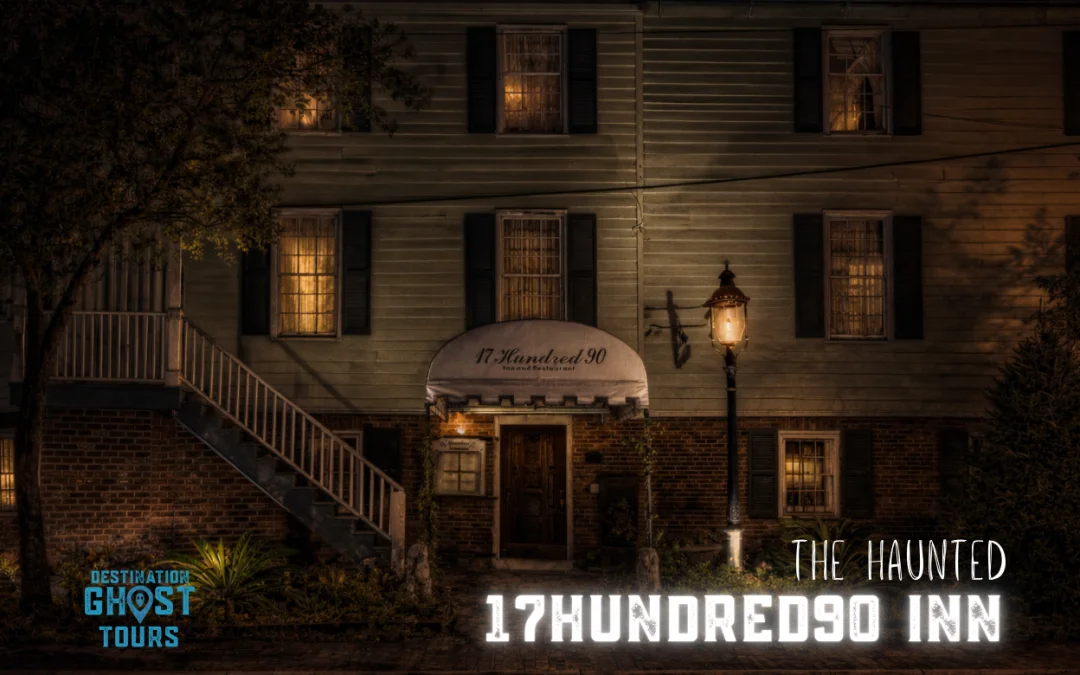
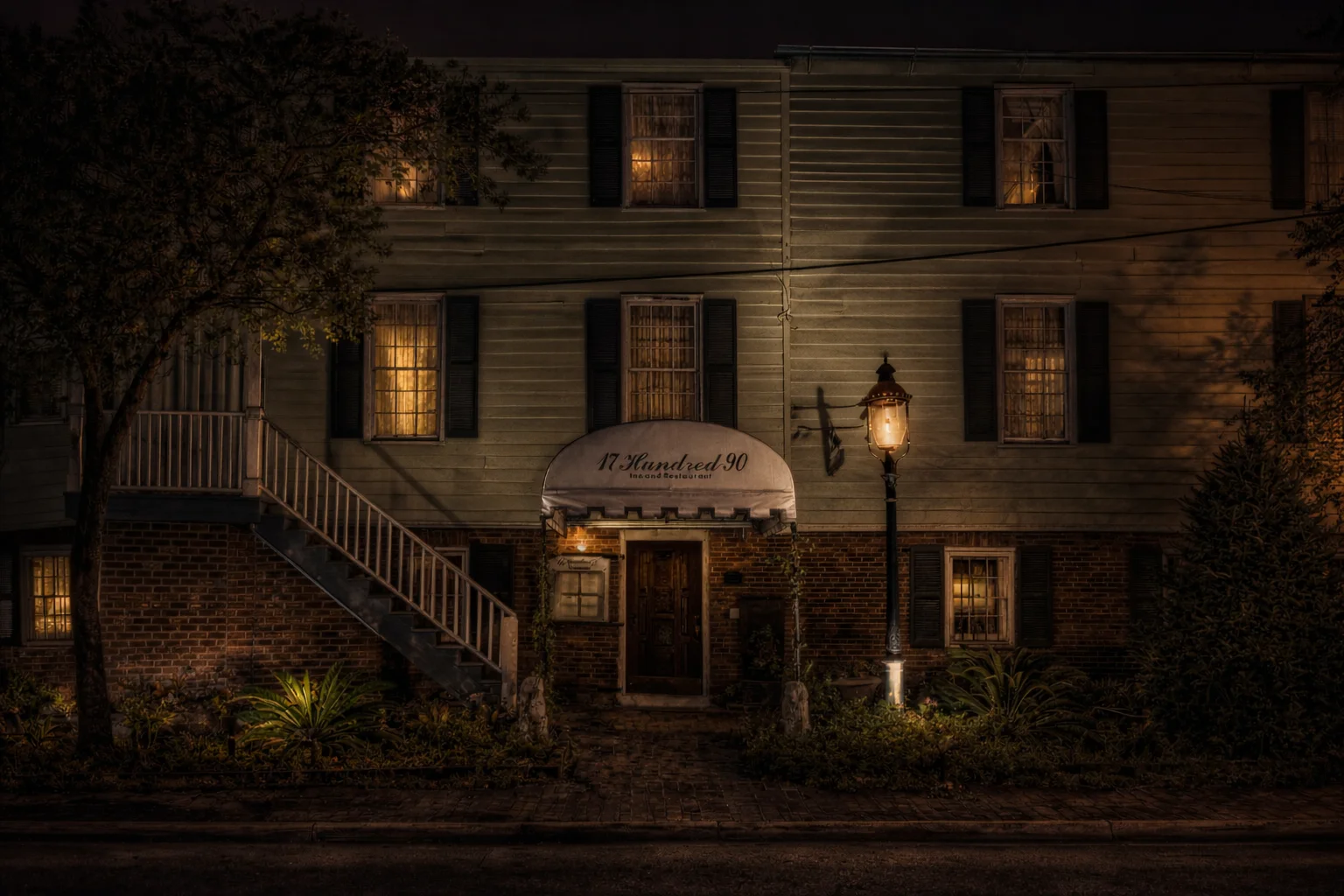
Savannah has a way of making time feel thin. One minute the city is all gaslight glow and cobblestone rhythm; the next, it feels like the past is standing close enough to fog a window. At the 17Hundred90 Inn, that sensation is especially hard to shrug off.
The building sits quietly along East President Street, worn smooth by centuries of footsteps, its brick and timber holding the kind of hush that is not quite silence. Even in the middle of a lively evening, there is often a moment when the air seems to pause — as if someone else is listening too. Visitors come for the history, the atmosphere, and the food and drink that make Savannah nights feel indulgent and old-fashioned. Many also come for a name that floats around this place like perfume that never fully fades: Anna.
Anna’s story is told and retold, sometimes carefully, sometimes carelessly — and that matters, because Savannah’s haunted reputation is at its best when it stays tethered to what can be reasonably supported. The 17Hundred90 Inn has plenty of legitimate age, legitimate mystery, and a long record of guest experiences. It does not need exaggeration. It needs only a close look, and Savannah rewards close looks.
Columbia Square and the World That Grew Around It

Savannah’s Historic District is famous for its squares — not merely because they are pretty, but because they were designed as civic breathing spaces, small green rooms where daily life could unfold within a larger structure. The wards-and-squares plan gave the city a rhythm that still shapes how visitors move through downtown today, and each square became its own pocket of memory, surrounded by homes, churches, businesses, and the evidence of who held power at the time.
Columbia Square is one of the later squares in the historic grid, laid out at the end of the eighteenth century, when the young United States was still defining itself. Its very name gestures toward national identity, and for Savannah it marked a growing confidence — a city stretching and refining its elegance. What makes it especially relevant to the 17Hundred90 Inn is proximity and continuity. This part of East President Street has been inhabited, rebuilt, renovated, subdivided, expanded, and repurposed again and again. Just a short stroll away, the Kehoe House rises with its own unmistakable presence, a later-era showpiece reflecting Savannah’s Gilded Age tastes. Nearby, the Isaiah Davenport House, now preserved as a museum, offers a grounded look at early nineteenth-century Savannah life and labor.
Taken together, these landmarks turn the area into a living cross-section of Savannah history — a neighborhood where it’s easy to imagine voices carried through open windows, carriage wheels striking stone, and candlelight flickering against plaster walls. It is also a neighborhood where tragedy, illness, and sudden disaster were not abstract possibilities, but frequent realities.

The Shadow of the 1820 Fire
Savannah’s Great Fire of 1820 remains one of the most significant events in the city’s early history — not a small blaze, but a sweeping catastrophe that destroyed hundreds of buildings and reshaped the city’s core. Fires were a constant fear in early American cities, where wood structures, close spacing, and open flames for light and heat were the norm, and the 1820 fire burned through the business heart of town with a severity remembered for generations.
For buildings and basements that may incorporate older material, the fire becomes part of the story even when the exact boundaries of damage vary by block and ward. This matters for a place like the 17Hundred90 Inn, because parts of its structure are associated with different periods of construction, including older ground-level elements often discussed in relation to earlier structures on or near the site. In Savannah, “old” is rarely one clean date — it is a collage, built from what survived, what was rebuilt, and what was reused. That layered history is one of the reasons historic inns feel so alive: people are not only sleeping in a room, they are sleeping inside a timeline.
The 17Hundred90 Inn: A Building Made of Multiple Lives
Despite the name, the inn’s story is more complex than a single year stamped on a sign. The property is widely described as having been formed from what were originally separate residences, later combined and adapted into the inn and restaurant people know today. Portions of the structure are tied to the early 1800s, with later additions in the late nineteenth century — the kind of incremental growth typical in Savannah, where buildings were expanded as families changed, fortunes rose or fell, and the economy shifted.
It’s worth pausing here, because this is where myth can creep in. A date like “1790” sounds clean and simple, and it’s easy for marketing language, even well-intended, to compress a complicated building history into a single headline. The better story is the real one: a property that contains multiple eras in its bones. That is more interesting than a tidy label — and more believable.
From a visitor’s perspective, the physical experience reinforces that complexity. The rooms don’t feel like identical hotel boxes; they feel like spaces that used to be something else, which is exactly what they were. Staircases, angles, and transitions hint at a structure reimagined more than once. Even for guests not looking for the paranormal, the inn gives off that “old house” sensation: warmth, creaks, and a sense that the building has moods. Downstairs, the tavern and dining spaces add another layer, because public rooms collect stories faster than private ones. Places that serve food and drink are memory magnets — and in Savannah, those memories do not stay neatly contained.
Ghosts and Legends: Room 204 and Anna

Savannah’s haunted lore is rich, but not all of it is equal. Some stories are rooted in documented tragedy, some are folkloric, and some are stitched together from repeated guest experiences that are sincere even when they can’t be proven in a strict historical sense. The 17Hundred90 Inn sits at the intersection of all three — which is why it remains one of the most discussed haunted places in Savannah. The most famous figure associated with the inn is often called Anna (sometimes Anne), and the story tends to orbit one focal point: Room 204.
Room 204 is regularly described as the inn’s most haunted room, and it has become a kind of pilgrimage stop for paranormal-curious travelers. The reports are notable for how consistent they are over time, even though each guest tells it differently. Common themes include:
- Items being moved, especially jewelry, clothing, or small personal belongings
- The sensation of a tug at the bedding, a nudge, or a light touch when no one else is present
- Unexplained sounds, often described as footsteps or soft movement in the room
- A feeling of being watched — not always threatening, but undeniably present
These are classic “friendly trickster” haunting motifs, and that can make skeptics roll their eyes. Still, the persistence of similar accounts — especially from guests who did not arrive expecting anything — is part of what keeps the story alive. The inn itself has leaned into the legend over the years, not as a carnival act, but as part of its identity in a city where history and haunting are so often intertwined.
The harder question is: who is Anna, really? Here the story becomes less stable. In the most commonly repeated framework, Anna is connected to the Powers family name, associated with a later portion of the building’s development, and is framed as a young woman caught in an intense romantic situation, sometimes involving a sailor. In some tellings she dies by falling or leaping from a window; in others, the death is darker, implying foul play. The responsible way to handle this is to treat the personal details as legend unless they can be confirmed through clear documentation. What can be said, groundedly, is this: the inn’s haunting tradition centers on a female presence widely known as Anna, associated with Room 204, and guest reports frequently describe playful disruptions rather than violent attacks or sensational horror. That alone is enough for a compelling story — especially in a city where the atmosphere does half the work.
The Three-Ghost Tradition
The 17Hundred90 Inn is also often said to have more than one spirit. In many retellings there are at least three distinct presences, with Anna the best known. The others are typically described more vaguely: a figure glimpsed in peripheral vision, a heavier footfall in the hallways, a sense of someone moving through spaces where no one is visible.
This is where haunted inns often land, because a multi-era building with multiple functions naturally gathers multiple kinds of stories. A former residence turned into an inn carries a different emotional imprint than a building designed only for transient guests — and adding decades of public dining and drinking below makes it easy to see why people feel the building has “company.” The most interesting aspect isn’t the number, but the character of the experiences. The reports here are often not theatrical. They are small. Domestic. Personal. And that is exactly why they stick.
A dramatic Hollywood ghost is easy to dismiss. A missing earring that reappears in an impossible place is harder to file away.
Why This Place Lends Itself to Ghost Stories
Savannah’s haunted reputation is not only about death and tragedy; it’s also about architecture and atmosphere. Several qualities of the 17Hundred90 Inn encourage people to interpret their experiences through a paranormal lens:
- Age and irregularity: older buildings have quirks, unusual drafts, and sound travel that can surprise modern guests.
- Layered construction: spaces that were once separate structures can create odd transitions, temperature shifts, and acoustic pockets.
- Emotional priming: people often arrive already aware of the legend, which makes them more attentive to small anomalies.
- Nighttime Savannah: the city itself sets the stage. When the streets quiet and lantern light hits the brick, imagination becomes more active.
None of this disproves anyone’s experience. It simply explains why the 17Hundred90 is an ideal environment for stories to form, persist, and grow. The most honest haunting narratives acknowledge both the mystery and the mechanics.
Columbia Square and the surrounding blocks hold an unusually high concentration of Savannah’s most iconic historic stops, so travelers planning a haunted weekend often end up orbiting this area without realizing it. The square’s fountains, brick paths, and surrounding homes form a kind of stage set for the city’s deeper history — wealth built from port commerce, the realities of enslaved labor, waves of disease, and the constant pressure of coastal weather and fire. That’s why ghost stories here feel emotionally heavy: Savannah’s beauty is real, but it is not innocent. Its charm sits atop complicated human lives, and when a guest feels a chill in a hallway or hears a soft step at 2 a.m., the city’s context makes it easy to wonder who walked here before.
A Grounded Way to Think About “Haunting” in Savannah
It helps to reframe what a haunting means in a city like this. Not every ghost story needs to be treated as either proven fact or total nonsense. Savannah’s best legends survive because they are plausible in feeling, even when the details are uncertain. At the 17Hundred90 Inn, the most grounded approach is simply this:
- The building is genuinely old and structurally layered, which creates sensory experiences that feel unusual.
- The inn has a long-standing tradition of guest reports centered on specific activity, especially in Room 204.
- The name Anna is deeply embedded in the inn’s modern folklore, and the repeated nature of the reports keeps the story alive.
- The details of Anna’s biography are less stable, and should be presented as legend unless independently verified.
That balance is exactly where a responsible haunted-history story should live — respecting the power of the place without turning it into a tall tale. It’s also why a well-crafted ghost tour matters. The best tours, including those led by Destination Ghost Tours, don’t rely on manufactured drama. They build a night out of the real city: documented history, carefully handled lore, and the sensations Savannah gives you for free once the sun goes down.
The strangest thing about the 17Hundred90 Inn is not that people claim to experience something. It’s how easily the building makes those claims feel possible. Savannah has a talent for that — a city where the past is not locked behind museum glass, but sits beside you on a bench, leans out of upstairs windows, and lingers in the smell of old brick after rain. Maybe that is all a haunting is: history that refuses to become abstract.
Visiting the 17Hundred90 Inn Today
The 17Hundred90 Inn is easy to work into an evening because it sits in the heart of the Historic District, near Columbia Square and within comfortable walking distance of many of Savannah’s most visited locations. Guests who want to lean into the legend often request Room 204 specifically, while others simply enjoy the inn for its historic character and the feeling of being inside old Savannah rather than merely observing it. A few tips to keep the visit enjoyable and respectful:
- Treat the inn as a historic property first: it is not a haunted-house attraction, but a real place with real guests.
- For the “Savannah after dark” experience, explore the area around Columbia Square in the evening, when the atmosphere shifts.
- If you’re pairing your stay with a ghost tour, choose one that prioritizes historically grounded storytelling over exaggerated claims.
Whether or not you experience anything unusual, let the building be what it is: an old Savannah survivor, layered with time, and famous for the way it makes people pay attention. And if, late at night, you hear a faint step outside your door, or find a small item moved to a place you swear it could not have reached on its own, Savannah’s best advice is simple. Do not panic. Just listen. In this city, the past has always had a voice — and sometimes it chooses to speak softly.
Walk Haunted Columbia Square With Us
The 17Hundred90 Inn, the Kehoe House, and the Davenport House all cluster around Columbia Square. Hear their stories — grounded in real history — on a walk with Destination Ghost Tours.
Book a Savannah Ghost Tour
Chris Allen is the founder of Destination Ghost Tours, a historian and storyteller with a lifelong fascination for the darker corners of history. He spends his time uncovering the true stories behind haunted legends, guiding guests through historic cities, and chasing down details that refuse to stay buried. When he is not working, he can usually be found with his partner Arissa, their dog Bear, and their two cats, Trouble and Covu, photographing old places, digging through archives, or disappearing into historical rabbit holes. He believes the best history is honest, atmospheric, and just unsettling enough to linger.