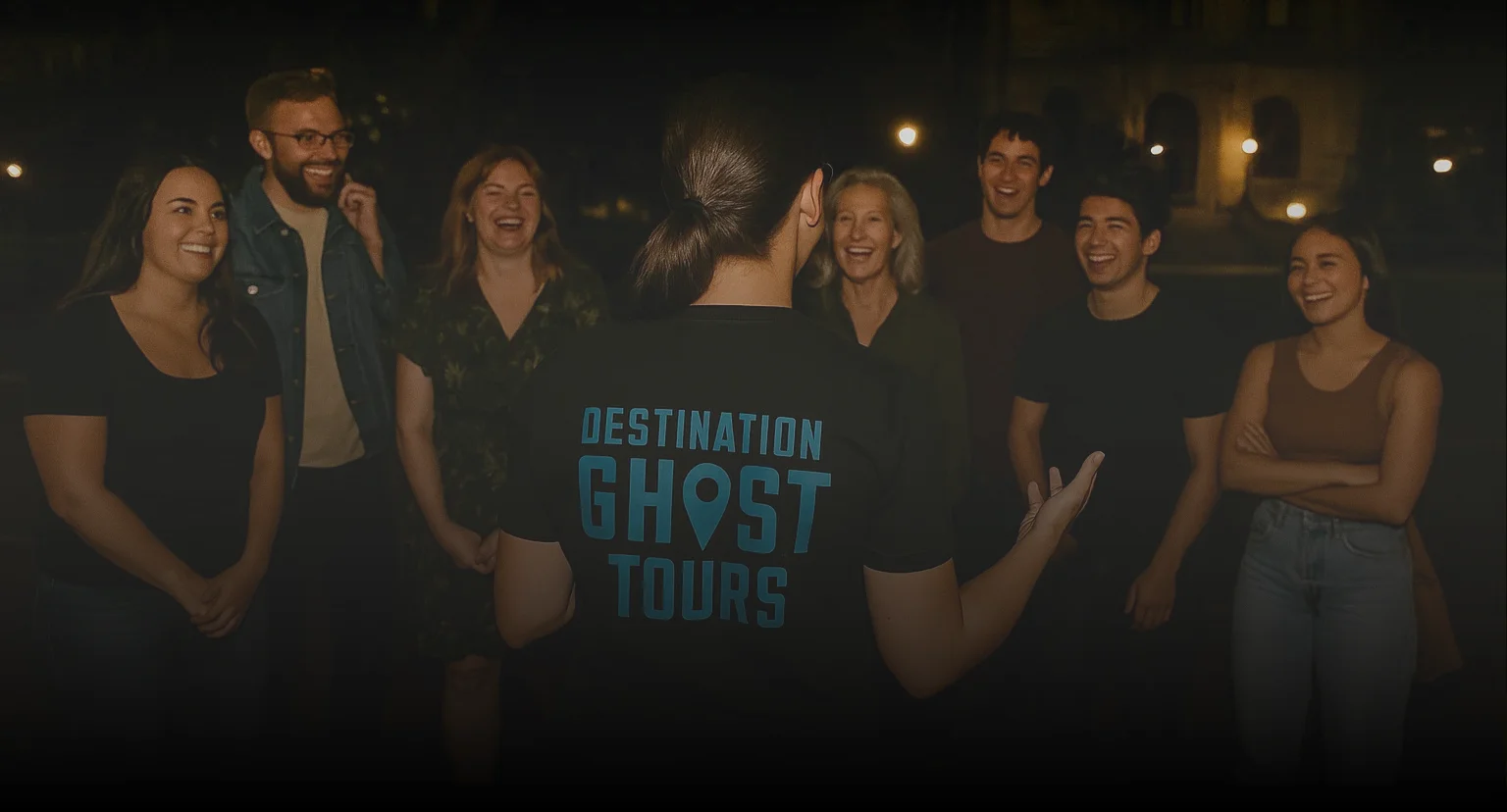

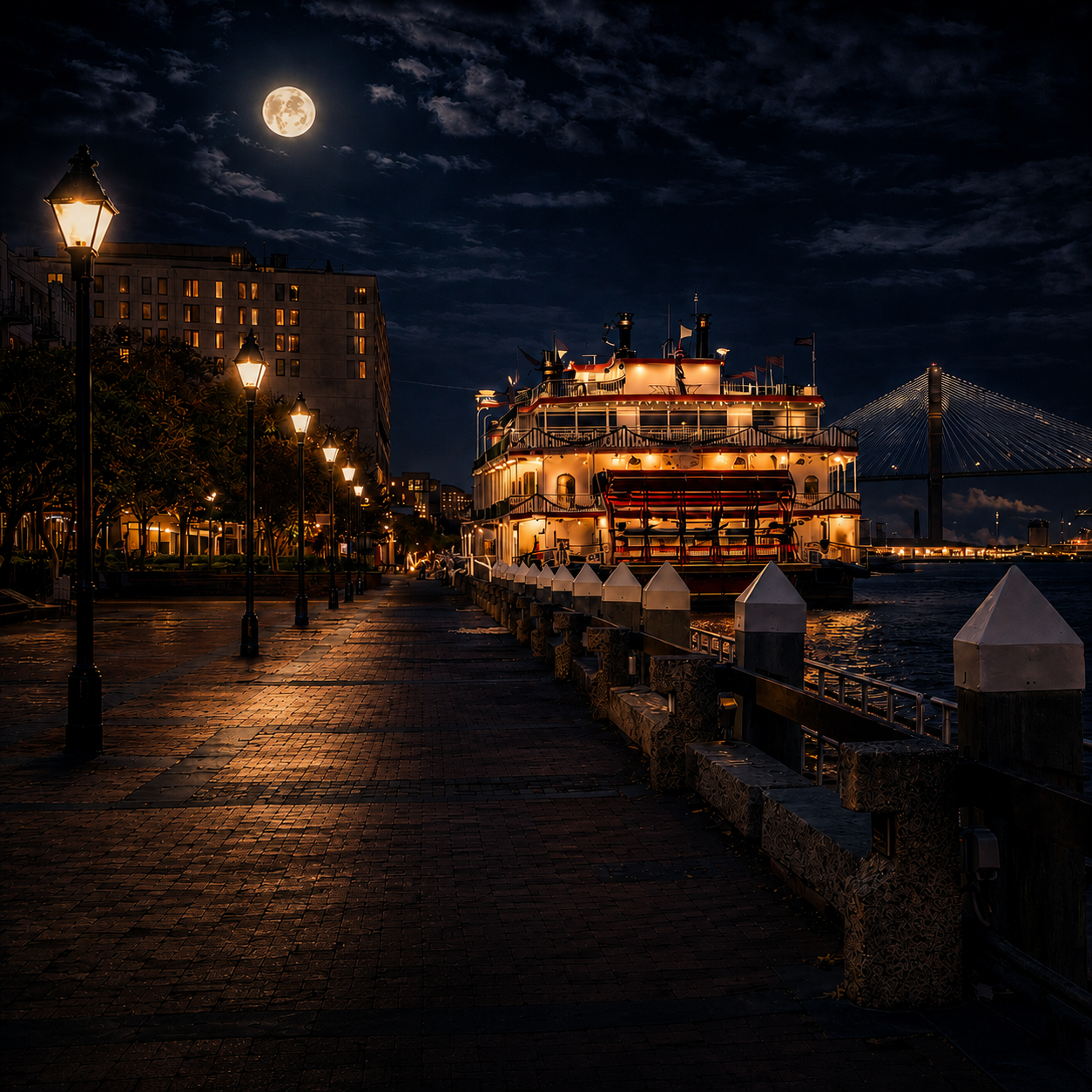
On a balmy Friday the 13th, the historic streets of Savannah take on an extra layer of mystery. As dusk falls, Spanish moss sways from ancient oaks and cobblestone lanes glisten under gaslight. The city’s famously haunted atmosphere feels even more pronounced on this superstitious date — the perfect night to explore Savannah’s haunted history alongside a lantern-carrying guide.
The Unluckiest Day: Friday the 13th
Friday the 13th has long been labeled the unluckiest of days — but why? The answer lies in an age-old tapestry of myth, religion, and cultural fear. Western culture has a longstanding unease with the number 13 (known formally as triskaidekaphobia): where 12 signals completeness — twelve months, twelve hours, twelve apostles — its successor has always seemed disruptively odd. To this day, many hotels and buildings skip a 13th floor, a quirk you can still spot in some of Savannah’s older, retrofitted inns.
Friday carries its own ominous baggage. In Christian tradition it was a day of penance — the day of the Crucifixion — and sailors long considered it unlucky to set sail. In the American South, Fridays were once grimly nicknamed “hangman’s day,” since public executions often fell at week’s end. Separately, Friday and 13 each had dark reputations; together they became a kind of super-superstition by the late 1800s, often traced (loosely) to Friday, October 13, 1307, when King Philip IV of France moved against the Knights Templar. The 20th century cemented the date in pop culture, from a 1907 stock-market thriller to the hockey-masked slasher of the 1980 horror films. For some, the dread runs so deep it has a clinical name: paraskevidekatriaphobia, the fear of Friday the 13th.
In Savannah, these global fears take on a local flavor. This is a city that has historically been both God-fearing and ghost-fearing, and even skeptics get a little more cautious when the date rolls around. As the tour-guide joke goes, you’ll never find exactly 13 guests at a Savannah dinner table on this night — someone always insists on being the 12th or 14th, just to play it safe.
Savannah’s Haunted Legacy: Why the Hostess City Holds So Many Ghosts
Savannah did not earn the nickname “America’s Most Haunted City” by accident. Established in 1733, it is old by American standards, and in a very literal sense it is built upon its dead: numerous colonial-era burial grounds were later paved or built over as the city grew. Wright Square itself was once a burial ground for the Yamacraw and their leader Tomochichi, whose grave was built over during the city’s development (a boulder now honors him there). Such disturbances of the dead, spiritualists say, are a recipe for hauntings.
The city’s history supplied plenty of tragedy. The 1779 Siege of Savannah turned parts of the city into a bloody battlefield, and legend holds that fallen soldiers were buried in mass graves where they fell — one rumored to lie beneath Madison Square. Yellow fever epidemics in 1820, 1854, and 1876 killed thousands, so swiftly that victims were sometimes buried in trenches, including at Colonial Park Cemetery. Layered atop this history is a rich stew of belief: the Gullah-Geechee root-magic traditions of enslaved West Africans, Caribbean influences carried by refugees of the 1790s, and the Victorian spiritualism of the city’s elite, who held séances in their parlors. Even the old custom of painting porch ceilings “haint blue” — to fool spirits into mistaking it for water they cannot cross — survives across the historic district today.
With that potent mix of history and belief, ghost stories sprouted on every corner. Locals half-joke that it’s harder to find a Savannah building without a ghost than one with. And on Friday the 13th, every one of those tales feels a touch more tantalizing.
Wright Square and the Ghost of Alice Riley
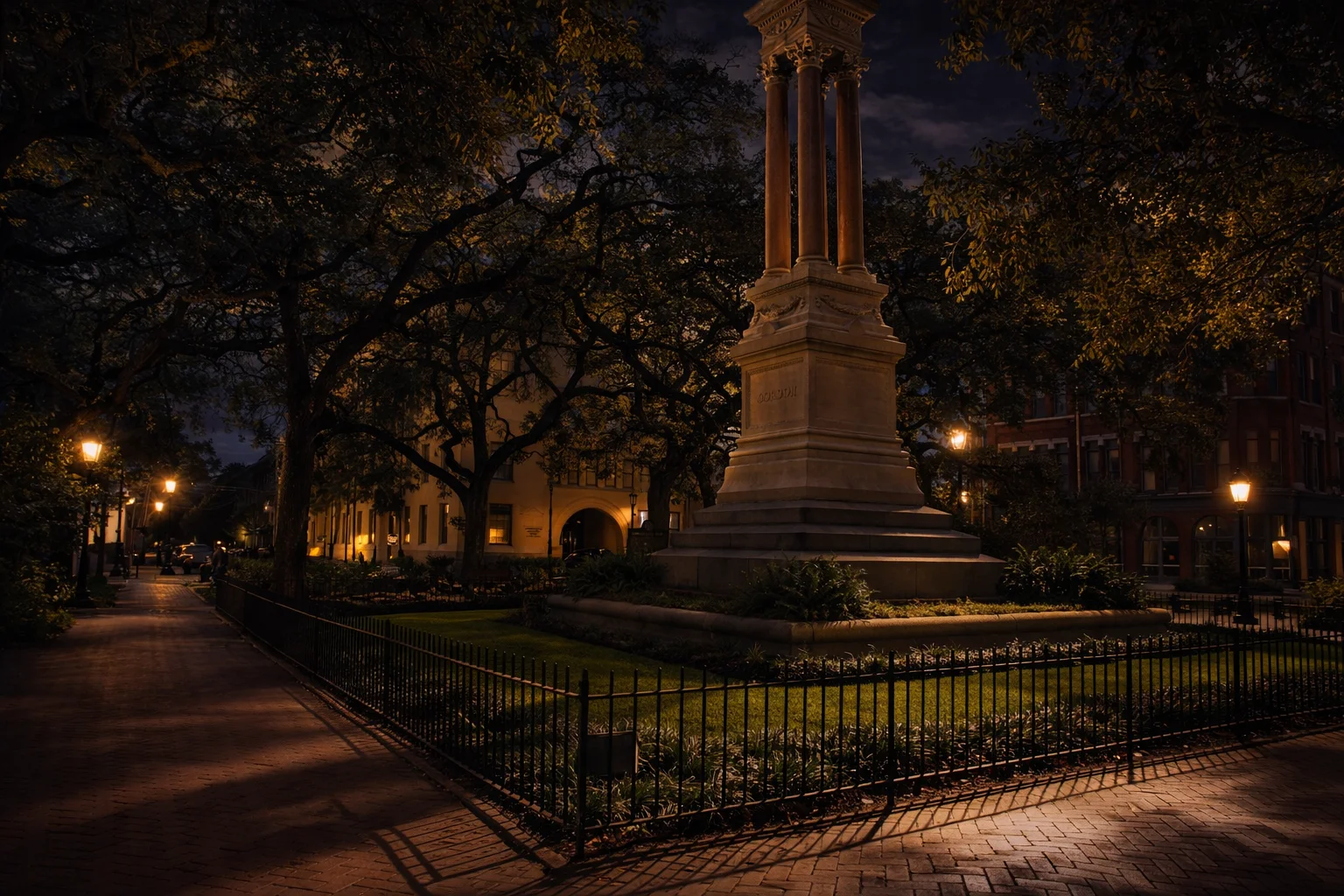
Wright Square looks tranquil by daylight, but its atmosphere shifts after dark — and no story captures that better than Alice Riley’s. A real young Irish woman of about seventeen or eighteen, Alice arrived in the raw new Georgia colony in the early 1730s as an indentured servant, bound alongside her partner Richard White to a notoriously cruel master named William Wise. In 1734, Wise was found dead — strangled and held under water in a livestock trough — and Alice and Richard, the obvious suspects, fled into the marshes before being caught. It was the first recorded murder in Savannah’s history, and the fledgling colony was eager to make an example. Richard was executed swiftly; Alice’s hanging was delayed only because she was pregnant. She gave birth in jail, the infant lived just weeks, and in early 1735 she became the first woman executed in the Georgia colony, hanged at Wright Square while maintaining her innocence.
For nearly 300 years, locals have claimed Alice haunts the square — a forlorn young woman in old-fashioned clothes, sometimes said to approach mothers and expectant women as if still searching for her lost baby. Visitors report eerie photos near the wrought-iron fence, faint sobbing, or the scent of salt water on a still night. It’s a story that always falls silent over a tour group, because behind the ghost stands a very human tragedy. As a quiet local tradition, some mothers-to-be still leave flowers by the Gordon Monument — a small gesture of remembrance for Alice.
Colonial Park Cemetery: Twilight in the City of the Dead
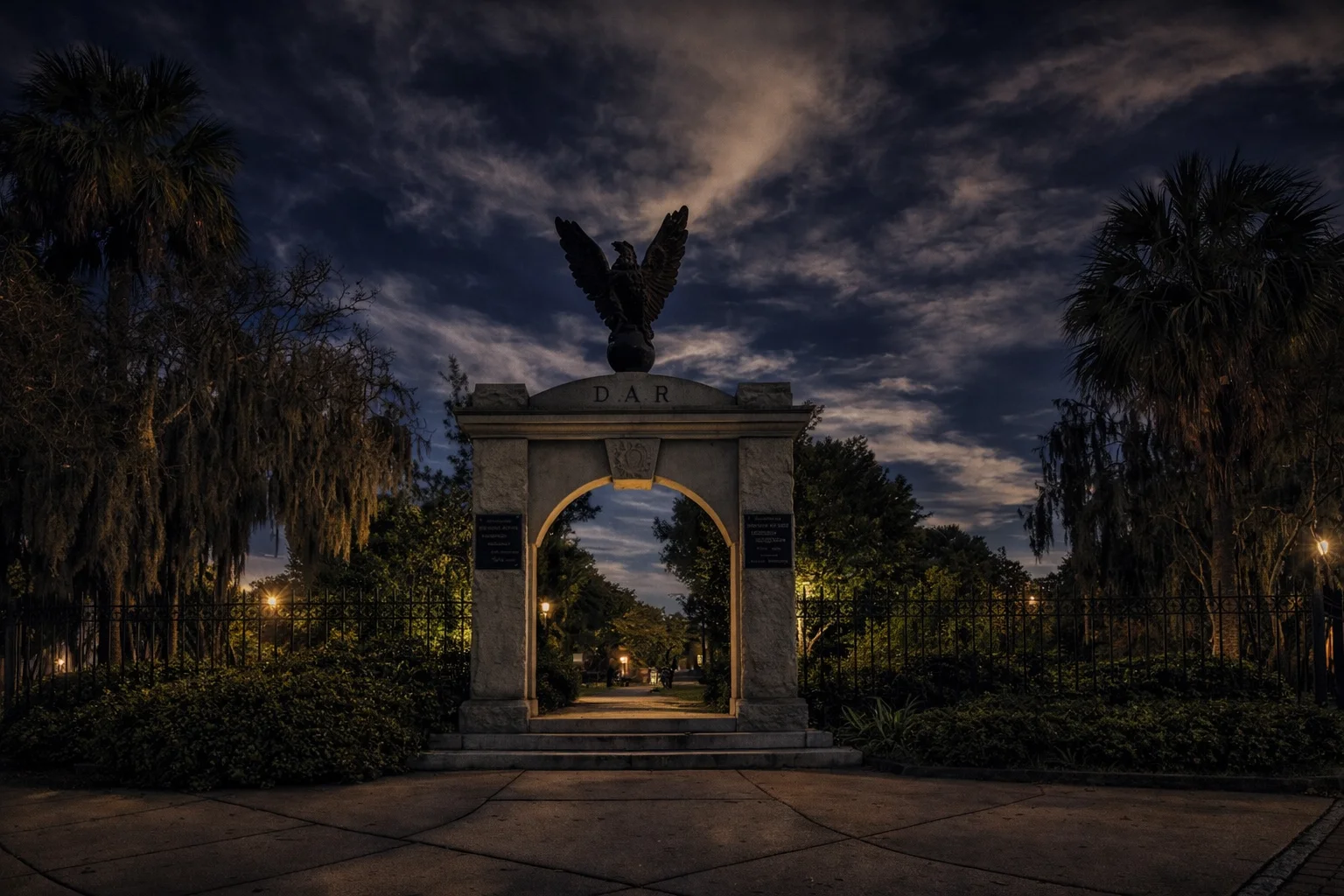
No Savannah ghost tour is complete without Colonial Park Cemetery, which locals sometimes call “Paranormal Central.” Founded in 1750 and closed to new burials in 1853, it holds an estimated 10,000 bodies beneath only about 600 visible markers. The reasons are grim: yellow fever epidemics forced mass burials in pits and trenches, weather erased simple wooden markers, and during the 1864 Union occupation, soldiers camping among the graves knocked over headstones and even re-carved dates as pranks — one stone now absurdly suggests its occupant lived to 544. The uneasy sense that not everyone here was properly laid to rest fuels endless reports of phantom footsteps, whispers, and figures glimpsed among the tombs.
The cemetery’s most infamous tale is that of René Rondolier, said to have been a seven-foot outcast lynched from a tree within the grounds after being blamed for the murders of local children. It’s a chilling story — and an honest guide will tell you there is no historical record that René ever existed; it appears to be pure folklore. Even so, visitors still report a towering shadow figure among the graves, proof of how readily suggestion and darkness conjure the uncanny. The grounds were also, historically, a site for late-night conjure rituals — groundskeepers of the 1920s and ’30s often found candle wax and grave dirt disturbed — which is part of why the city eventually locked the gates after dark.
The Sorrel-Weed House: Betrayal and Despair
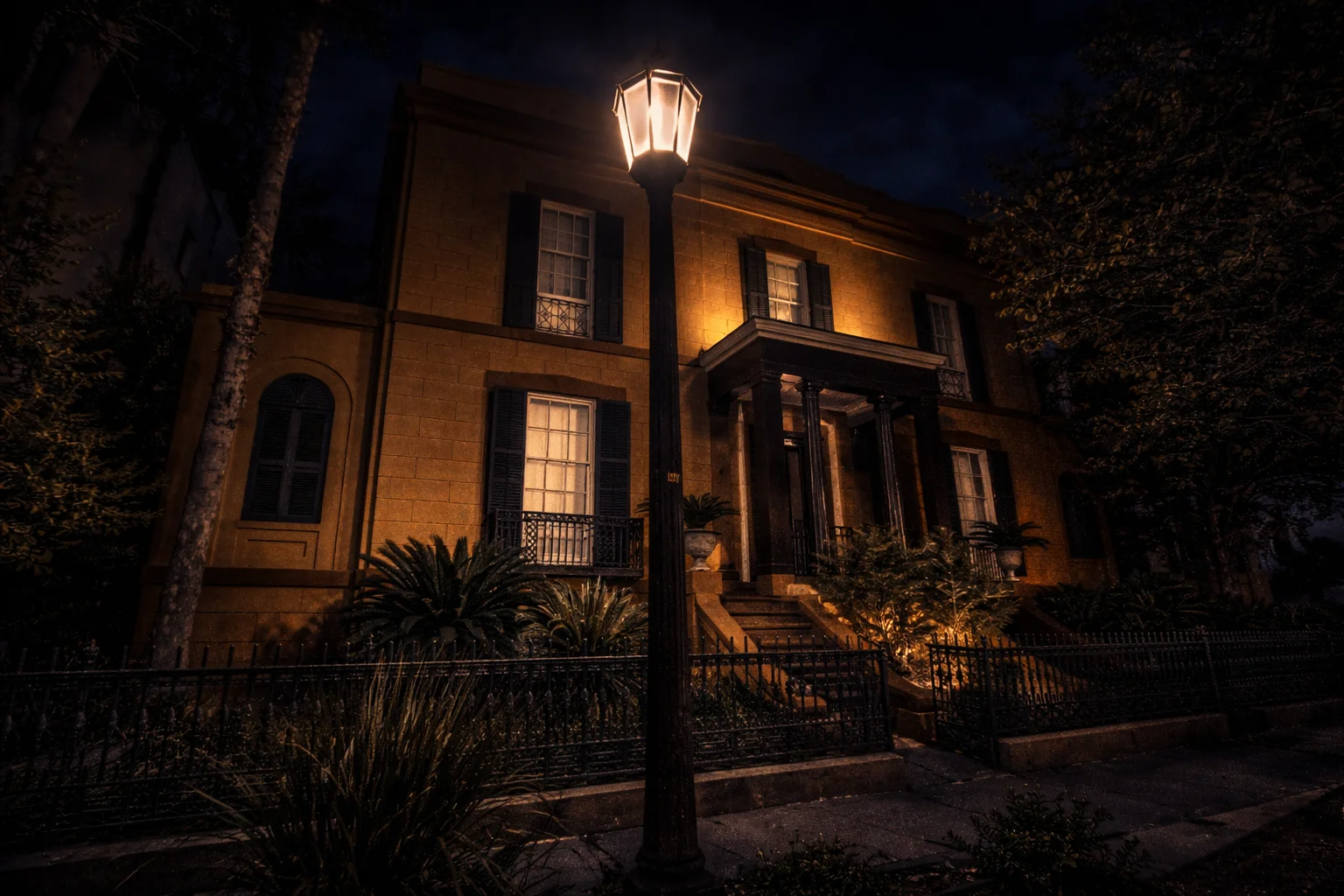
Rising at the corner of Madison Square, the Sorrel-Weed House is one of Savannah’s architectural treasures and one of its most famous haunted homes. Completed around 1840 for the wealthy shipping merchant Francis Sorrel, it saw real tragedy: Matilda Sorrel died in 1859 after a fall from an upper story of the house — whether by accident or her own hand was whispered about even then. Legend built a darker tale around it: that Matilda had discovered her husband’s relationship with an enslaved woman named Molly (a relationship no enslaved woman could freely consent to), and that Molly was soon found dead in the carriage house. There is no definitive proof of the love-triangle rumor, and the details of Molly’s death remain unverified — but the story has clung to the house for generations.
Whatever the truth, visitors and staff report a litany of phenomena: disembodied voices and sobbing, cold spots on the second-floor balcony, and shadows moving in the carriage house. One widely shared photo appeared to show a woman’s face reflected behind a tour group, and paranormal investigators claim to have recorded unsettling EVPs. Many who are sensitive describe an oppressive sadness in certain rooms — the emotional echo of a house shaped by loss.
The 17Hundred90 Inn: Love Lost
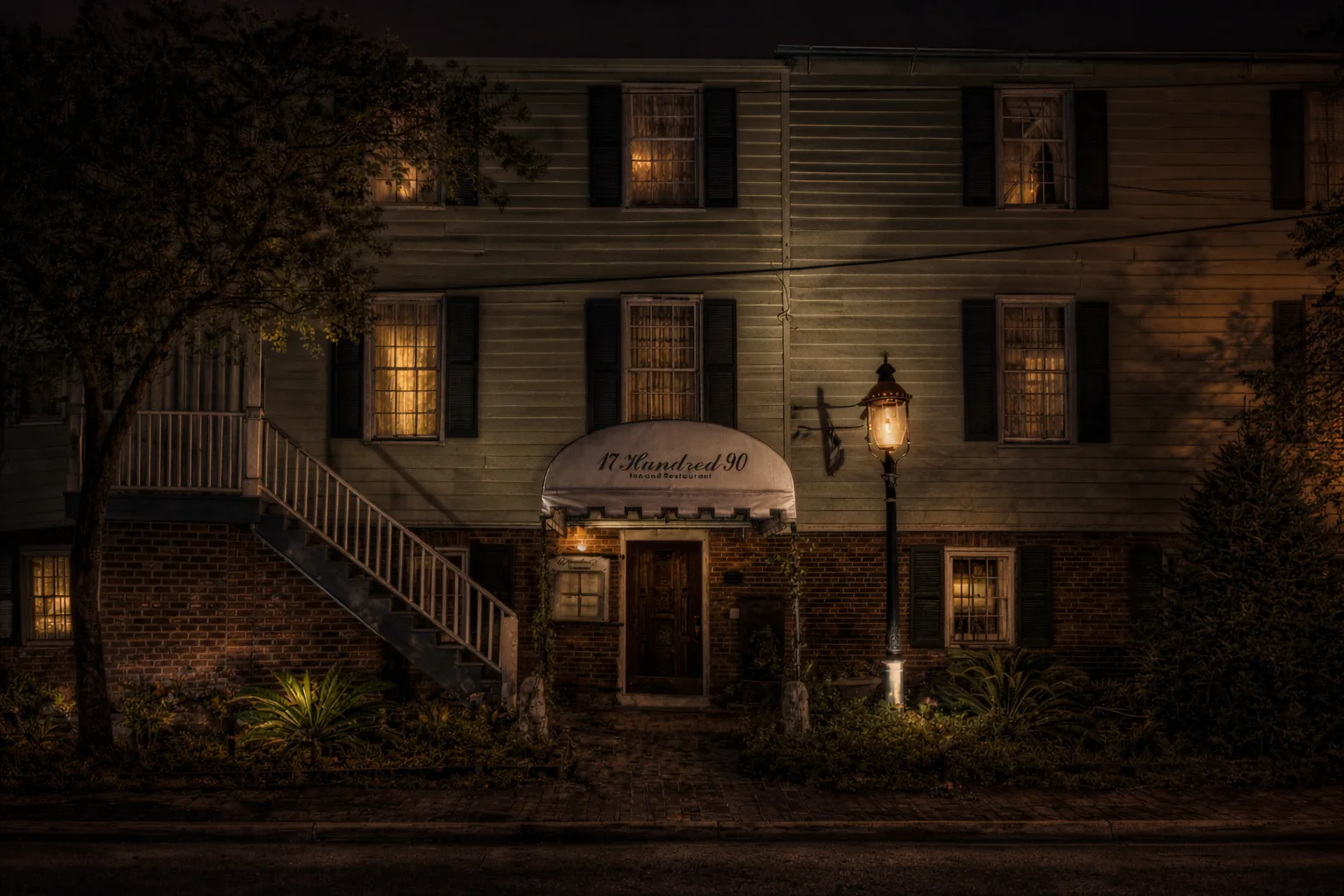
At the 17Hundred90 Inn on East President Street lives Anna, Savannah’s most famous “broken-hearted” ghost. As the legend goes, Anna fell deeply in love with a sailor who stayed at the inn; when he left her behind — whether lost at sea or simply gone — her grief became unbearable, and she fell to her death from an upper window. Room 204 is consistently named as the center of the haunting.
Guests in 204 report belongings that move on their own, a lock that clicks itself open, lights that flicker despite modern wiring, and the gentle tug of bedsheets at night. Far from malevolent, Anna is described as gently melancholic — still pining, perhaps hopeful that each new guest might be her sailor returning. Staff have glimpsed a woman in white on the staircase, and one housekeeper famously refused to service the room again after a rocking chair began rocking on its own. Fittingly for the Hostess City, Anna’s ghost seems less interested in frightening guests than in checking on them — and many visitors now request 204 specifically, hoping for an encounter.
The Olde Pink House: A Diligent Spirit
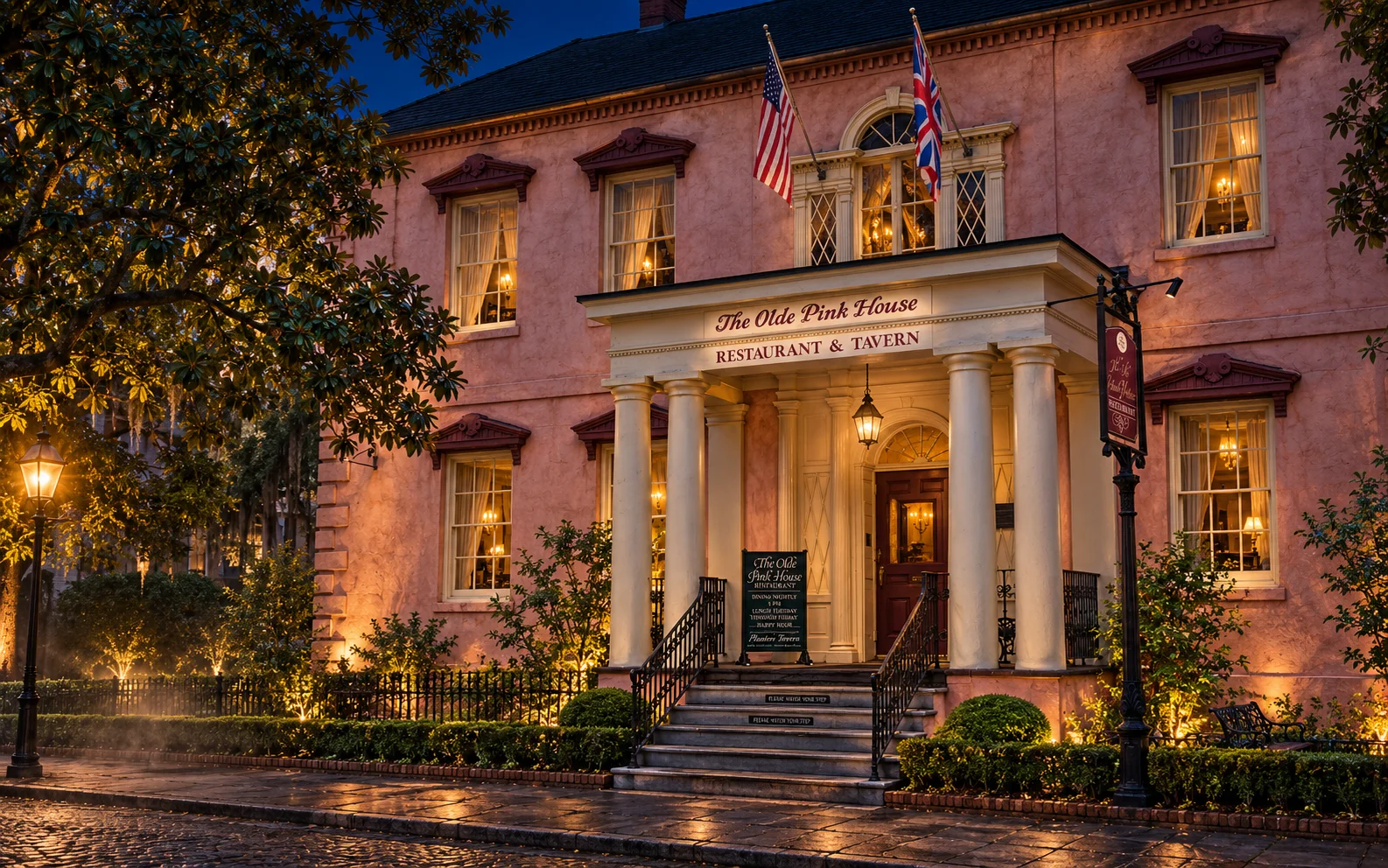
A colonial mansion on Reynolds Square now operating as a beloved restaurant, the Olde Pink House gets its blush from old red brick bleeding through white plaster. It was built in the 1770s by James Habersham Jr., a Revolutionary-era figure and reputed perfectionist who, local lore holds, took his own life in the 1790s. He seems never to have truly left his beloved home — but unlike Savannah’s tragic specters, this one is famously well-mannered.
Diners and staff describe a dapper gentleman in colonial coat and breeches, matching descriptions of Habersham, who behaves less like a haunt than the world’s most obsessive host. Chairs left askew are quietly pushed back into place; a fork out of line is straightened when no one is looking; lights switched off are found glowing again in his old study, where a candle-lit silhouette is sometimes seen surveying the square. It’s a lighter, oddly charming counterpoint to the city’s darker tales — a reminder that not every Savannah ghost was born of murder or heartbreak. Some are simply devoted to their homes.
Moon River Brewing Company: A Rowdy Ghost Named Toby

The Moon River Brewing Company on West Bay Street occupies a building with a long and tumultuous past — constructed in 1821 as the City Hotel, Savannah’s first, and later a post office and bank before its rebirth as a brewery. Its most famous resident is Toby, a name staff gave to whatever unseen force stirs up mischief around the bar. Toby has never been tied to a specific record, but his presence is strongly felt, especially on the second floor.
He is, in essence, a pub poltergeist: bartenders report bottles sliding across counters and glasses leaping from tables, heavy footsteps pacing empty upstairs rooms, and — his signature move — a firm, unseen shove on the staircase. More than one skeptic has been made a believer after being pushed at the very moment they doubted him aloud. The building has darker chapters too, including the 1832 death of a hot-tempered local named James Stark, shot on the stairway during a feud, whose agitated spirit some believe still roams. At Moon River, it seems, the spirits come in both pint glasses and phantom form.
The Marshall House: Hospital of Horrors Turned Hotel
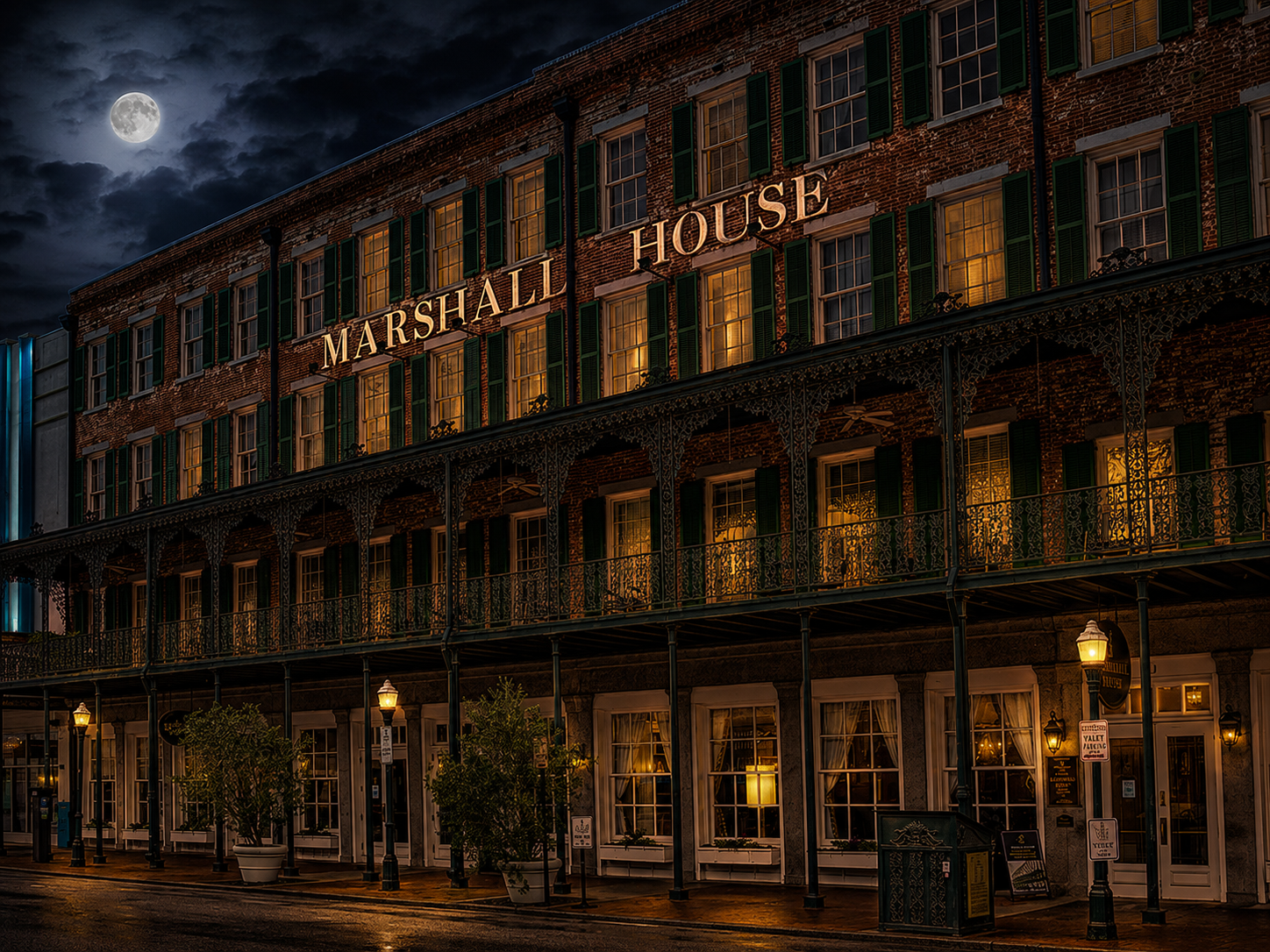
Opened in 1851, the Marshall House on Broughton Street is one of Savannah’s oldest hotels — and among the most haunted in America. Built by Mary Marshall, it was pressed into service as a Union hospital during Sherman’s 1864–65 occupation and again during later yellow fever epidemics, its halls filled with the wounded and dying. That grim history surfaced literally during renovations in the late 20th century, when workers found human skeletal remains beneath the floorboards — amputated limbs from Civil War surgeries, buried where they fell.
Little wonder the hotel’s ghosts are so numerous. Guests report phantom footsteps and the tap of a cane, faucets that turn themselves on, doorknobs that jiggle, and the smell of a hospital ward that comes and goes. Most unnerving are the figures — some in old-fashioned nursing dress or Union uniform — seen bending over a bed as if checking for fever, and the pitter-patter and giggling of unseen children in the halls. The Marshall House embraces its reputation with good humor (guests routinely request the “most haunted room”), but the guide tells these stories with somber respect: these may be the souls of real people who suffered greatly right where visitors now sleep.
Friday the 13th Meets Savannah’s Ghosts
On a night like this, the veil between then and now feels paper-thin.
There’s a real psychology to Friday the 13th. When many minds collectively focus on a superstition, people tune themselves to notice the unusual — and in a city already full of the unusual, that heightened sensitivity can make a tour feel electric. A few Savannah touches deepen the mood: many innkeepers still swear that rooms with haint-blue ceilings see less activity, and there’s a delightful irony that Georgia was the 13th colony and that only 22 of the city’s original 24 squares remain. Savannahians have always coped with what scares them through humor — there’s a tongue-in-cheek local “legend” that the ghosts gather in Colonial Park every Friday the 13th to trade scare tactics and gossip about which guide is telling their story wrong.
Savannah is a city that doesn’t hide from its past — it invites you to stroll with it, hand in hand with the departed, under the moss and moonlight. Confronting the superstitions, and the stories, is the real magic of a ghost tour on the unluckiest of nights. Even a lifelong skeptic walks away with a collection of vivid tales, having explored the haunted heart of Savannah — and lived to tell about it.
Walk the Haunted City on Friday the 13th
Embrace the dark with Destination Ghost Tours as your guide. You’ll get goosebumps, learn a great deal, and laugh in spite of yourself — on the unluckiest night of the year.