
Savannah — a charming Southern port famed for its picturesque squares and rich history — also harbors a lesser-known past rife with vice. From the colony’s earliest days through the 20th century, prostitution thrived in Savannah’s alleyways, taverns, and “houses of ill repute.” This is the story of that shadowy history, drawn from newspaper reports, court records, and scholarly research.

How did the sex trade take root in colonial times, expand with the booming port, and persist through wars and social upheaval? Where were Savannah’s red-light districts, who ran the infamous brothels, and how did the law respond — from tacit tolerance to crackdowns, ordinances, and reform campaigns? The following chronicle traces Savannah’s “houses of ill fame” from 1733 to the modern day.
Colonial Origins of Prostitution (1733–1800)
Savannah was founded in 1733 by General James Oglethorpe with lofty moral intentions — the Georgia colony initially banned slavery, hard liquor, and even lawyers in hopes of fostering a virtuous citizenry. There is no evidence Oglethorpe explicitly outlawed prostitution, but his strict rules against rum and idleness show he aimed to curb vice in general. Despite these utopian ideals, vice inevitably crept in. As a seaport and military outpost, Savannah drew a transient male population — sailors, soldiers, traders — with the usual appetites of port towns. Where liquor flowed, prostitution quietly followed, and by the mid-18th century anecdotal reports indicate the sex trade had taken root.
One of the first documented brothels dates to 1770, when a woman known as Mrs. Stuart was noted for operating a house of prostitution, reportedly tucked into the city’s southeastern defenses. By 1771 she had relocated to Yamacraw, a settlement just west of town — beyond the immediate scrutiny of authorities. This early example reveals two patterns that would persist for a century: prostitution clustered on the geographic margins of the city, and it moved whenever pressure mounted. After the Revolution, as the port reopened and boomed, brothels multiplied. In the 1790s a man named Robert Boyd established one in Oglethorpe Ward, deliberately choosing a poorer, mixed neighborhood where oversight was thin and a ready clientele of laborers and seamen lived nearby.
The late 1700s also brought the first crackdowns. Georgia criminalized keeping a “disorderly house” (a common euphemism for a brothel) in 1787, though enforcement was spotty. In 1789 a woman identified as Mrs. McLean was convicted and sentenced to 40 days in jail; in 1805, five people were indicted in a small county crackdown, though only one conviction resulted. By 1808 community leaders were openly alarmed: that April, the Chatham County Grand Jury condemned “the various houses of ill fame in our city, from which issue many of the mischiefs that interrupt our peace,” warning that they corrupted the young and spread disease “to the third and fourth generations.” The following year, another grand jury lamented that brothels were “suffered to be kept in the very centre of the city.” Laws existed; enforcement did not — and the trade only grew as the new century began.
Antebellum Savannah’s Sex Trade (1800–1860)
In the first half of the 19th century, Savannah became one of the South’s most important seaports — and its vice economy expanded with it. Prostitutes found a ready market among the waves of visiting sailors who spent their wages, as one historian put it, “in the bars and brothels of Bay Street and Yamacraw.” Along Bay Street and the darkened alleyways of Factor’s Walk, numerous small brothels operated, hidden from the city watch. Emily Burke, a traveler in the 1840s, was warned that Bay Street and the Bluff were “always so thronged by sailors, slaves and rowdies of all grades and colour, that it is not safe for ladies to walk there alone.” So long as vice stayed out of the genteel squares, the police largely turned a blind eye.
Geography of the Red-Light District
Savannah’s antebellum red-light district was never formally bounded, but its shape is clear from the records. On the east side, the run-down Trustees’ Garden quarter became a notorious vice zone; the police chief’s 1855 report counted five large houses of ill fame in the easternmost wards. On the west, the historic Yamacraw neighborhood held its own cluster — “four noted houses of ill fame,” per the same report — in a polyglot working-class area described as “very mixed, consisting of Americans, free Negroes, and foreigners of all classes.” Both districts lay at the city’s edges and weren’t regularly patrolled until 1854, making them natural havens. But discreet brothels existed downtown, too: as early as 1809 grand jurors complained of houses “in the very centre of the city,” and by 1861 citizens were petitioning to remove a notorious brothel on State Street just south of Reynolds Square.
Brothel Life and Operations

Savannah’s houses ranged from dingy one-room “cribs” to substantial multi-room establishments run by a madam. Censuses masked them with euphemisms — brothels appeared as “female boarding houses,” the women as “boarders” or “seamstresses.” In 1860, for instance, Mary Thorpe and Fannie Fall were indicted for “keeping and maintaining a lewd house,” yet the census blandly listed them as running ladies’ boarding houses. (Fall, a 29-year-old Irish immigrant, exemplified the significant Irish presence in the trade after the famine migration.) Convictions were difficult; juries often failed to convict, or charges were quietly dropped.

The women came from diverse backgrounds: poor locals of both races with few other options, destitute immigrants, and free women of color. Notably, the trade “did not adhere to a color bar” — white and Black women often worked side by side and served customers of any race. The legal system, however, applied a stark double standard: in 1856 a white woman named Sarah Hoyt served 85 days in jail for “drunkenness and adultery with a Negro,” while no Black man was charged. Inside the brothels, life could be brutal — violence, exploitation, alcohol, and disease were constant. A Confederate officer’s 1862 diary recorded a soldier who “got on a spree…visited some house of ill fame, got the venereal disease,” and, hospitalized, leapt from a window and broke his leg. “So much for Whisky & harlots,” the officer concluded. Venereal disease was rampant in an age when the only treatment was mercury.
Madams, Clientele, and Economics
The period produced madams of local notoriety, and a few upscale “parlor houses” catering to wealthier gentlemen — cotton brokers and, it was quietly understood, some city fathers. Savannah also had “assignation houses,” short-stay establishments where a man could meet a prostitute discreetly; the mayor counted three of them in 1856. Prostitution was a double-edged economic force: it drained visiting sailors’ wages but circulated that money to tavern owners, landlords, and merchants, and a savvy madam could accumulate real wealth. The social costs — disorder, drunkenness, and the spread of disease — drew steady complaint from churches and reformers, but the male-dominated city government tolerated the trade so long as it stayed contained. Only when certain lines were crossed — above all, the involvement of children — did the courts respond with swift, severe punishment.
A remarkable statistical snapshot survives thanks to Dr. William Sanger, whose 1858 History of Prostitution gathered figures from cities nationwide. Savannah’s mayor reported that in 1856 the city had 15 houses of prostitution, 3 assignation houses, 93 white prostitutes, and 105 “colored” prostitutes — nearly 200 sex workers in a city of about 28,000. The near-even racial ratio confirms how thoroughly the trade crossed color lines, and the sheer numbers reveal a robust customer base of locals, sailors, and travelers on the eve of the Civil War.
The Civil War and Reconstruction (1861–1870s)

The Civil War transformed Savannah’s sex trade. As a Confederate staging ground, the city filled with idle soldiers far from home, and demand for prostitution surged. Venereal disease became a serious military problem — at least 8% of Union troops were infected over the course of the war, with Confederate rates likely similar. At the same time, the war pushed more women into the trade: with husbands at the front and the economy in disarray, many turned to prostitution simply to survive. When Sherman’s army approached in 1864, hundreds of Confederate troops flooded the city, swelling the market further. The Chatham grand jury that year thundered that brothels “have of late multiplied in the city, and are opened in some instances in most respectable vicinities” — a sign that, with policing lax, the trade had spilled well beyond its old segregated zones.
Sherman took Savannah without a fight that December, famously offering it to President Lincoln as a “Christmas present.” Unlike Nashville or New Orleans, Savannah never saw a formal Union-run system of regulated prostitution — the occupation was too brief. Emancipation, however, reshaped everything: thousands of freedpeople came to the city, and some freedwomen, lacking support, drifted into the trade, while others became independent madams. During Reconstruction, authorities largely resumed the antebellum pattern of tolerating a degree of vice so long as it caused no public scandal. Police often charged streetwalkers with the easier offense of vagrancy — a fine or short jail term, after which the women returned to work. Meanwhile, the first organized reform stirrings appeared: temperance groups formed, and in 1876 a small “Magdalen House” opened as a refuge for women willing to leave the trade — a modest beginning to the reform movement that would later gather force.
Gilded Age Vice and Progressive Reforms (1880–1910)
In the late 19th century, Savannah’s red-light district reached its notorious peak. Travel writers noted that for all the city’s genteel charm, one could walk a few blocks from the elegant Bay Street hotels and find cheap dance halls and houses of ill repute teeming with activity. West Broad Street (today Martin Luther King Jr. Blvd.) became a strip of saloons and brothels sometimes called “The Line” or “Frogtown,” while Factor’s Walk still hid its riverfront houses. Vice was so entrenched it reached the fashionable core: by one account, the “best brothel in town” at the turn of the century stood near Reynolds Square — ironically within sight of the statue of Methodist founder John Wesley — a luxurious “parlor house” for wealthy clients.
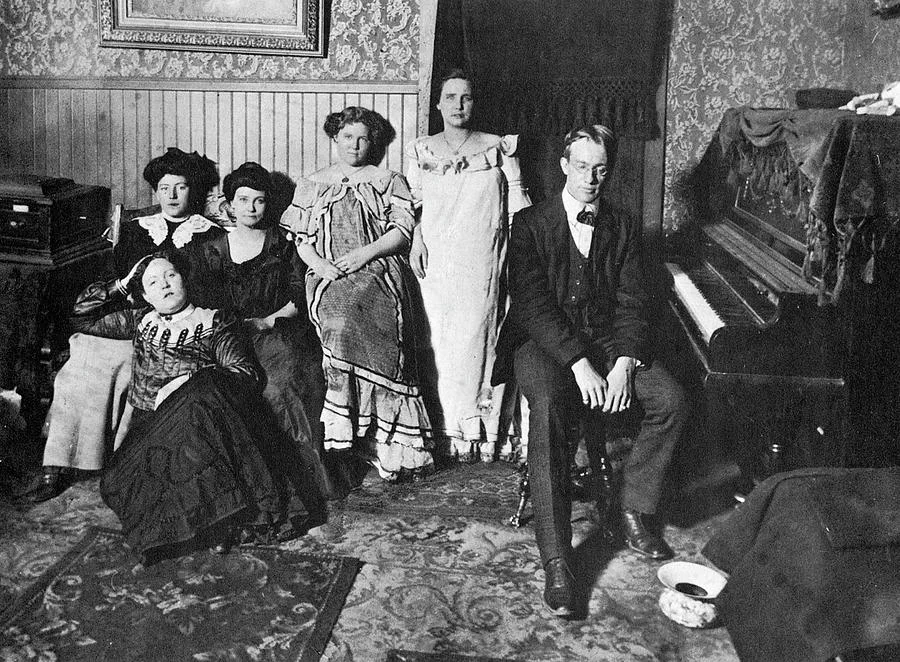
Many surviving buildings carry this history. The Rail Pub on West Congress Street, still operating today, opened as a brothel in 1890 — a saloon below, rooms above — a pattern common across the City Market district. The era’s madams became colorful local legends: figures like Mollie Stone, reputed to keep police “on retainer,” and Annie DeLacy, whose Bryan Street house was described as “sumptuously furnished…with French decor and mirrors.” Below them worked the anonymous “crib girls,” the poorest women of the trade, who entered the record only when they became victims of crime.
That such houses operated openly for decades points strongly to payoffs. Mayor John J. McDonough’s 1892 report exposed part of the machinery: the city had effectively been licensing “houses of ill-fame” to sell liquor, and many brothels functioned as unregulated all-night saloons, with alcohol “sold ad libitum…at high prices.” McDonough argued that liquor profits propped up the whole trade, and pushed through stricter rules that cut madams off from legal liquor licenses. Reform pressure grew through the 1890s — women’s clubs formed “purity committees,” preachers warned that “Savannah must be saved from Sodom” — but enforcement remained a revolving door. A dramatic 1907 raid on Yamacraw hauled in dozens of women, yet within weeks nearly all were back on the streets. Reformers learned that piecemeal raids weren’t enough; what was needed was a stronger legal tool.
The Final Crackdown and Prohibition (1910s–1930s)
That tool arrived in 1917, when Georgia passed a Red-Light Abatement law declaring “houses of lewdness, assignation, and prostitution” a public nuisance. It allowed any citizen or prosecutor to seek a court order shutting a brothel down — closing the building for a year and even selling its furnishings — without waiting for a criminal trial. Savannah’s authorities moved quickly, and through 1917–1918 a series of injunctions padlocked known brothel properties one by one. Madams who had run houses for years were forced out of business; those who tried to reopen elsewhere found the law followed them. In 1920 the Georgia Supreme Court upheld the abatement law in Williams v. State ex rel. McNulty, putting the legal weapon on solid footing. The era of the open brothel in Savannah was effectively over.
World War I sharpened the campaign. As the U.S. entered the war in 1917, military authorities pressed cities to protect soldiers from venereal disease, and the state law dovetailed perfectly with the war effort. By the war’s end, virtually all of Savannah’s known brothels had been officially closed — though prostitution itself, of course, adapted rather than vanished. National Prohibition (1920–1933) scattered it further: former brothels became clandestine “bawdy speakeasies,” and prostitutes dispersed into call-girl arrangements and furtive streetwalking. By the 1930s, public tolerance for open prostitution had evaporated; what was once viewed as a necessary evil was now something reformers believed society could defeat. Former brothel buildings were repurposed or torn down, and an Army survey in 1941 found Savannah’s prostitution “scattered and furtive” rather than organized — exactly what reformers had hoped.
World War II and the Late 20th Century (1940s–2000s)
World War II made Savannah a military town once more, and the federal government took no chances. Under the May Act of 1941, which made prostitution near military bases a federal offense, remaining vice centers were systematically broken up by joint city-military policing. With Camp (later Fort) Stewart and Hunter Field nearby, wartime stings rounded up streetwalkers to “sanitize” the city for servicemen’s liberty — a heavy-handed approach that nonetheless produced a real public-health win, with far lower venereal disease rates than in WWI.
In the postwar decades, prostitution continued only on a small, hidden scale. “Massage parlors” and “spas” appeared in the 1960s as thin fronts, and street activity shifted away from the tourist core into poorer residential areas — neighborhoods around West 33rd–35th and Jefferson were known strolls into the 2000s. The trade also divided by race and class: most visible street prostitutes were Black, while white prostitution moved into discreet call-girl rings serving affluent clients — a division law enforcement reinforced by policing the streets while largely ignoring behind-closed-doors escort services. By the 1980s and beyond, the crack epidemic entangled street prostitution with addiction, and sex trafficking — run through hotels, private homes, and internet ads — emerged as the modern form of an old problem, a world away from the brothel-district model of the past.
Remnants of a Red-Light Past in Today’s Savannah
Beneath Savannah’s genteel façade, one can still sense the echoes of revelry in the dark — and the old warning, “so much for whisky and harlots.”
Though the brothels are long closed, traces of that bawdy past still linger. The Factor’s Walk area is today a quaint assemblage of shops and restaurants, but an observant eye may catch the bricked-up doorways and narrow staircases where the trade once operated — and ghost-tour guides love to point them out. In Reynolds Square, few visitors admiring the statue of John Wesley realize that the “best brothel in town” once stood nearby; the Planters Inn is said to occupy the site, and its resident legends are a favorite of storytellers. One place that openly embraces its history is The Rail Pub, which celebrates its origin as an 1890 brothel — and whose second floor, locals insist, is thoroughly haunted.
The reform era left its own marks: the Salvation Army’s early Savannah mission began partly as “rescue work” for women leaving the trade, and the city’s legal archives — grand-jury presentments, petitions, and indictments now preserved at the Georgia Historical Society — keep the confrontations between madams and the law vividly documented. Perhaps the most concrete remnant is Yamacraw Village, the 1941 public-housing project built on the very ground that once nurtured the red-light quarter. Savannah’s journey — from a colonial port with clandestine “ill-famed houses,” to a 19th-century city of open brothels, to a reformed community that erased them — is a microcosm of America’s complicated relationship with the “oldest profession.” The district is gone, but through records, lore, and preserved architecture, its story is still very much alive.
Selected Sources
- Tim Lockley, “Survival Strategies of Poor White Women in Savannah, 1800–1860,” Journal of the Early Republic 32.3 (2012).
- William W. Sanger, The History of Prostitution (1858) — Savannah statistics reported by the mayor for 1856.
- Chatham County Grand Jury presentments, 1808 & 1864; Mayor John J. McDonough’s Annual Report, 1892 (Digital Library of Georgia).
- Georgia Laws 1917 (Nuisance Abatement Act); Williams v. State ex rel. McNulty, 150 Ga. 480 (1920).
- Emily Burke, Reminiscences of Georgia (1840s); Georgia Historic Newspapers; Ray City History Blog (Washington F. Stark diary).
Hear Savannah’s Untold History After Dark
The scoundrels, saloons, and secrets of old Savannah come alive on our adults-only Spirits & Scoundrels tour — a late-night walk through the city’s darker past.