
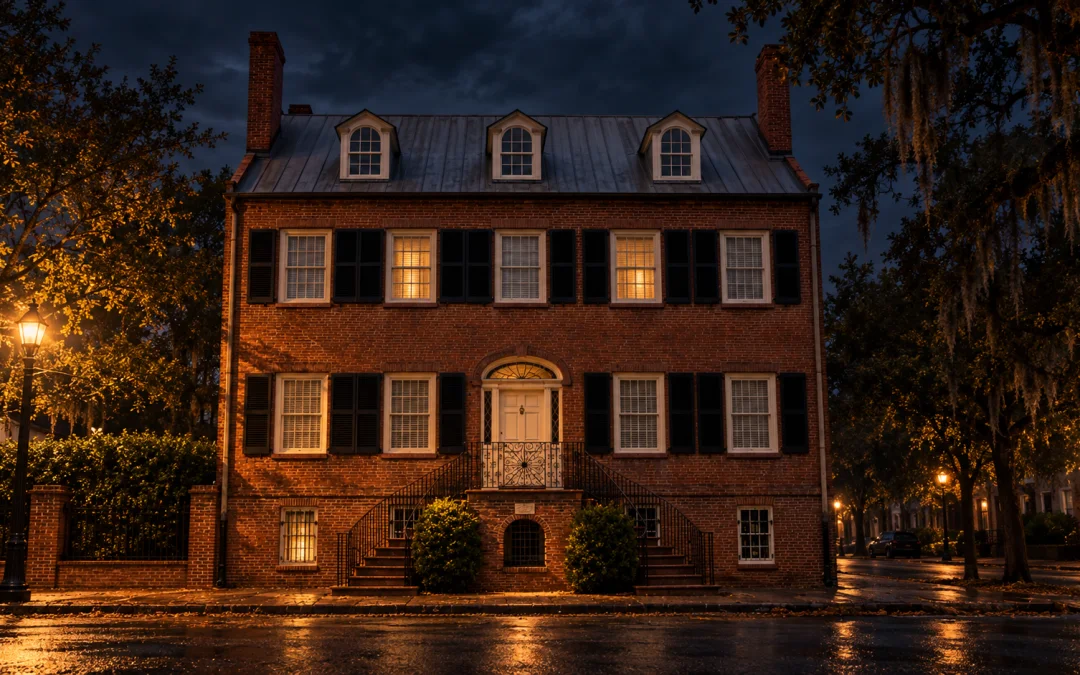
On Columbia Square stands a house that didn’t just survive Savannah’s past — it saved the city’s future. The Isaiah Davenport House is a beloved landmark, treasured by locals and preservationists alike, and the first home ever rescued by the Historic Savannah Foundation.
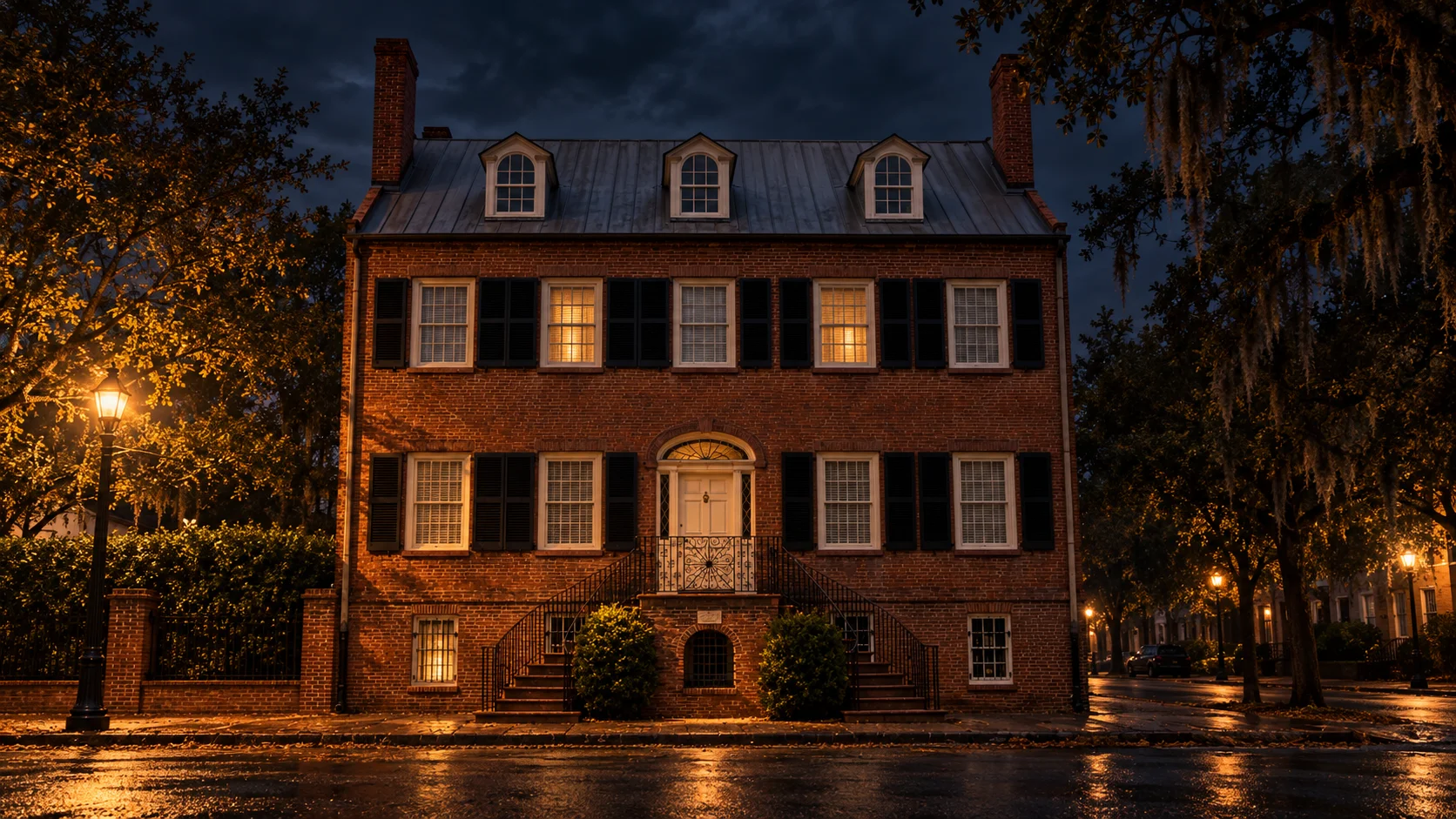
Its elegant Federal-style architecture and outsized place in Savannah’s history make it a genuine point of civic pride — and, as with so many of the city’s oldest homes, it comes with a few permanent residents who never checked out.
The Historic Legacy: A Federal-Style Landmark

Situated at 324 East State Street, on the northwest corner of Columbia Square, the Isaiah Davenport House has been a museum since 1963. Completed in 1820 (though it didn’t appear on the tax rolls until 1821), it’s an outstanding example of Federal-style architecture — all graceful proportion, delicate plasterwork, and a famous cantilevered staircase that seems to float in midair. Built of brick at a time when most Savannah homes were wood, it announced the wealth and skill of its creator: Isaiah Davenport, a New Englander who became known as Savannah’s master builder.
Davenport’s first known Savannah project was Laura’s Cottage, built shortly after he arrived in 1808. His exceptional craftsmanship and perfectionist standards quickly set him apart, and his own residence — the Davenport House — is regarded as one of the finest Federal-style homes in the South.
Isaiah Davenport’s Life and Achievements
Isaiah Davenport was born on November 3, 1784, in Little Compton, Rhode Island, and learned his trade under a carpenter in New Bedford, Massachusetts. At twenty-four, he moved to Savannah, where he met and married Sarah Rosamund Clark. The couple had ten children, though only six survived into adulthood — and it’s said the spirits of the four they lost still linger in the house. The household also included nine enslaved people, whose labor helped run the home and whose lives the museum now works to remember alongside the Davenports’ own.
Isaiah’s professional life flourished. Beyond building numerous private homes, he served as a contractor for the city — helping restore Savannah’s historic squares and constructing temporary housing after the Great Fire of 1820 — and his skills even drew federal work, including a Martello tower on Tybee Island for coastal defense. He was also deeply civic-minded, serving as a city alderman from 1817 to 1822, a firemaster, and later a constable for Columbia Ward.
Tragically, his life was cut short by yellow fever on October 16, 1827, at only forty-two. He was first buried at Colonial Park Cemetery, and his remains were later moved to Laurel Grove. His tenth child, Dudley, was born a month after his death — and would himself die young, at forty.
The House After Isaiah
Following Isaiah’s death, his widow, Sarah, turned the family home into a boarding house to support their six children — taking on the management of property, finances, and debts in a way rarely expected of women in the 1820s. She eventually sold the house in 1840 to Benjamin Baynard, and it remained in the Baynard family until 1955, by which time the once-grand mansion had declined into a rundown rooming house in a rough part of town.
Then came the moment that changed Savannah forever. In 1955, a funeral home planned to demolish the Davenport House and pave the lot for parking. Outraged, the journalist Anna Colquitt Hunter rallied six friends — seven women in all — who raised the $22,500 needed to buy the house themselves. It was the founding act of the Historic Savannah Foundation. As the Foundation likes to put it: what began as an effort to save one house became a movement that saved an entire city.
What began as an effort to save one house became a movement that saved an entire city.
The Foundation restored the home — using it as its own headquarters for years — and opened it as a museum in 1963. By the mid-1980s, the interpretation was refined to reflect the house’s 1820s appearance, work that later earned the Davenport House Museum the Preserve America Presidential Award in 2005 and the Georgia Governor’s Award in the Humanities in 2010.
The Paranormal Presence

Like many of Savannah’s old homes, the Davenport House is known for its ghostly activity. Visitors regularly report shadowy figures and disembodied voices — but the most famous apparition of all has four legs. A spectral cat is often seen darting through the rooms or perched on a windowsill, and although staff assure guests that no living cats live in the house, visitors have described the very same phantom feline for years.
Another frequently reported spirit is a young girl, seen wandering the house and gardens, gazing out of windows, or playing in the attic — only to vanish when approached. Some speculate she may be one of the Davenport children, while others believe she was a child who lived here during the boarding-house years, perhaps another victim of the yellow fever that took so many in this city.
Experiencing History
Each October, the Davenport House Museum stages a remarkable living-history program often called “Dreadful Pestilence,” reenacting the 1820 yellow fever outbreak that devastated Savannah. It’s important to note that this is not a haunted attraction but a serious, moving educational experience — a credibly documented look at how the epidemic reshaped the city, one that many find more affecting than any jump-scare.
The program also honors the work of Mary Lavinder, one of Georgia’s first female physicians, who played a crucial role in caring for the sick during the epidemic. Her dedication, and the Davenport House’s long, layered history, reflect the same thing that runs through so much of Savannah: resilience, in the face of fire, fever, and time itself.
Explore Haunted Columbia Square
The Davenport House is one of the historic homes we pass on our walk through haunted Savannah. Come hear its story — and its ghosts — after dark.
Book a Savannah Ghost Tour
Chris Allen is the founder of Destination Ghost Tours, a historian and storyteller with a lifelong fascination for the darker corners of history. He spends his time uncovering the true stories behind haunted legends, guiding guests through historic cities, and chasing down details that refuse to stay buried. When he is not working, he can usually be found with his partner Arissa, their dog Bear, and their two cats, Trouble and Covu, photographing old places, digging through archives, or disappearing into historical rabbit holes. He believes the best history is honest, atmospheric, and just unsettling enough to linger.