
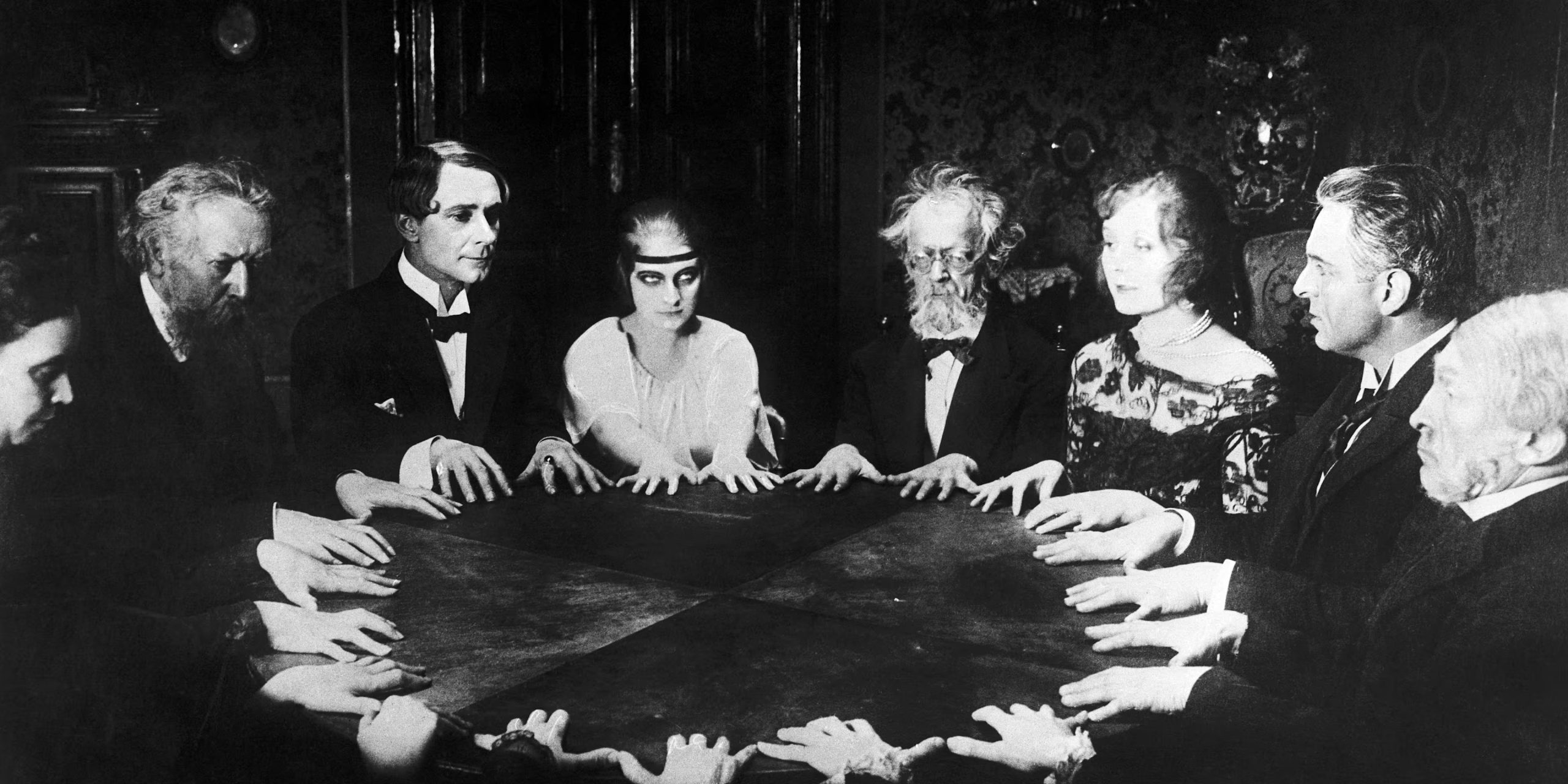
The lamps are turned low in a Savannah parlor, casting flickering shadows on silk wallpaper. Around a mahogany table sit a dozen figures in evening dress, hand-in-hand despite the swelter of a coastal Georgia night. A medium in lace closes her eyes and sways as the air grows thick. Outside, Spanish moss drips from the oaks and a carriage’s hooves echo down the cobblestones. Inside, one question hangs in the hush: will the spirits speak tonight?

Spiritualism Sweeps the Victorian Era
The scene above could have played out in any number of Victorian homes, from London to New York — and, indeed, in Savannah. During the mid-19th century, Spiritualism — the belief that the dead can communicate with the living — surged in popularity on both sides of the Atlantic. It began in 1848 with two young sisters in New York, the Fox sisters, who claimed to speak with a ghost through mysterious rapping sounds. In the decades that followed, séances (from the French for “sitting”) became a fashionable pastime, and by 1897 the movement claimed some eight million followers across the United States and Europe. Even figures like Sir Arthur Conan Doyle and magician Harry Houdini got involved — the latter chiefly to expose the many fraudulent mediums riding the craze.

Spiritualism promised something tantalizing: proof of life after death, delivered not by clergy or scripture but by loved ones supposedly speaking from beyond the veil. It emerged in a world straddling candlelight and electricity, superstition and science. Many earnest believers attended séances hoping for comfort from departed family; others treated them as sensational entertainment. And not everyone was convinced — as reports spread of charlatans using hidden trapdoors, glowing paint, and ventriloquism, skeptics scoffed and clergy condemned the practice. In October 1888 one of the original Fox sisters publicly confessed the whole thing had been a hoax, producing her “rappings” by cracking her toe joints; newspapers, Savannah’s included, trumpeted “Spiritualism’s Downfall.” Yet even scandal could not fully squelch the fascination. People wanted to believe — and nowhere was that yearning more potent than in places well acquainted with death.
Séances Come to Savannah
Savannah in the 19th century was just such a place. This genteel Southern city had seen more than its share of loss — from yellow fever epidemics to Civil War battles and the everyday perils of a port town. Its residents wore black mourning crape and tallied empty chairs at their tables as often as any of their Northern counterparts, so it’s little wonder the Spiritualist movement quietly took root here. Across the American South, though, it often took a form tempered by the region’s religious culture. Where Spiritualism became its own distinct religion in the North, many Southern believers folded spirit communication into their Christian faith — a séance might follow Sunday evening church, seen as another way to reach heaven, or at least the nearby dead.

Even prominent citizens were intrigued. Mary Todd Lincoln, the President’s wife, famously held séances in the White House during the Civil War to reach her deceased sons — news that spread nationwide. If the First Lady could seek solace from mediums, surely ladies in Savannah’s elite circles might do the same behind drawn drapes. The city’s newspapers confirm the interest: ads and articles about spirit communication appeared from the early 1850s, and the Savannah Republican advertised popular books like Judge Edmonds and Dr. Dexter’s Spiritualism (1853). One 1856 item mocked a Georgian who had spent $20,000 on Spiritualism in two years, predicting he’d spend $25,000 more before learning that “a fool and his money is soon parted.” Clearly, Savannah had its share of true believers and skeptics trading barbs in print.
By the late 1800s there were organized Spiritualist meetings and visiting mediums across Georgia, and small Spiritualist churches and camps dotted the South. In Savannah, the Church of the New Jerusalem (followers of the mystic Emanuel Swedenborg) maintained an outpost by mid-century; Swedenborgians weren’t Spiritualists exactly, but their belief in communication with the spirit world likely primed local interest. And in a very real sense, this old city offered fertile ground for ghostly pursuits — Savannah is literally built on its dead, its early cemeteries later absorbed by growth, so that workmen now and then unearthed a coffin or skull beneath a house. In such a landscape, the living naturally wondered who might be lingering unseen.
Parlors of the Paranormal: High-Society Séances

Behind the elegant facades of Savannah’s townhouses, parlors became theaters for the supernatural. Usually after midnight, when the port had quieted, well-to-do residents might draw the curtains and gather a select few friends to “call upon spirits.” Picture a circle of fashionably dressed ladies and gentlemen around a polished table in a Greek Revival mansion, gaslights turned low. The medium — sometimes a professional passing through from up North, sometimes a local hostess who had discovered a “gift” — might offer a prayer or play a somber melody to set the mood before the questions began: “Is Jack with us? Jack, can you hear me?” A rap from a dark corner, the scratch of a planchette on a writing board, or the trembling of the heavy walnut table itself would draw gasps. Table-tipping was a popular parlor amusement by the 1870s, even among those who only half-believed.
Notably, these gatherings were one social arena in which women often took the lead. The era placed strict limits on women’s public roles, but as trance mediums or séance hostesses, women could speak with authority — and for a time, Spiritualism was one of the few avenues in which a woman could address a public audience and be taken seriously. Many early suffragists and reformers got their start as acclaimed mediums, using the séance room to champion messages of hope and even women’s rights. Nor were all seekers white or wealthy: after the Civil War, African-American communities in coastal Georgia carried their own rich traditions of spirit contact. In Gullah-Geechee folklore, a person “born with a caul” was said to have the second sight to see ghosts, and root doctors held midnight rites to consult or quiet restless souls. These weren’t called “séances,” but they shared the same intent — bridging worlds — and flourished alongside the parlors of the elite. Savannah’s haunted reputation was, in that sense, a truly egalitarian creation.
Two Famous Séance Tales

A Sensational Séance on Perry Street
One famous account comes from a 19th-century townhouse at Perry and Price Streets. As related by Savannah supernatural historian Margaret Wayt DeBolt, the family believed a ghost dwelled there and enlisted friends to investigate. One stormy night the group gathered around a Ouija board in a candlelit room and asked, “If a spirit is present, give us a sign.” For a long moment the planchette refused to move — then, as the winds outside rose to a gale, a heavy branch tore loose from an oak and crashed to the ground just outside the very window where they sat. Shaken, they regrouped and asked, “Was that you? Please, give us a sign.” This time the planchette stirred and spelled a chilling reply: “I just did.” For years afterward, neighbors spoke of that old oak with a mix of fear and reverence, and DeBolt later recorded a psychic — unaware of the history — who felt an overwhelming discomfort at that same window.
A Ghost’s “Graduation”
Not every séance story in Savannah’s papers was local. An 1894 Savannah Morning News article — reprinting an incident from Allegheny, Pennsylvania, which Savannahians devoured with glee — described a violent spirit interrupting a circle. As the sitters sang a hymn in the dark, an apparition of an old woman appeared, seized two of the ladies and hurled them to the floor, then fled toward the cellar. One clairvoyant medium gave chase, following a phosphorescent glow down into the pitch-black basement, where she felt a cold breath on her neck. The group concluded the “earth-bound” spirit was a former resident who refused to move on — and, remarkably, resolved not to banish her by force but to educate her, holding further circles to teach the stubborn ghost how to leave this world. The Morning News marveled at this “new and unprecedented move in the annals of spiritualism” — graduation day for a ghost. It captures just how far Victorians would go in treating spirits as part of the family.
Socialites and Spirits: Savannah’s Haunted Houses
Given the city’s size, many well-known families likely dabbled in the trend, and several of Savannah’s most storied haunted houses trace their legends to Victorian tragedy. The Sorrel family experienced one of the city’s most notorious. In 1859, Matilda Sorrel, wife of the merchant Francis Sorrel, died after a fall from the family home — a documented tragedy whose cause has been debated ever since. Legend built a darker story around it: that Matilda had discovered her husband’s relationship with an enslaved woman named Molly, and that Molly was soon found dead in the carriage house. (The relationship, if it occurred, was one no enslaved woman could freely consent to, and the details of Molly’s death are unverified — but the tale has clung to the house for generations.) Whether or not any grieving member of the household ever attempted a quiet séance, the Sorrel-Weed House has been steeped in ghostly legend ever since, with visitors reporting a shadowy woman in 19th-century dress upstairs and a despairing presence in the lower level. Modern psychic tours there sometimes hold “call and response” sessions — essentially 21st-century séances in the very rooms where Victorian scandal turned to horror.
Another beloved haunt owes its legend to heartbreak. The 17Hundred90 Inn on President Street is famous for the ghost of Anna, a young woman whose story is told in countless variations but always set in the 1800s. In the popular version, Anna fell in love with a sailor and, when he betrayed her or sailed away, threw herself from an upper window into the brick courtyard. For over a century, guests have reported pillows moved, windows opened, and rocking chairs swaying on their own, and ghost tours still bring dowsing rods to Room 204 to coax her into conversation. Savannah’s spirits aren’t only human, either: the Federal-style Davenport House, built in 1820, has long been rumored to host a mischievous phantom cat — darting around corners, brushing against legs, leaving paw prints in the dust with no living cat on the premises. And on Columbia Square, the grand Kehoe House, built in 1892 by iron magnate William Kehoe, mixes romance with its hauntings: guests speak of the scent of roses in empty halls and a graceful lady in a satin gown, believed by some to be Annie Kehoe, still watching over her home.
The Social — and Supernatural — Significance
The séance dangled a thrilling possibility: one more chance to say goodbye, to apologize, or simply to hear a familiar voice.
Victorian séances in Savannah were more than parlor tricks; they reflected the city’s soul in a time of profound change. Those who gathered in candlelit rooms were often coping with very real grief. The Civil War had claimed countless husbands, sons, and brothers, and yellow fever epidemics — such as the terrible one in 1876 — snuffed out life with frightening randomness. Elaborate mourning customs offered no guarantee of closure, but the séance offered the possibility of immediate contact. It’s easy to empathize with a bereaved mother turning to a medium to reach the child she lost to fever, or a man who never recovered from his brother’s death at Gettysburg seeking reassurance that he rests in peace. For many, Spiritualism did not oppose Christianity so much as complement it — a kind of emotional insurance that the preacher’s promise of heavenly reunion was really true. Some local mediums framed their work in pious terms, calling their séances “prayer circles.” Others among the clergy railed against it as the devil’s work, warning that a “demon in angel’s guise” might answer a mourner’s call.
The séances also sat at the intersection of science and mysticism. The late 1800s were an age of wonders — telegraphs, X-rays, phonographs — that made the unseen visible and the distant near. If electricity could invisibly light a room at the flip of a switch (Savannah’s Hamilton-Turner House was reputedly among the first in the city to have electric lights in the 1880s), then why couldn’t some unknown energy carry messages from the dead? Some circles kept almost scientific logs of knocks and table motions; others hired traveling stage mediums to perform materializations for a paying audience. In April 1876, an itinerant medium from New Orleans rented a Savannah hall to demonstrate spirit-trumpet calls — drawing enthusiasts and reporters looking to debunk him alike. These events blurred the lines between sincere faith, entertainment, and outright fraud, making Victorian Savannah a microcosm of the wider movement.
Lingering Lore — and a City in Two Worlds

The aftermath of Savannah’s 19th-century séances is written not in history books so much as in the city’s enduring ghost lore. Nearly every haunted-house tale told today has roots reaching back to those decades when Spiritualism was in vogue. Savannah’s modern ghost community — from paranormal teams to psychics reading in quaint shopfronts — traces a lineage straight back to the Victorian spiritualists. In 1911, just after the era closed, a flamboyant medium named Madame Grace Gray DeLong announced her “First Public Appearance in Savannah” with a séance she claimed was “identical to one she gave at The White House,” advertising in the Savannah Tribune and setting up shop on Broughton Street. Her success shows how thoroughly the groundwork laid in Victorian times endured, and oral histories hint that some Savannah homes kept a “spirit room” well into the 1900s, hung with departed relatives’ portraits, where the family would occasionally try to reach them in the quiet hours.
Today, stroll the Historic District on a foggy evening and you might find a costumed guide recounting these very stories — the tragic Sorrel legend, the heartbroken Anna, the omen of the Perry Street oak — sometimes with a mini-séance or dowsing-rod demonstration for the group. During the Halloween season, some historic homes even hold Victorian séance reenactments in the same rooms where real Savannahians once tried to reach the dead. Savannah’s Victorian séances remind us that the 19th century was not all starched manners and magnolia blossoms — it was also a time of deep spiritual questioning, of ordinary people reaching out for extraordinary answers. The socialites, widows, merchants, and formerly enslaved men and women who sought out spirits were all, in their own way, trying to make sense of life and death in this beautiful, haunted city. The parlors may be empty now, but listen closely, and Savannah’s conversation with its past feels very much alive — carried on the humid breeze, thin as ever between the worlds, just as it was when a circle of friends gathered in the dark and dared to ask the silence, “Is anyone there?”
Ask the Silence for Yourself
Hear the true stories of Savannah’s spirits — and the Victorians who first invited them in — on our adults-only Spirits & Scoundrels tour through the haunted Historic District.