
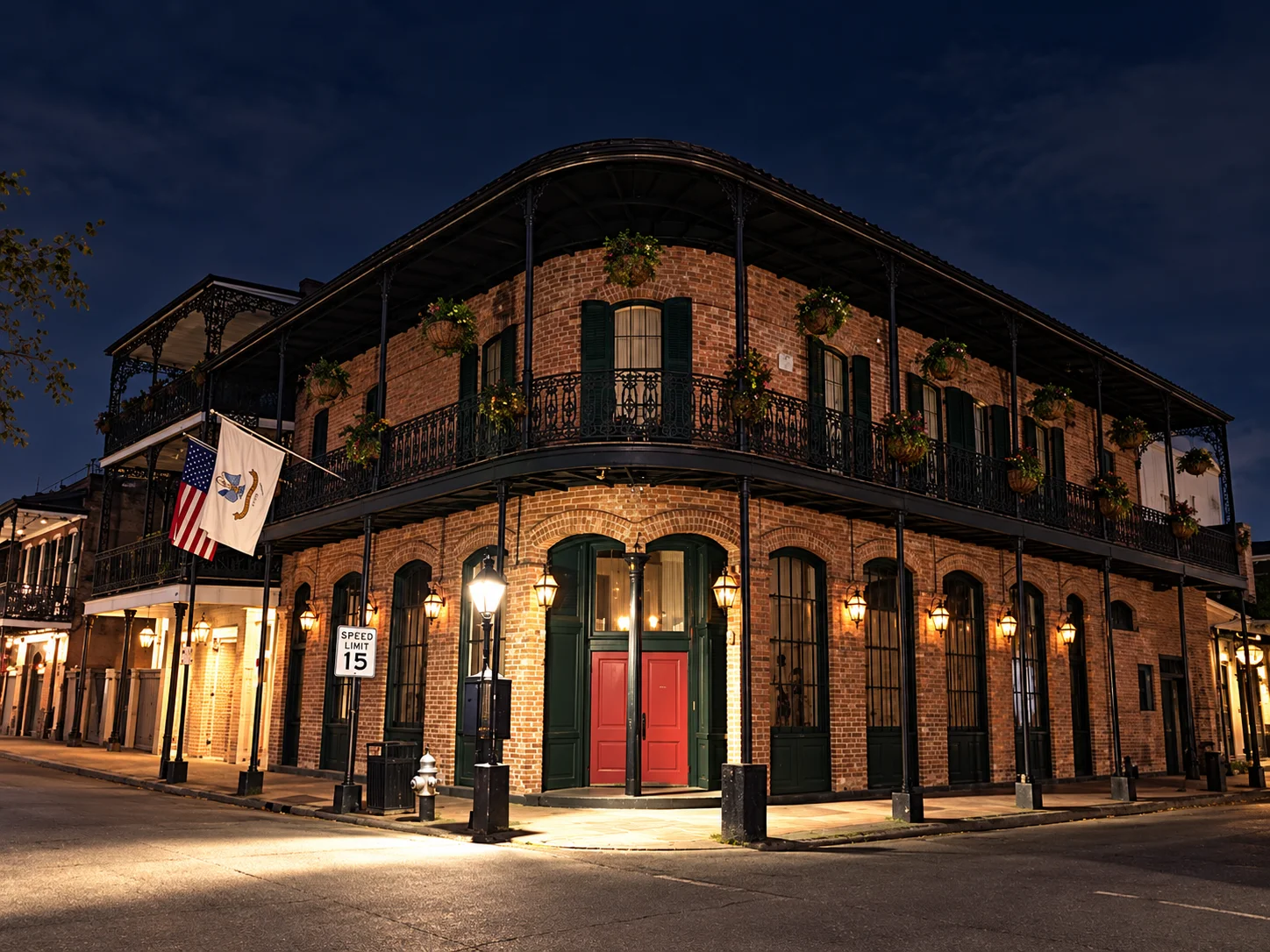

1039–1041 Royal Street, French Quarter, New Orleans
Jacques Saint-Germain
A haunted history of 1039 Royal Street and New Orleans’s most enduring vampire legend: the elegant stranger who never ate at his own table.

At the corner of Royal and Ursulines streets stands a two-story brick building with galleries wrapping around its exterior.
Its history can be traced through property records and a nineteenth-century newspaper account. The man supposedly hiding behind its doors is harder to find.
His name was Jacques Saint-Germain, according to the legend. He came to New Orleans with money and an impressive knowledge of the past. He entertained guests, offered them elaborate meals, and declined to eat alongside them. Later, a woman was said to have escaped his home with a wound to her neck.
The story has become a familiar part of New Orleans vampire folklore. It should be understood as a legend, however, rather than a verified criminal case. The alleged attack and the discovery that followed have not been established by the historical sources reviewed for this article.
The House on Royal Street
The building commonly associated with Saint-Germain is numbered 1039–1041 Royal Street. The Historic New Orleans Collection’s Vieux Carré Survey preserves an 1884 newspaper description of a two-story brick building erected at Royal and Ursulines for James Scallen. The report attributes its design to E. Surgi and its construction to W. Garcia.
Its commercial origins help explain the two addresses. The building combined business space below with living accommodations above, rather than beginning as the secluded mansion sometimes suggested by the vampire story.
The survey’s published chain of title does not identify Jacques Saint-Germain as an owner. That does not rule out a tenant, but it also supplies no evidence that the legendary host lived there. The building’s existence is documented; its association with him is a separate claim.
The galleries give the legend a visible setting. Someone hearing about the woman’s escape can look up toward the upper floor and picture the distance to the street. That is part of the story’s power, even though the building cannot confirm the incident attributed to it.
The Count Who Came Before Jacques
Long before the New Orleans tale, there was a European figure known as the Count of Saint-Germain. Unlike the Royal Street vampire, this man appears in contemporary correspondence.
In a letter dated December 9, 1745, Horace Walpole described a mysterious man in London who called himself Count Saint-Germain. Walpole said he would not reveal his origins and acknowledged using a name other than his own. He also described the count’s musical abilities, including his violin playing and composition.
The letter records curiosity, conflicting rumors, and an arrest followed by release. It provides evidence of a real man whose uncertain background fascinated the people around him.
Later biographical accounts describe the count moving among European courts, with interests in chemistry and claims concerning alchemy and prolonged life. His death is generally dated to 1784, although stories of subsequent appearances helped sustain his reputation for immortality.

Claims that he could defeat aging belong to the mythology surrounding him. They are not evidence that he lived for centuries. Nor does the existence of the historical count establish that a vampire bearing a similar name arrived in Louisiana more than a hundred years later.
The New Orleans legend draws much of its character from that earlier reputation: an elegant stranger whose knowledge seems difficult to explain, and whose personal history remains out of reach.
The Stranger Who Never Ate
In commonly repeated versions, Jacques Saint-Germain arrived in New Orleans in the early 1900s. Some give 1902; others place his arrival in 1904. Those differing dates are one indication that the story lacks a settled contemporary record.
He is described as a wealthy Frenchman who made an impression through his hospitality. Guests enjoyed the food he provided while their host drank what appeared to be red wine. His refusal to eat became one of the peculiarities attached to him.
The other was his conversation. Saint-Germain supposedly described distant places and events from long before his lifetime with the familiarity of someone who had witnessed them. He claimed a family connection to the European count, and the resemblance between the two men became part of the tale.
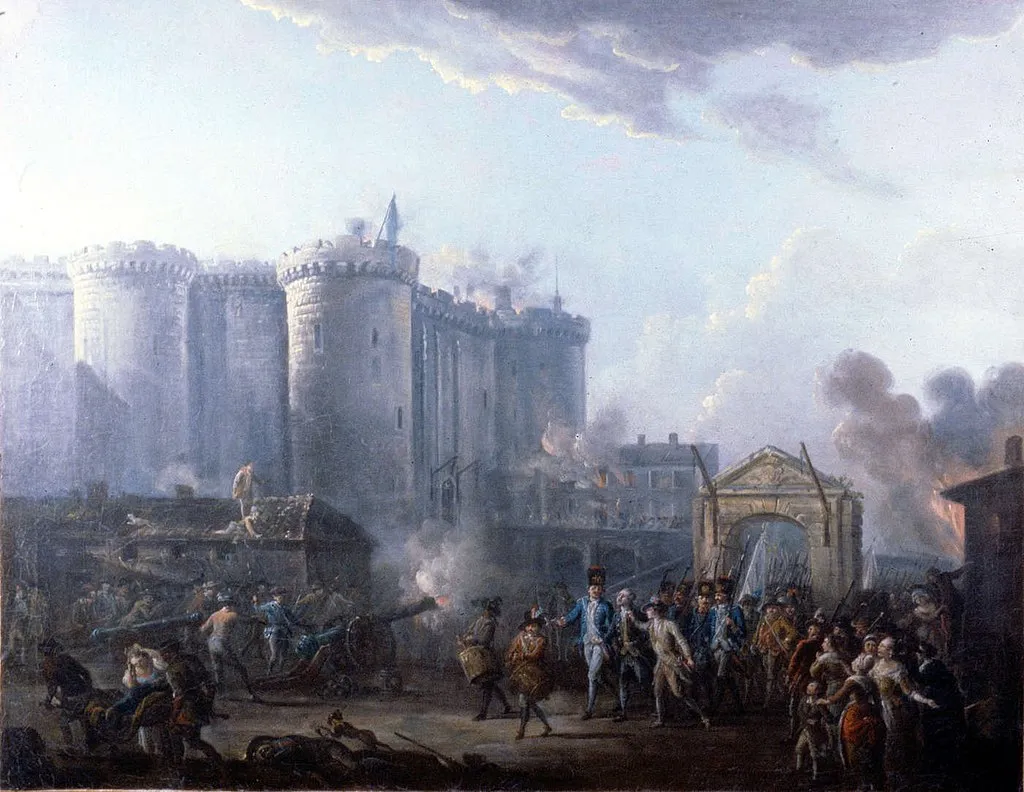
Within the legend, admiration gradually gives way to suspicion. His guests have accepted the house, the meals, and the charming conversation. Only afterward do the details begin to suggest that their host’s life may be very different from their own.
Only afterward do the details begin to suggest that their host’s life may be very different from their own.
The Woman Who Escaped
The central incident concerns a woman who was said to have jumped from an upper balcony or window to escape Saint-Germain. Retellings differ about the year and the circumstances surrounding her visit.
In one published version, he attacked her and bit her neck. A knock at the door distracted him, allowing her to break away and reach the street. Injured, she told the authorities what had happened.
Some accounts describe the woman as a sex worker or dismiss her as intoxicated. Those characterizations are elements of particular retellings, not established facts about an identifiable victim. No verified name or contemporary statement was located in the sources reviewed here.
The tale then turns on the response to her accusation. In versions where police speak with Saint-Germain that night, his social standing works in his favor. He is allowed to provide a formal statement the following morning.
He never arrives.
What the Bottles Contained
When the authorities return in the familiar telling, Saint-Germain has disappeared. The search produces the detail that completes his transformation into a vampire: bottles containing blood, or a mixture of blood and wine.
Some versions add bloodstained linens or a lack of food and utensils. The details vary, but the bottles supply the explanation for the host’s unusual drinking habits.
This is the legend’s decisive discovery. It is also a claim that requires evidence before it can be presented as history. The published retellings reviewed for this article do not supply a contemporary police report or laboratory record confirming what was found.
A story describing a police search does not become an official case record simply because it names the police.
Where the Historical Trail Ends
Writer A. P. Sylvia examined the legend for Locations of Lore in 2022 and reported being unable to find a contemporary account of the incident. That research located people with similar names in other records, but none could be securely identified as the wealthy Royal Street host.
Sylvia also acknowledged that the search was not exhaustive. That is a useful limit to preserve. Missing evidence does not settle every question, but it does prevent a confident claim that this attack and investigation occurred as described.
Later retellings continue the story beyond Saint-Germain’s disappearance, claiming that he still walks the French Quarter. Such claims are part of the vampire tradition. They do not provide a verified continuation of the historical count’s life or establish the identity of a modern stranger.
The distinction leaves the legend intact while keeping its boundaries visible. Jacques Saint-Germain can be discussed as a figure in New Orleans folklore without inventing a police file, naming an unsupported victim, or turning uncertain dates into a precise chronology.
The Guest at the Table
The Saint-Germain legend is disturbing because its danger begins in an inviting place. The host appears generous. His guests have every reason to enjoy themselves, and the detail that troubles them at first is merely that he does not eat.
By the end, the wine has acquired another meaning.
The Royal Street building remains a real part of New Orleans history. The stranger associated with it survives principally through the telling of his story. Whether that tale began with an actual incident remains unresolved.
For the listener, its most lingering image is still the dinner party: everyone enjoying what the host has provided, while no one knows what is in his glass.
Research sources
- Historic New Orleans Collection, Vieux Carré Survey, 1039–1041 Royal Street
- Horace Walpole, letter to Horace Mann, December 9, 1745
- The Reader’s Biographical Encyclopaedia, Count of Saint-Germain
- Locations of Lore, Jacques St. Germain, Vampire of the French Quarter
- Terrebonne Parish Library System, Vampires in the Deep South
- M.S. Rau, The Haunted Neighbors of M.S. Rau
The folklore sources are used to identify published versions of the legend, not to verify the alleged attack, blood discoveries, or supernatural claims. No invented dialogue, reconstructed eyewitness scenes, or unsupported victim identities have been added.