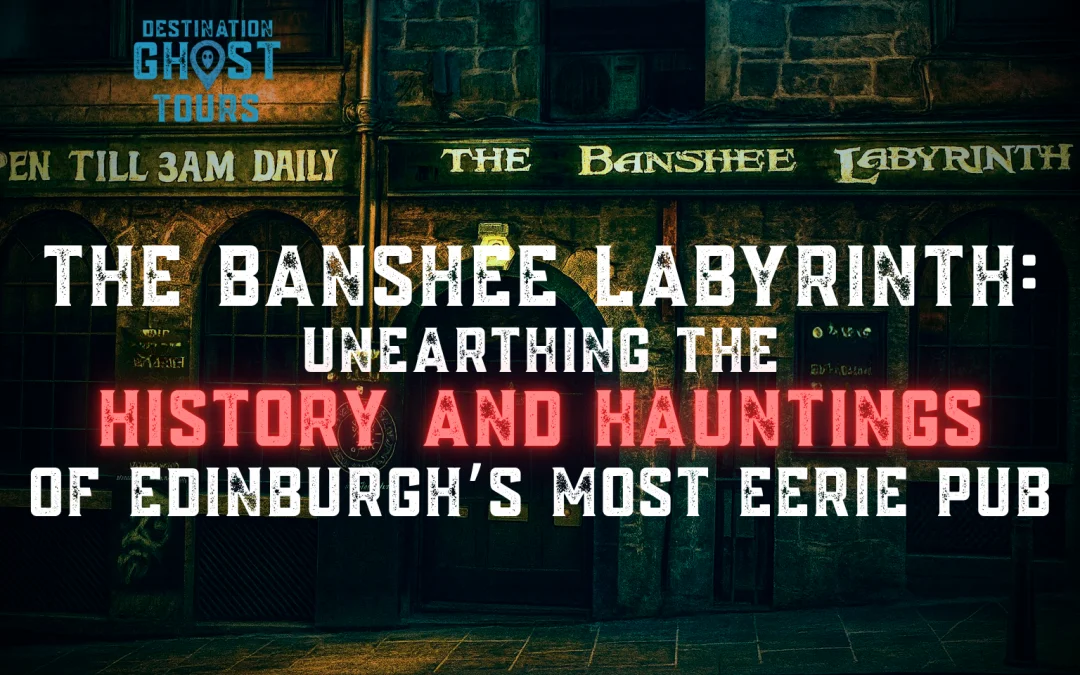
Down a dim close off Edinburgh’s ancient Royal Mile, a heavy wooden door creaks open into darkness. The air is cold and carries the smell of damp stone. Flickering candlelight casts jagged shadows on vaulted walls. You’ve entered The Banshee Labyrinth, a pub that many swear is Scotland’s most haunted bar.
Beneath the cobbled streets of the Old Town, history and legend intertwine. Patrons come for the pints and live rock music, but stay for the chills as much as the thrills — because something unseen lurks in these underground chambers. To understand why this pub is a centerpiece of Edinburgh’s ghost lore, one must descend into its history: a tale spanning centuries of darkness, tragedy, and inexplicable encounters.

Beneath the South Bridge: A City’s Hidden Underworld

Edinburgh has always been a city of dualities — light and dark, high society and underworld, the living and the dead. In no place is this more literal than beneath the South Bridge, not far from where The Banshee Labyrinth now lies. In the late 18th century, Edinburgh’s Old Town was cramped, so city planners built the South Bridge to span a valley and connect the Royal Mile to the University district. Completed in 1788, the bridge wasn’t just a road; within its nineteen stone arches, builders created a honeycomb of hidden vaults and chambers, intended as workshops and storerooms for the merchants of the bustling city above. At first it seemed a brilliant idea — an underground commercial street tucked below the cobbles.
Yet from the very start, the South Bridge carried a bad omen. As the story goes, the city arranged a grand ceremony to open the bridge, selecting a respected judge’s elderly wife, one of the district’s oldest residents, to be the first to cross. But fate intervened: the woman died just days before the opening. Bound by their promises, officials sent her coffin across the bridge as the inaugural “passenger.” To Edinburgh’s superstitious residents, this was a dire sign — the first to cross the new bridge was a corpse — and the South Bridge was cursed from that day forward. Many townsfolk refused to cross it for years.
Curse or not, the vaults soon proved disastrously flawed. Rushed to completion and never properly waterproofed, they let the city’s frequent rain seep down through the stone, leaving the chambers perpetually damp and cold. Before long, legitimate merchants abandoned them, and the grand commercial dream deteriorated into something far more sinister.
By the early 19th century, the empty vaults had become a refuge for those the city wanted to forget. The destitute moved in, lighting fires against the perpetual dark, and the chambers transformed into a warren of slums. In pitch-black alcoves, illicit enterprises flourished: unlicensed taverns pouring cheap whisky, brothels behind rough wooden doors, opium dens offering oblivion. Crime became common — muggings, fights, and worse — and it’s said that if someone vanished in those days, the vaults were a likely end. Some whispered that body snatchers, like the infamous Burke and Hare, prowled these catacombs for fresh corpses to sell to the medical schools. In the absolute darkness below Edinburgh’s streets, unspeakable things could happen unseen.
Amid this misery, the vaults earned a reputation for being truly cursed — locals reported phantom footsteps and faint voices where no one lived. And then came the disaster that sealed their dreadful legend. In November 1824, the Great Fire of Edinburgh swept through the Old Town, collapsing part of the street near the Tron Kirk. As flames consumed the buildings overhead, the vaults beneath became like a stone oven. Official accounts record at least ten deaths in the fire, but rumor has long insisted that a far greater number died below ground, trapped and suffocated in those lightless chambers, their screams muffled beneath the streets.
By the mid-19th century, the authorities had had enough; many of the chambers were filled with rubble and sealed off, as if to bury a nightmare. For over a century the vaults lay forgotten, surviving only in ghost stories — until they were excavated and rediscovered in the 1980s. When sections were opened for tours in the 1990s, visitors immediately reported unsettling sensations: sudden drops in temperature, an inexplicable sense of dread, figures flitting at the edge of vision, the faint sound of children crying in empty corners. Even skeptics admitted the vaults had a deeply eerie atmosphere.
Today, The Banshee Labyrinth occupies a portion of this very underworld. Its maze-like layout of snug rooms, narrow corridors, and steep stairs isn’t whimsical design — it’s dictated by the contours of those 18th-century vaults. Step inside and you truly feel you’ve left the modern city and entered lost, older chambers where, even on a crowded night, you might suddenly feel utterly alone and watched.
Lord Nicol Edwards and the Witch’s Dungeon

Long before The Banshee Labyrinth became a pub — and long before the vaults even existed — this patch of Edinburgh had its own dark legacy. In the early 17th century, according to local legend, a mansion stood on or near this site, home to a powerful man with a grim reputation: Lord Nicol Edwards, said to have been a Lord Provost of Edinburgh during the reign of King James VI.
King James VI (who also became James I of England) was famously obsessed with witchcraft; under his rule, Scotland launched fervent witch trials, and Edinburgh was no exception. As the legend goes, Lord Nicol Edwards eagerly supported the king’s witch hunts — a cruel man, notoriously so to his own wife, and crueler still to the women he accused of sorcery. Local lore claims he built a personal dungeon beneath his house on Niddry Street, perhaps just yards from where pint glasses now clink, and there imprisoned and tortured women suspected of witchcraft. Picture a damp stone cellar lit by flickering torches, iron shackles on the wall — and remember that in 17th-century Scotland, women were accused on the flimsiest of grounds: a spiteful neighbor’s word, a misunderstood illness, simply being in the wrong place at the wrong time.
No plaque marks where this private dungeon stood, and historians debate whether it existed at all — but the stories persist strongly in Edinburgh’s folklore, and Edwards’ house is said to have stood directly in front of the vaults that later formed the Banshee Labyrinth’s back rooms. When a previous pub occupied this site — fittingly named “Nicol Edwards” after the man himself — staff spoke of uneasy feelings and ghostly happenings even then. Some present-day visitors describe a cold, oppressive atmosphere in certain corners, or claim to glimpse a stern figure in period clothing. Whether that’s the shade of the witch hunter or simply the weight of history playing tricks, the legend of Lord Edwards is an inescapable part of the pub’s character — and the backdrop to the tale that gave the bar its very name.
A Bloodcurdling Omen: The Banshee’s Scream

The year is around 2007, and the long-neglected pub space on Niddry Street is being renovated under new owners. Construction crews are clearing out the lower vault rooms to prepare for the reopening. For days the work goes as planned — until one afternoon, deep in the old vaults, two workmen are confronted with something no training could prepare them for.
In the cool, stale air underground, a sudden scream tears through the silence — not of surprise or pain, but something unearthly: a prolonged, high-pitched wail that freezes the blood. It seems to come from everywhere and nowhere, echoing off the curved stone. The men search the isolated chamber, which has only one way in or out, calling to see if someone is hurt. No living soul answers.
According to the story that has since entered local legend, one workman followed the sound to a dark corner and found a figure crouched there: a woman in a tattered grey dress, her face buried in thin, pale arms as she sobbed. When he gently asked if she was alright, she lifted her face — and issued a horrible, earsplitting scream directly at him before vanishing, leaving nothing but its echo and his own gasping breath. Shaken, the two workers fled up the stairs into daylight. As they gathered themselves on the street, one man’s phone rang with awful news: a family member had died unexpectedly, only moments earlier.
Only later did the pattern become clear. A wailing female spirit, followed by a message of death — this matched the ancient legend of the banshee. In Gaelic folklore, a banshee (from the Irish bean sí, “fairy woman”) is a spirit whose mournful cry foretells a death in a particular family. The owners had planned to call the pub simply “The Labyrinth,” after its maze of vault rooms — but after this incident, the name practically chose itself. Thus The Banshee Labyrinth was born, christened by the scream of what many believe was a true banshee lurking in its depths. Was she one of Lord Edwards’ long-ago victims, or a ghost roused by the renovation itself? Skeptics may call it coincidence — but the banshee became only the first of the pub’s many spirits.
Ghosts of the Banshee Labyrinth
Since opening, the pub has gained a reputation as a refuge for restless spirits. Staff and patrons have accumulated countless stories of strange sightings and inexplicable events — the vaults that once harbored criminals and tragedy now seem to host a whole roster of otherworldly “regulars.” Some are playful, others downright sinister. Here are the best-known.
Little Molly, the Lost Child

One of the most frequently mentioned ghosts is a little girl known as Molly. In a venue that admits only adults, the laughter of a child or the glimpse of a small figure is especially startling — yet many claim to have seen her: about six years old, with long hair and an old-fashioned dress, skipping down a corridor or peeking around a corner before vanishing.
Legend says a girl by that name went missing in this neighborhood in the mid-1800s, when the surrounding vaults were crowded slums. One popular story holds that Molly became trapped in a narrow chimney passage — perhaps during a game, perhaps as one of the tiny children once used as chimney sweeps. It’s said that during later renovations, workers found a small old shoe tucked inside a bricked-up chimney, with the name “Molly” on it. There were no remains left to find, but the shoe was enough to spark the tale.
Unlike some of the pub’s other spirits, Molly seems benign — staff affectionately call her a “happy little ghost” — though her antics can raise the hairs on your neck. Bartenders have found small handprints smudged low on freshly cleaned mirrors and windows, in spots no living child could reach. Others have heard a faint giggle echo in an empty room, or a tiny voice murmur “Hello?” over the staff radios. One patron even claimed a playful presence followed him home, with flickering lights and small footsteps in his hall — until he returned and said aloud, “I think I have something of yours. Please stay here,” after which his home fell quiet. Guests who encounter Molly often leave more sad than scared, feeling a pang of sympathy for a lonely little spirit drawn to the warmth and bustle of the pub.
Old Jock’s Pranks

Not all the spirits here are as gentle as Molly. If you visit the ladies’ restroom on the lower level, you might meet the antics of a ghost the staff call “Old Jock.” His presence reveals itself with a bang — women alone in the bathroom report a stall door suddenly slamming shut as if kicked, or rattling on its hinges with no draft to explain it. The motion-activated hand dryers have a habit of roaring to life on their own, blasting an empty room. More than one wide-eyed patron has emerged insisting they heard footsteps or laughter with no one else inside.
No one knows for certain who Jock was. “Jock” is a traditional Scottish nickname for an everyman, and the staff likely gave him the jovial name to make light of the unnerving happenings. He might have been one of the poor souls who frequented the vaults in the 19th century — an old vagrant or a regular who, even in death, wasn’t ready to leave the pub life behind. His tricks are scary in the moment but never truly harmful, more like a feisty old man having a laugh. One cleaner, tidying up alone one morning, heard a disembodied cough and a raspy voice humming, then loud thumps from a closed stall; when she yanked it open, it was empty. “Alright, that’s enough, Jock,” she announced — and the noises stopped, as if he’d been told off and decided he’d had his fun.
Mr. Boots, the Watcher in the Dark

Some spirits here are far less playful. Among the dim alcoves and winding corridors lurks a male presence known to send genuine fear into those who encounter him: Mr. Boots, sometimes called The Watcher. His nickname comes from the sound of heavy booted footsteps echoing on the stone, or a fleeting glimpse of an old-fashioned boot rounding a corner. Late-night staff locking up have heard the slow, deliberate thud of boots following behind them in an empty hallway — when they stop and turn, there’s only silence and darkness; when they resume walking, the phantom steps pick up again, keeping an unnerving pace a few yards back.
Sometimes he shows himself, at least in part: a tall shadowy figure in a doorway or at the foot of the stairs that dissolves when looked at directly. A few witnesses describe more detail — a man in outdated attire, a long coat, a tricorn-style hat, and stout boots clacking on the stone. That same figure has reportedly been seen in other pubs along the underground network, as though Mr. Boots stalks the whole warren of vaults rather than one building. Unlike Molly’s innocence or Jock’s cheek, Mr. Boots exudes malice; encounters bring a sudden feeling of being glared at, a prickling on the neck, a sense of being prey. Some believe he was one of the violent criminals who once haunted the vaults in life.
One musician, packing up alone after a gig, felt an overwhelming sense of someone right behind him, heard a boot scrape on grit, and then felt a distinct shove against his back — hard enough to make him stumble. He whirled around to nothing, grabbed what he could, and fled into the street. Visitors on ghost tours have similarly reported being pinched, pushed, or having small stones tossed from the darkness in the vault areas. Even the staff are cautious: some won’t go alone into certain back rooms after closing, and when cleaning near a particular archway by the pool table — where an extra set of footsteps is sometimes heard — they’ve been known to talk aloud, appeasing an unseen listener.
The Wailing Woman of the Vaults
Her presence was first heralded by that infamous scream during the renovations — but many believe the banshee did not simply vanish after delivering her omen. Encounters with a wailing or weeping female spirit have continued, weaving a sorrowful thread through the pub’s lore. She is often described as a Lady in Grey, perhaps the same grey-clad figure the workman saw: a slender woman with long, disheveled hair in a flowing grey gown, glimpsed from behind and gone by the time you follow. Occasionally someone catches her face — pale, with milky, lifeless eyes and a mouth open in a silent scream.
Unlike Mr. Boots, who radiates anger, the Grey Lady radiates despair. Her appearances are often accompanied by an overwhelming wave of sadness that can bring a person to tears for no reason, and staff note cold spots near one sealed-off alcove where the air feels unbearably heavy, as if someone is sobbing right beside you. Who might she be? One theory ties her to the witch trials — a victim of Lord Nicol Edwards’ dungeon, unable to rest. Another connects her to the Great Fire of 1824, or to the slum years, a grieving mother whose cries still echo. Whoever she is, encountering her is a haunting, poignant experience: a group once reported a faint lullaby drifting from an empty chamber, as though a mother’s ghost were singing to a child. In a place so full of live music and merriment, her quiet sorrow stands out — a reminder that beneath the laughter, these walls remember pain.
Haunting Legacy
Walk out of The Banshee Labyrinth and back into the night air of Niddry Street, and you can’t help but feel you’ve emerged from another world. What makes the place so compelling is its dual identity. On one hand, it’s a lively rock bar — a late-night refuge for alternative culture, with a mini-cinema and karaoke into the wee hours. On the other, it’s essentially a living museum of darkness, where every stone arch has a story: of 18th-century bridge builders and 19th-century criminals, of witch hunters and the persecuted, of fire and forgotten children. Unlike a museum, though, these stories aren’t tucked behind glass — they linger in the air, sometimes announcing themselves with a whisper or a slam, a flicker or a scream.
Some spirits here come by the glass. Some are the unseen kind that might just follow you home.
The owners lean proudly into the reputation — it’s not every pub that can claim its own banshee, plus a retinue of other ghosts — and paranormal investigators have flocked here to test their nerve and their equipment. Yet the place remains warm and welcoming to anyone who loves a good scare with their beer. Perhaps you’ll leave a skeptic, having experienced nothing all night. Or perhaps, just as you finish your drink, you’ll feel a soft breath on your neck though no one is behind you, or hear the faint strains of a child humming near the empty staircase. The beauty of a place like this is that it leaves you wondering. So the next time you find yourself in Scotland’s capital, dare to descend those steps off Niddry Street, order a whisky, and settle into a corner of the vaults. You are not just in a pub — you are in a story. And if a mournful cry suddenly echoes through the corridors, you’ll understand exactly why it’s called The Banshee Labyrinth.
A Self-Guided Ghost Tour of Haunted Scotland
Destination Ghost Tours is bringing its storytelling across the Atlantic — and The Banshee Labyrinth will be one of the stops on our upcoming self-guided tour of haunted Edinburgh. Watch this space.
Explore Destination Ghost Tours