
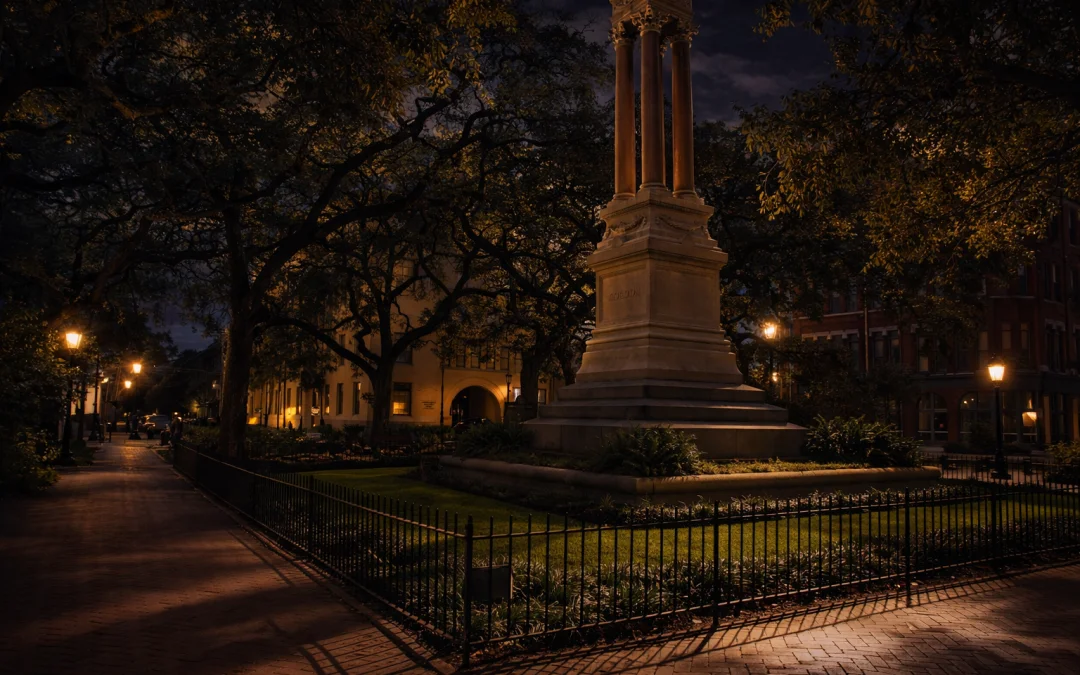
The story of Alice Riley has long since crossed from history into legend — which is a shame, because the truth is every bit as compelling as the myth. She was the first woman ever hanged in Georgia, and if the stories are true, she has never stopped searching Wright Square for what was taken from her.
The surviving records about Alice Riley are scarce, but what they reveal is a tale of desperation, injustice, and tragedy that needs no embellishment. Let’s separate the woman from the ghost.

Unveiling Alice Riley
Imagine the allure of a new beginning — a fresh start in a New World, teeming with opportunity and the promise of a better life. That dream has drawn countless souls across the ocean over the centuries, and Alice Riley was one of them. But her path to America came with no guarantee of freedom or fortune.
In the autumn of 1733, Alice Riley and Richard White, along with roughly 38 other Irish servants, set sail for the new colony of Georgia after a perilous voyage from Ireland. They arrived on the brink of starvation, kept alive as much by stubborn hope as by anything else — and their hardships were only beginning. As indentured servants, they did not choose where they would go or whom they would serve. That decision would prove fatal.
A Grim Discovery
The quiet of the young colony was shattered on March 1, 1734, when William Wise, a disreputable cattle farmer, was found dead in his home on Hutchinson Island. His head had been forced into a bucket of water, and a neckerchief was knotted tightly around his throat. It was the first murder ever recorded in the colony of Georgia — and suspicion fell immediately on the two servants who lived and worked under his roof.
A Disreputable Master
William Wise’s bad reputation had followed him across the Atlantic. It was said that he had brought a woman with him whom he passed off as his daughter — in truth, a prostitute. His unsavory character was enough to get him struck from the Georgia Trustees’ charity list, yet he still managed to make his way to Savannah. Rather than send him back to England, the colony’s founder, James Oglethorpe, chose to exile him to a remote cattle farm on Hutchinson Island. It was there, isolated with only his indentured servants for company, that Wise’s downfall began.
Desperate Servants
Assigned to Wise as indentured servants, Alice Riley and Richard White quickly grew to dread their master. Surviving accounts describe his cruelty, his lewd remarks, and his unwanted advances — and some suggest Alice suffered far worse abuse at his hands. Documented letters to General Oglethorpe from the town recorder, Thomas Christie, narrate the grim circumstances that led up to Wise’s death, implicating the two servants in what looks, across the centuries, like a desperate bid to escape an unbearable situation.
After the killing, Alice and Richard fled Savannah, but they were soon captured hiding out on a nearby island and hauled back to face justice. Their trial was held on May 11, 1734. The correspondence collected in General Oglethorpe’s Georgia, 1733–1737 preserves much of what we know: Christie’s letters describe the crime scene in detail, while a firsthand account by Edward Jenkins recounts Richard White’s capture and Alice Riley’s execution — an execution she went to still insisting she was innocent.
The First Woman Hanged in Georgia
Both Alice and Richard were sentenced to hang for the murder of William Wise. Richard White went to the gallows in the public square first (after reportedly escaping and being recaptured). But when the time came for Alice, the authorities discovered she was pregnant. Even in the harsh justice of the 1730s, the colony would not hang an expectant mother — not out of mercy for Alice, but for the sake of the unborn child. Her execution was stayed until after she gave birth.
Alice Riley was hanged on January 19, 1735, in the square we now call Wright Square, becoming the first woman ever executed in the colony of Georgia. She protested her innocence to the very end, and by some accounts cursed the town that condemned her. Her body was left hanging for three days as a grim warning. Her infant son, James, survived her by only a matter of weeks before he too died — leaving no one at all to remember her name kindly. (Accounts even differ on the child’s father, some naming Richard White, others darkly suggesting Wise himself.)
She went to the gallows insisting she was innocent — and left behind a child who would not outlive her by long.
The Ghost of Wright Square
It is that final, heartbreaking loss — a mother and her child, gone within weeks of each other — that gives Alice Riley’s ghost its enduring power. For nearly three centuries, visitors to Wright Square have reported encountering a young woman in 18th-century dress who approaches them in distress, begging for help finding her lost baby. When they turn to look, or move to help her, she vanishes. So convincing is the apparition that tourists still occasionally call the Savannah police to report a frantic woman searching for her child — a call the veteran officers have long since learned to recognize.
And then there is the Spanish moss. A coastal Georgia legend holds that the moss will not grow where innocent blood has been spilled. Sure enough, locals and guides will point out that the live oaks of Wright Square are strangely bare of it, particularly around the spot where the gallows once stood — as if the land itself remembers, and refuses to forget, that an innocent woman may have died here.
Alice Riley’s Legacy
Centuries later, Alice Riley remains one of the most captivating figures in Savannah’s storied past — her name forever tied to Wright Square, and her ghost among the most frequently reported in the entire country. Was she a murderer, a victim of a cruel master and a crueler system, or both? The scant records leave room for endless speculation, and that uncertainty is part of what keeps her story alive.
Her tale is a reminder that history, with all its gaps and shadows, is often stranger and more moving than any invented ghost story. If Alice had lived in our time, her abuse might have been heard and her life spared. Instead, she was silenced — and, if the legends are true, she has been trying to be heard ever since. Should you ever cross paths with a distraught young woman in Wright Square, asking for help finding her child, perhaps you’ll remember the truth behind the legend — and say her name.
Meet the Ghost of Wright Square
Alice Riley’s tragic story is one of the most haunting in Savannah — and it’s best heard where it happened, after dark. Walk the squares with Destination Ghost Tours.
Book a Savannah Ghost Tour
Chris Allen is the founder of Destination Ghost Tours, a historian and storyteller with a lifelong fascination for the darker corners of history. He spends his time uncovering the true stories behind haunted legends, guiding guests through historic cities, and chasing down details that refuse to stay buried. When he is not working, he can usually be found with his partner Arissa, their dog Bear, and their two cats, Trouble and Covu, photographing old places, digging through archives, or disappearing into historical rabbit holes. He believes the best history is honest, atmospheric, and just unsettling enough to linger.