
Savannah has long reveled in a reputation as one of America’s most haunted cities, where moss-draped oaks and cobblestone squares seem to whisper old secrets. But beyond the ghost tours and spooky legends lies a rich history of psychics, mediums, and mystics — a legacy woven into the city’s cultural fabric from its colonial founding to the modern day.

In Savannah’s story, fortune-tellers peered into crystal balls, spiritualist mediums held séances in Victorian parlors, and conjure women quietly dispensed charms in the backstreets. This long timeline of the “sixth sense” spans West African hoodoo carried by enslaved people in the 18th century, the Spiritualism craze that swept America in the 19th, and a 20th-century revival of occult and paranormal interest that continues today. Drawing on old newspapers, archives, and local lore, let’s trace the evolution of Savannah’s psychic history — from colonial root doctors to Gilded Age fortune-tellers, Jazz Age mystics, and modern “Midnight in the Garden of Good and Evil” hoodoo.
Colonial Roots: Folk Magic in Georgia’s First City

Savannah’s fascination with the supernatural reaches back to its founding in 1733. General James Oglethorpe’s settlers brought European superstitions and religious fervor, while enslaved Africans carried profound spiritual traditions that would quietly take root here. From the beginning, enslaved West Africans and Afro-Caribbeans preserved folk magic and spiritual rites — speaking of “haints” (restless ghosts) and laying secret charms against evil. In the mid-1700s, members of the First African Baptist Church drilled a diamond-shaped Bakongo cosmogram into the floorboards of the basement — a sacred Kikongo symbol, West African spiritual geometry embedded in the very foundations of the city. Archaeologists later found hoodoo bundles beneath old buildings: little packets of grave dirt, iron nails, and herbs buried for protection.
Enslaved root doctors became healers when official medicine failed, and their covert power was so feared that some enslavers banned African herbs on their plantations — repression that only drove hoodoo deeper underground. One legendary tale speaks of a conjure woman called Old Julie, said to have “conjured so much death” against cruel overseers that her enslaver tried to sell her away — only for her magic, the story claims, to turn the boat around and force him to keep her. Whether or not one believes it, the legend attests to the awe surrounding these early practitioners. Vodou arrived by another path: during the 1779 Siege of Savannah, hundreds of free Black Haitian soldiers — the Chasseurs-Volontaires de Saint-Domingue — fought to defend the city, calling on their loa spirits for protection and planting early Vodou seeds in Savannah’s cultural soil. Beneath the genteel colonial facade, an undercurrent of belief in unseen forces was very much alive.
Antebellum Shadows: Ghosts, Visions & Conjure

As Savannah grew into a prosperous port in the early-to-mid 1800s, its fascination with the supernatural deepened. On the surface, the elite upheld a veneer of Victorian Christianity; beneath it, belief in spirits and magic persisted across racial and class lines. Enslaved Africans and their descendants continued practicing hoodoo for healing, protection, and occasionally revenge, and accounts of powerful root doctors were common. White Savannahians were not immune to its lure either — plantation journals hint that some slaveholders quietly consulted the very root workers they publicly decried, seeking love potions or prosperity charms. This uneasy dance — publicly disavowing “witchcraft” while privately believing in it — characterized much of the era.
Ghost lore flourished, too. Long before the city was branded “haunted” for tourists, locals swapped ghost stories by the hearth, and the mounting losses of the Civil War gave plenty of fodder for tales of spirits and warning visions. It was in this period that modern Spiritualism — sparked by the Fox sisters’ supposed spirit communications in 1848 — began seeping into Savannah. A small Swedenborgian congregation (precursors to the Spiritualists, claiming direct insight into the spirit world) maintained a presence in the city, and though documentation is sparse, private séances almost certainly took place in Savannah parlors after the war, as grieving families — like their counterparts in New York and Boston — sought contact with fallen soldiers. Folk magic and emerging spiritualism blended, setting the stage for an explosion of overt psychic activity in the decades to come.
Reconstruction & Gilded Age Mystics (1865–1900)

After the Civil War, fortune-telling and spiritualism moved out of the semi-clandestine realm of folklore into a more public sphere. Professional mediums and clairvoyants set up shop, and African American conjure women began advertising their services in print. No case is more notable than that of Madame Margaret Smith, an African American fortune-teller who became a local legend. She was bold enough to advertise in the Savannah Tribune — the Black-owned newspaper — as early as 1876, billing herself as a “Fortune Teller and Astrologist.” In an 1888 ad she proclaimed fifty years of practice and invited clients to her house on Margaret Street, promising to “reveal the deepest secrets, unveil the future,” reunite separated lovers, and even provide lucky lottery numbers, crowning herself “the Queen and Star Fortune Teller without a superior.” It is a remarkable slice of history: a formerly enslaved Black woman running a thriving metaphysical consultancy in the heart of Jim Crow Savannah.
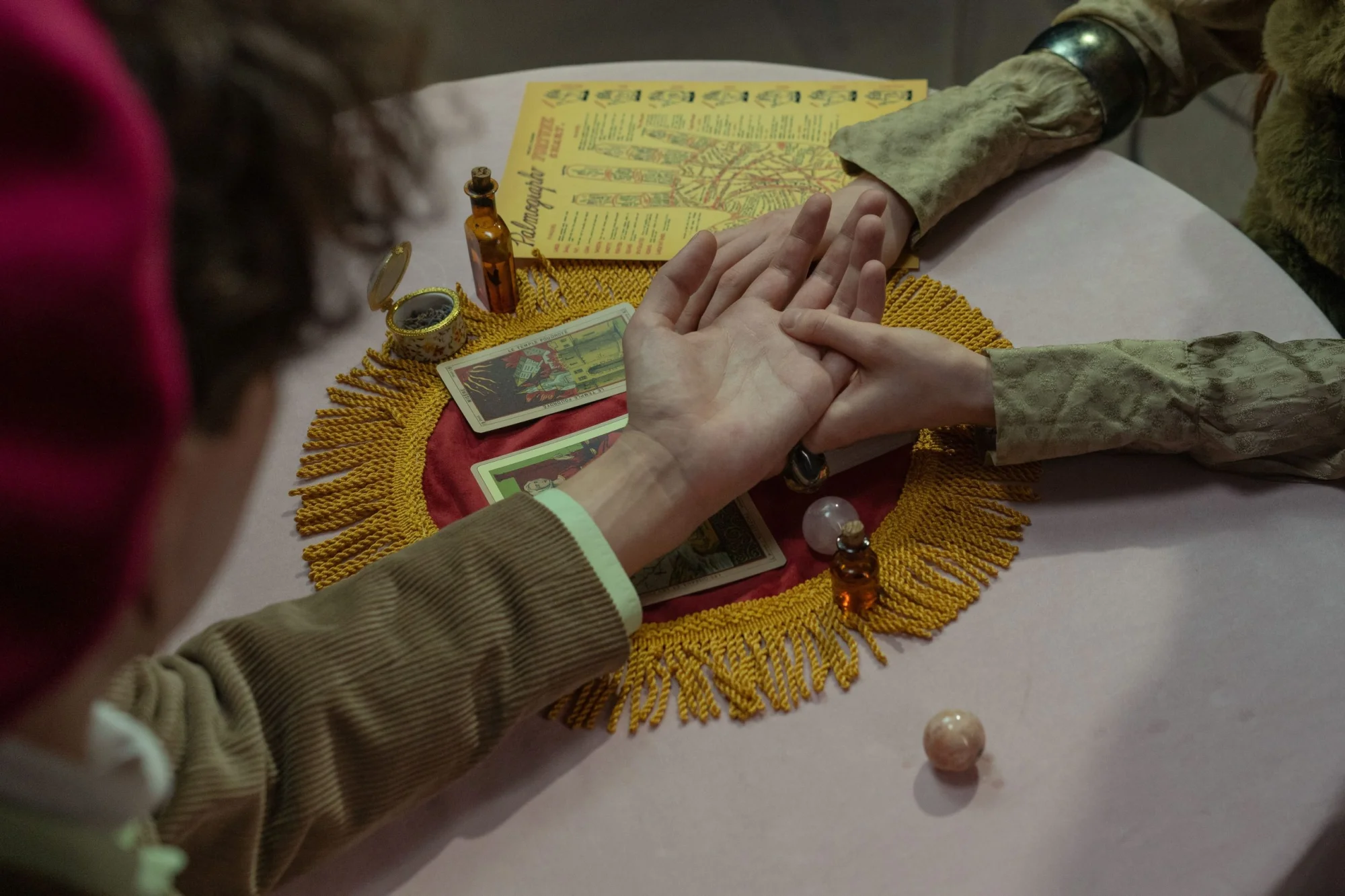
She had plenty of company. Traveling clairvoyants and palmists advertised in the 1880s and ’90s papers, stage “mentalists” drew crowds to the Savannah Theatre, and by 1900 the city papers carried commonplace notices like “Madame Hearn, palmist and mind reader…life reading 25¢.” National media even caricatured the trade — an 1898 Leslie’s Weekly illustration, viewed now as cringingly racist, depicted a Black fortune-teller reading a society lady’s palm — confirming just how familiar such figures had become. Not everyone approved: clergy warned against consulting fortune-tellers, skeptics mocked them in letters to the editor, and the city periodically considered ordinances against fraud. Yet the practice flourished. By 1900, Savannah was in some ways psychically saturated — a person might attend church on Sunday, visit a palmist on Monday, and keep a mojo bag in the dresser drawer just in case.
The Early 20th Century: Mediums & Secret Spells (1900–1940)

The new century brought even more colorful characters. Chief among them was Grace Gray DeLong, a well-traveled professional medium who swept into Savannah in 1911. Styling herself a “palmist, clairvoyant, medium, and life reader,” she announced her “First Public Appearance in Savannah” at Mechanics’ Hall with a “Spiritual Séance identical to one she gave at The White House” — an audacious claim for which no evidence has ever been found, but exactly the sort of publicity stunt itinerant psychics loved. For two nights that December, crowds gathered to watch her read sealed letters and convey messages from spirits, even blending in “moving pictures” for showmanship. She set up a consulting office, advertised heavily in the African American press, opened a photography studio in 1918, and dubbed herself “The Woman with 1,000 Eyes.” City directories track her through the 1910s and early 1920s before she drifted off to Florida, Mississippi, and Washington, D.C. — a true psychic entrepreneur, always on the move.
Meanwhile, African American conjure practitioners remained active but kept a lower profile, serving communities on the city’s periphery like Frogtown and Sandfly. In the 1930s, WPA folklorists interviewing elderly residents along the Georgia coast found people reluctant at first to discuss conjure — then full of stories of buried “conjure bundles,” hexes, and root-doctor cures. One fascinating figure bridging hoodoo and commerce was Mamie Wade Avant, a Black Savannah fortune-teller and root worker whose crystal ball and handwritten spell books were later acquired by Emory University’s Rose Library — tangible evidence of a life in the mystic arts. In an era when opportunities for Black women were severely limited, fortune-telling offered a measure of independence and respect within the community. As the Great Depression set in, hard times only drove more people to seek supernatural aid, and practitioners like Mamie saw their reputations grow.
Hoodoo Revival & Haunted Fame (1940s–1990s)
Through the mid-century, the old traditions lived on behind closed doors even as the overt psychic scene quieted. Mamie Wade Avant truly blossomed in these decades — a gentle but powerful spiritual advisor with a crystal ball, well-worn tarot cards, and spells for every occasion, who crafted mojo bags and served both Black and white clients (the latter often coming covertly, given the prejudices of the time). By the 1960s a handful of storefront “spiritual advisors” appeared downtown, and the New Age movement of the ’60s and ’70s layered astrology and ESP onto Savannah’s older ghost lore and hoodoo — which never got eclipsed; they simply joined the mix.
The turning point came in the 1990s, when two forces converged. First, Savannah deliberately embraced its haunted history as a tourism asset: the earliest regular ghost tours began in the late 1980s and early ’90s, and by mid-decade multiple companies ran nightly walks. TV shows like Ghost Hunters filmed at famously haunted spots such as the Sorrel-Weed House and Moon River Brewing Company, and by the early 2000s Savannah was being widely declared “America’s Most Haunted City.”


The second, more pivotal force was the 1994 publication of Midnight in the Garden of Good and Evil by John Berendt. The bestseller — later a Clint Eastwood film — captured readers with its atmosphere and one character in particular: Minerva, the voodoo priestess who performs midnight hoodoo rituals in Bonaventure Cemetery, famously intoning that “the half hour before midnight is for doin’ good, the half hour after midnight is for doin’ evil.” Minerva was not fictional — she was based on a real Savannah rootworker, Valerie Fennell Boles, said to be the common-law wife of a root doctor known as Dr. Buzzard. For years she had quietly helped people with spiritual work, much as Mamie Avant had, but Berendt’s book put her archetype on a pedestal. Suddenly the world saw a romantic, spooky vision of Savannah where high society and hoodoo intersected under mossy oaks, and paranormal tourism surged. In its wake, some Gullah-Geechee guides began incorporating more authentic talk of rootwork, distinguishing Hollywood “Voodoo” from the real Lowcountry Hoodoo that had been in Savannah all along.
The Modern Era: Savannah’s Living Sixth Sense

Today, what was once whispered in slave quarters or practiced behind parlor curtains is emblazoned on tour brochures — yet beneath the commercialization, the authentic traditions remain vibrant. A stroll along Broughton Street might bring you past a softly lit window offering tarot readings; metaphysical studios and spiritual boutiques now line the city’s heart, offering private readings, handcrafted candles, healing crystals, and even candlelit séance events. Where fortune-tellers once operated quietly on the fringes, they’re now part of the city’s thriving cultural scene — a new generation that sees no contradiction between spiritual authenticity and entrepreneurship, continuing the legacy of the mediums and root workers of the past.
Living Traditions
Outside the tourist spotlight, the Gullah-Geechee root-magic tradition persists quietly in Savannah and the surrounding Lowcountry. Rootworkers and spiritual healers still serve those who feel a calling, often by word of mouth rather than by advertisement. And the old folkways remain visible everywhere: porch ceilings painted “haint blue” to turn away wandering spirits, and bottle trees in yards, their glass bottles hung to trap malevolent spirits before they can enter the home. These are not museum pieces but active, living traditions. Even those who chuckle at ghost-tour theatrics might still nail a horseshoe above a door “just in case,” or consult an elder about a strange dream.
Respecting the Spirits
For all the commercialization, Savannahians maintain a genuine reverence for what underlies the ghost stories. The First African Baptist Church still preserves those diamond-shaped floor patterns, now openly acknowledged as culturally important, and there is growing academic interest in figures like Madame Smith and Mamie Avant — the latter’s papers preserved at Emory’s Rose Library, ensuring these once-“fringe” subjects are recognized as valuable facets of African American and women’s history. What truly sets Savannah apart is its embrace of mystery as part of its identity. This is a city where people don’t hide from talk of ghosts or psychics — they lean into it, creating a feedback loop in which those with unusual experiences feel safe coming forward, which only adds to the tapestry of stories.
In Savannah, the veil between worlds does feel a bit thinner — here, the paranormal is normal.
Savannah’s psychic history — from conjure women and séance-holders to shopfront psychics and lantern-lit guides — isn’t relegated to dusty books. It’s a living continuum. The characters change and the methods update, but the core impulse stays the same: Savannahians, and those drawn to Savannah, seek connection with forces unseen, whether for comfort, guidance, or the thrill of the unknown. As local lore has it, “Savannah was built on its dead” — and those restless souls are thought to linger. The psychics and spiritualists, then and now, are simply those attuned to listening. The next time you wander the moss-draped lanes of Bonaventure at dusk or stand beneath the ancient oaks of Wright Square, don’t be surprised if you feel a gentle tug at your consciousness. It might be a ghost — or it might just be Savannah awakening your own sixth sense.
Selected Sources
- Whittington B. Johnson, Black Savannah in the Nineteenth Century (University of Arkansas Press, 1996).
- Nancy Gray Schoonmaker, “Mystery and Possibility: Spiritualists in the Nineteenth-Century South” (Ph.D. diss., UNC Chapel Hill).
- Savannah Tribune (1876, 1888) & Savannah Morning News (1900) — fortune-teller advertisements, via Georgia Historic Newspapers.
- Emory University Rose Library — the papers, crystal ball, and spell books of Mamie Wade Avant.
- John Berendt, Midnight in the Garden of Good and Evil (1994) — the “Minerva” character, based on Valerie Boles.
Awaken Your Own Sixth Sense
From conjure women to Victorian séances, Savannah’s mystic past comes alive after dark. Walk the haunted Historic District with Destination Ghost Tours and feel the veil grow thin.