
Spanish moss drapes like tattered lace from ancient oak branches in Savannah’s midnight squares, swaying in a humid breeze that seems to carry whispered prayers and secrets. To understand this city’s haunted reputation, you have to look beneath its genteel surface — into the rich Hoodoo and Voodoo heritage that has shaped its paranormal lore for nearly three centuries.

An 18th-century port city “as slow and sweet as honey” yet full of tragedy, Savannah has long been a place where West African Hoodoo and Caribbean Voodoo traditions intertwine with local folklore. Walk a moonlit cobblestone lane here and you might feel it — a mystical presence lingering just beyond the gaslight’s glow. Let’s step into the “Garden of Good and Evil” and discover how these traditions, from the secret rituals of enslaved people to the practitioners who keep them alive today, have shaped the city’s ghostly reputation.
Historical Roots: Hoodoo and Voodoo in Savannah’s Past
Savannah’s introduction to Hoodoo and Voodoo dates back centuries, arriving on the very ships that carried enslaved Africans to Georgia’s coast. Those men and women brought with them West and Central African spiritual practices — rituals for honoring ancestors, casting spells, and protecting against evil. Over time, these mingled with the harsh realities of slavery and the influence of Christianity to form what we now call Hoodoo, sometimes dubbed “Lowcountry Voodoo.” Unlike Vodou (Voodoo) — an organized religion with West African and Caribbean roots — Hoodoo is a folk spirituality: a toolkit of charms, herbal medicine, and magic for everyday needs.
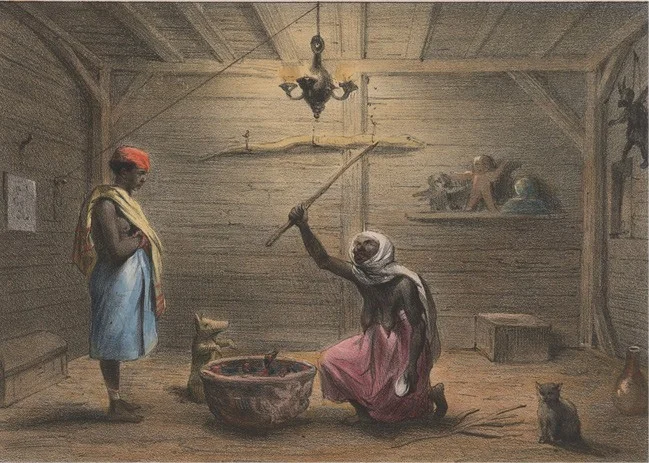
Enslaved people in coastal Georgia — the Gullah-Geechee people — developed a rich spiritual culture despite oppression. They spoke of “haints” (restless spirits) and witches, and believed deeply in the power of conjuration to influence the seen and unseen. By the mid-1700s, Savannah’s First African Baptist Church — one of the oldest Black churches in North America — held a powerful secret. Drilled holes in its floor formed a diamond-shaped Bakongo cosmogram, a sacred Kikongo spiritual symbol showing that African cosmology endured beneath the church’s foundations. The same holes provided air to freedom seekers hiding below, but their pattern was no accident — it was West African prayer magic embedded in the heart of Savannah. The city’s soil held other traces of conjure, too: archaeologists have found charms buried under old cabins — bundles of grave dirt and iron nails placed for spiritual protection.
Hoodoo grew as an act of resistance and resilience. Enslaved conjurers became healers and warriors in a spiritual struggle against their oppressors. They used rootwork to treat illness when no doctor would help, and to “trick” bloodhounds and slave-catchers — for instance, rubbing graveyard dirt on their feet to throw off tracking dogs. Many enslavers so feared Hoodoo’s power that they banned the use of African herbs, terrified of being poisoned or cursed — a fear that only drove the tradition further underground. One legend tells of an enslaved conjure woman called Old Julie, said to have “conjured so much death” on a plantation that her master tried to sell her — only for her magic to allegedly turn the boat around, forcing him to keep her. Hoodoo, it seemed, could not be uprooted from Savannah’s story.
Voodoo influences reached Savannah through more indirect paths. During the American Revolution in 1779, hundreds of free Black soldiers from French Saint-Domingue (Haiti) — the Chasseurs-Volontaires — fought in the Siege of Savannah, praying to ancestral loa for protection in battle. Most returned home (some later helping to spark Haiti’s own revolution), but their presence planted early Vodou seeds in Savannah’s cultural soil. Over the following decades, Caribbean and African spiritual practices continued to trickle in through the port, and whisperings of Voodoo queens and root doctors working in the shadows became part of the city’s lore.
After Emancipation, Hoodoo in Savannah did not disappear — it evolved. Freed Black communities on the city’s outskirts, like the Sandfly area, kept African traditions alive. An anthropologist interviewing residents in the 1930s found people reluctant to discuss conjure at first, but many eventually recounted “folks havin’ spells put on ’em and findin’ conjuh bags buried in the yard.” One woman suffered endless bad luck until she dug up a curious bundle of clay on her property — a conjure bag planted by an enemy. She destroyed it, and her fortunes improved. In Gullah-Geechee folklore, a witch called a “boo-hag” became a famous figure of dread — a shape-shifting, skin-stealing sorceress who slips into homes at night. If you woke feeling paralyzed or drained, folks said a boo-hag had “ridden” you in your sleep, stealing your breath like a vampire. Such beliefs gave shape to nightmares and unexplained illness, tying the supernatural to everyday life.
Modern Practices: Living Traditions Today
Though often hidden, Hoodoo and Voodoo remain very much alive in Savannah, woven into the city’s cultural fabric. Stroll through historic neighborhoods and you’ll notice hints: porch ceilings painted a pale “haint blue” to ward off wandering spirits, and here and there a glint of cobalt glass bottles hanging from a tree branch. These aren’t merely quaint Southern decorations — they are active folk practices born of Hoodoo lore. Haint blue, a blue-grey shade like water or sky, is meant to fool ghosts into thinking they cannot enter (spirits supposedly won’t cross water, and mistaking the color for sky, they drift away). The bottle tree, meanwhile, traces to the Congo region: evil spirits are lured into the bottles by their sparkling colors, trapped inside, and destroyed by the morning sun. Both survive from Gullah-Geechee belief, and both remain common sights across the historic district — old protective spells living on in plain view.
Beyond these subtle signs, modern practitioners still quietly ply their craft. Locals say it’s possible to hire a “root doctor” if you know where to look — someone skilled in laying tricks, preparing mojo bags, and communing with spirits on a client’s behalf. Need to bless a new business, rekindle a love, or ward off a run of bad luck? There’s a ritual for that. A few shops in town sell herbs, oils, and candles for do-it-yourself conjure, but much of this heritage is kept low-key, passed down in families or shared in trusted circles. Secrecy, after all, has always been part of Hoodoo’s power — a necessity when the practice was outlawed or scorned.
Dr. Buzzard: The Legend of the Lowcountry


No account of Lowcountry root work is complete without Dr. Buzzard, the most legendary conjure man of them all. Stephen Robinson (1885–1947), of St. Helena Island in Beaufort County, South Carolina, became famous across the region for “chewing the root” and, above all, for his courthouse work: clients believed he could sway a judge and jury in their favor, and he was known to sit in court quietly chewing a piece of root to bend a trial toward his client. His fame was so great that his very name became a title — later root doctors, including one whose widow would become central to Savannah’s most famous ghost story, took up the mantle of “Dr. Buzzard” after him. That tradition of conjure aimed at the courtroom would echo, decades later, in the drama at the Mercer House.
One remarkable modern discovery proved just how intact these traditions remain. In the Gullah-descended enclave of Sandfly, a woman known as “Madam Truth” was a famed fortune teller and conjurer in the mid-20th century. After she passed, the remnants of her home revealed a hidden treasure: an entire Hoodoo altar concealed behind a wall, left exactly as it was for years. A section of old wood had turned unnaturally dark; opening it revealed a secret cubby holding ritual objects, candles, and offerings that visitors had quietly continued to leave. Today that altar — along with a doll said to be cursed — is preserved in Savannah’s Graveface Museum, a tangible reminder that Hoodoo’s imprint still lingers in modern Savannah homes, not on some distant island but in a neighborhood just down the road.
Even those who don’t practice often respect its presence. Many families have stories of a grandmother who knew healing spells or a neighbor reputed to lay curses. The line between church and conjure can be blurry — some root doctors were also churchgoers who saw no conflict in consulting the Bible and the spirits in the same breath. Gospel hymns on Sunday and graveyard dirt on Monday: that’s Savannah’s unique blend of faiths, a living folk tradition rather than a thing of the past.
Common Misconceptions: Myth vs. Reality
With Hoodoo and Voodoo so woven into Savannah’s mystique, it’s easy for myth and pop culture to blur fact and fiction. Let’s clear up a few of the most common misconceptions.
Hoodoo vs. Voodoo — Not the Same
One major confusion is treating the two as interchangeable. Voodoo (properly Vodou) is an African Diaspora religion — practiced notably in Haiti and Louisiana — with established deities, liturgies, and priests. Hoodoo, by contrast, is a folk magic tradition rather than a formal religion: a blend of spiritual practice, herbal medicine, and supernatural work drawn from many African cultures rather than one organized doctrine. Savannah’s spiritual scene leans historically toward Hoodoo rootwork — so while locals may casually say “voodoo,” they often mean hoodoo.
Are They “Evil” Practices?
Thanks to Hollywood and sensational legend, people often brand these traditions as “dark” or “satanic.” In truth, they are no more inherently evil than any other belief system. Hoodoo grew out of necessity and oppression, and much of it is devoted to healing and protection — using herbs, roots, and prayers to remove curses, banish harmful spirits, and bring good luck. Vodou, likewise, serves God (Bondye) and the spirits, and often centers on community healing and justice. The idea that practitioners are devil-worshippers is a myth born of fear. If you’ve ever tucked a sachet of herbs under your pillow or sipped ginger tea for a cold, you’ve brushed up against the same plant-based folk wisdom Hoodoo employs. The real dark history here is how enslavers demonized these practices — because they feared the power of enslaved people caring for themselves and fighting back.
Voodoo Dolls and Zombies
Pop culture loves the pin-stuck voodoo doll and the grave-risen zombie. Both have roots in genuine tradition but are wildly distorted. Effigies in Hoodoo and Voodoo were as often used for healing or blessing as for harm; the media’s fixation on sticking pins into enemies exaggerates a very small corner of folk practice. And the “zombies” of Haitian lore were never the flesh-eating monsters of film, but rather people said to be placed in a trance-like state — a phenomenon tangled up with colonial fear-mongering rather than everyday Vodou worship. In Savannah’s haunted tales you’ll seldom find true zombies, but you’ll find plenty of “restless dead,” closer to traditional ghosts and haints than to anything from Hollywood.
“It’s Just for Tourists”
Another misconception is that all this talk is hammed up for ghost tours and novels. While books like Midnight in the Garden of Good and Evil have certainly dramatized these practices, the traditions themselves are real and historically rooted — locals for generations sincerely believed in spirits and spells, and some still do. What’s often fictionalized is the nature of those practices. One famous story claims the tragedies at the Sorrel-Weed House were caused by “a voodoo-practicing slave” casting curses in revenge. It makes for great late-night tour material, but there’s scant evidence for it, and it leans on the tired trope of the “vengeful voodoo witch.” Attributing every haunting or misfortune to conjure is an oversimplification — sometimes a ghost is just a ghost. Savannah’s Hoodoo legacy is complex and rich, not a catch-all explanation for spooky happenings.
Hoodoo, Voodoo, and Paranormal Encounters
In a city steeped in such traditions, it’s no surprise that paranormal activity often comes with a Hoodoo or Voodoo twist. Savannah’s ghost stories are more than ethereal apparitions; they frequently feature spells, curses, and conjured spirits as plot points, blurring the line between haunting and magical working. An unexplained illness might mean a hex has been laid; a knock at the door with no one there could be a spirit messenger; a run of bad luck might prompt a visit to the root doctor to see if someone “fixed” you.


The most famous real-life intersection of Hoodoo and the paranormal is the saga at the Mercer House on Monterey Square. In 1981, antiques dealer Jim Williams shot his young assistant Danny Hansford, and the trials that followed were immortalized in Midnight in the Garden of Good and Evil. Facing dire odds in court, Williams secretly enlisted a local root doctor — a woman named Valerie Boles, whom the book calls “Minerva.” Boles had taken over the practice of her late partner, the root doctor whom author John Berendt renamed “Dr. Buzzard.” At midnight in Bonaventure Cemetery, under moss-draped oaks, she is said to have performed rituals to petition the dead for justice, laying out offerings and working in the darkness while Williams listened for any sign from Danny’s spirit. According to legend, conjure was aimed at the judge, the jurors, even the victim’s restless ghost.
Williams was ultimately acquitted after four trials — but Hoodoo has a knack for ironic twists. Just months later, in 1990, he died suddenly in his study, collapsing near the very spot where Danny had fallen. The timing fed whispers that a spiritual debt had come due. Did the conjure backfire, or did the spirits simply take their due? Savannah’s storytellers will forever relish that chilling coda, and visitors to the Mercer House often report an uneasy feeling inside, as if the charged energy of that drama still lingers.
Not every tale is so modern. In the dim confines of Colonial Park Cemetery, legend holds that late-night Hoodoo ceremonies once stirred forces best left dormant. Over a century ago, locals frequently found evidence of ritual there — cryptic symbols in the dirt, candle wax, small bundles left on graves. Ghost enthusiasts like to say those rites “opened doors that couldn’t be closed,” which is one way of explaining why the cemetery teems with sightings to this day. Its most infamous spirit is Rene Rondolier, a giant of a man who, as the story goes, was blamed for the deaths of children and lynched among these graves — after which more killings were said to follow, blamed on his vengeful ghost. It’s a grim legend rather than documented history, but it’s become inseparable from the cemetery’s eerie atmosphere.
From the Lowcountry swamps comes the Boo Hag — Savannah’s very own nightmare creature. Unlike a typical ghost, a Boo Hag is a malevolent spirit or witch that sheds its skin and flies by night, said to slip through the tiniest crack to sit on a sleeper’s chest and steal their breath, leaving them exhausted and panicked. To this day some homeowners paint their window frames and door trim haint blue specifically to keep the Boo Hags out — practical magic for a paranormal problem. And if you ever feel paralyzed in bed with a weight on your chest (what science calls sleep paralysis), an old-timer in Savannah might tell you a boo-hag “rode” you the night before.
Ultimately, Hoodoo and Voodoo provide a language for the supernatural in Savannah. Rather than simply say “a ghost did it,” a Savannah storyteller might say “someone put a root on that man, and his spirit can’t rest.” These beliefs make the city’s ghost stories extraordinarily colorful and deeply rooted in culture — the paranormal here isn’t just cold spots and EMF readings, but midnight graveyard visits, cursed objects, and conjure bags left on doorsteps.
Haunted Sites Where Hoodoo and Voodoo Echo
Savannah has no shortage of haunted places, but a few seem to thrum especially with Hoodoo and Voodoo energy — steeped in spiritual legend, and in some cases in real ritual activity.
Colonial Park Cemetery
Established in 1750, this downtown graveyard is a crossroads of paranormal and Hoodoo history. Practitioners are said to have held rituals among its vaults and headstones, and locals long suspected those gatherings riled up the dead. Beyond the wandering specter of Rene Rondolier, visitors report ghostly figures and mysterious lights after dark. Many graves were disturbed over the centuries — General Sherman’s troops famously camped here, and some markers were later altered — so restless spirits are said to abound even without magic. By day it’s a beautiful historic site; after dark, with gnarled trees casting shadows, it’s easy to imagine rootworkers softly chanting among the tombs.
Bonaventure Cemetery
Arguably Savannah’s most evocative resting place, Bonaventure is a riverfront expanse of Gothic tombstones beneath canopies of oak and silvery moss. Famous for its beauty and its starring role in Midnight in the Garden of Good and Evil, it’s also where “Minerva” performed her midnight rituals in the book’s telling. That imagery has stuck — many visitors half-expect to glimpse a cloaked figure crouched by a grave at the witching hour. Its legendary ghosts include little Gracie Watson, whose lifelike statue seems almost to watch you through the fog. The hauntings here aren’t overtly tied to conjure, but the cemetery’s role as the setting for Hoodoo workings in popular lore makes it feel inherently mystical.
Sorrel-Weed House
This grand 1840s mansion on Madison Square is often called one of America’s most haunted homes. Its backstory centers on two tragic deaths: Matilda Sorrel, who died in 1859 after a fall from the house, and Molly, an enslaved woman said to have been found hanged in the carriage house. Sightings here include shadowy figures and a “Lady in Black” in the courtyard. The Hoodoo connection comes entirely from unverified legend — the claim that Molly was versed in voodoo and cursed the family, or that Matilda herself turned to conjure to win back her husband’s affection. Hard evidence for any actual ritual in the house is lacking, but the legend endures and gives the haunting its distinct flavor. It’s a vivid example of how Savannah’s real history gets entangled with hoodoo lore.
Mercer House (Jim Williams House)
A stunning Italianate mansion by day, the Mercer House gained lasting infamy from the 1981 shooting and the ghost book that followed. People now visit hoping to catch a glimpse of something otherworldly; while the family has maintained that no ghostly happenings occur, some visitors swear they’ve seen a misty figure near the study doorway or felt an unexplained chill. Given the documented Hoodoo rituals connected to the case, the Mercer House is a rare instance where real conjure practice intertwines with a haunting. One eerie detail persists: Jim Williams died close to where Danny fell, almost as if reenacting the fatal scene — leaving some to wonder whether the two are locked together in an unfinished confrontation.
Hidden Hoodoo Altars
Not every charged place is on the tourist maps. Some of Savannah’s Hoodoo-rich spots have been found only by accident — like Madam Truth’s secret altar behind a wall. Such hidden shrines were likely more common than anyone realized, especially in eras when open practice was risky. Renovation crews in the historic district have reported odd caches: feathers and rusty nails arranged inside a wall, or a Bible bound with red string as a protection trick. In one downtown renovation, a small space under a stair was said to hold dozens of feathered bundles and wax figures — possibly decades of accumulated spell work, which the owners had a rootworker remove properly, just in case. In this sense, Savannah’s very buildings can be “haunted” by Hoodoo — not always in a frightening way, but as quiet repositories of spiritual effort.
The Spell of Savannah
A bit of Africa, a bit of Haiti, a dose of the Bible, and a dash of swamp magic — all stirred together in this moss-draped cauldron of a city.
In Savannah, history and mysticism walk hand in hand. Hoodoo and Voodoo have cast a spell over the city’s imagination, infusing its very air with a sense of the unseen. On any balmy evening, as night-blooming jasmine mingles with the swampy musk of the river, you can almost feel the veil between worlds thinning. A woman in a white dress drifts beneath a gas lamp — flesh and blood, or one of Savannah’s famed phantoms? The answer may depend on whether you believe, as Hoodoo teaches, that the spirits of the dead remain among us.
What’s certain is that Savannah’s connection to these traditions has given us some of the most captivating stories in American ghost lore — a place where a charming square might hide the memory of a midnight ritual, and where every cemetery is both a final resting place and a potential meeting ground between conjurer and spirit. These traditions have been misunderstood and sensationalized, yet they continue to thrive in whispers: in herbs tucked above a doorway, blue paint on an eave, and stories swapped about the time someone saw a haint and laid it to rest with prayer and a pinch of salt. By embracing both the history and the mystery, Savannah honors its ancestors — those who endured pain and found strength in these spiritual practices — and keeps their memory alive with every tale told after dark.
Walk the Garden of Good and Evil
Hear the true stories of Savannah’s root doctors, curses, and conjure spirits on our adults-only Spirits & Scoundrels tour — a late-night walk through the city’s darkest history.