
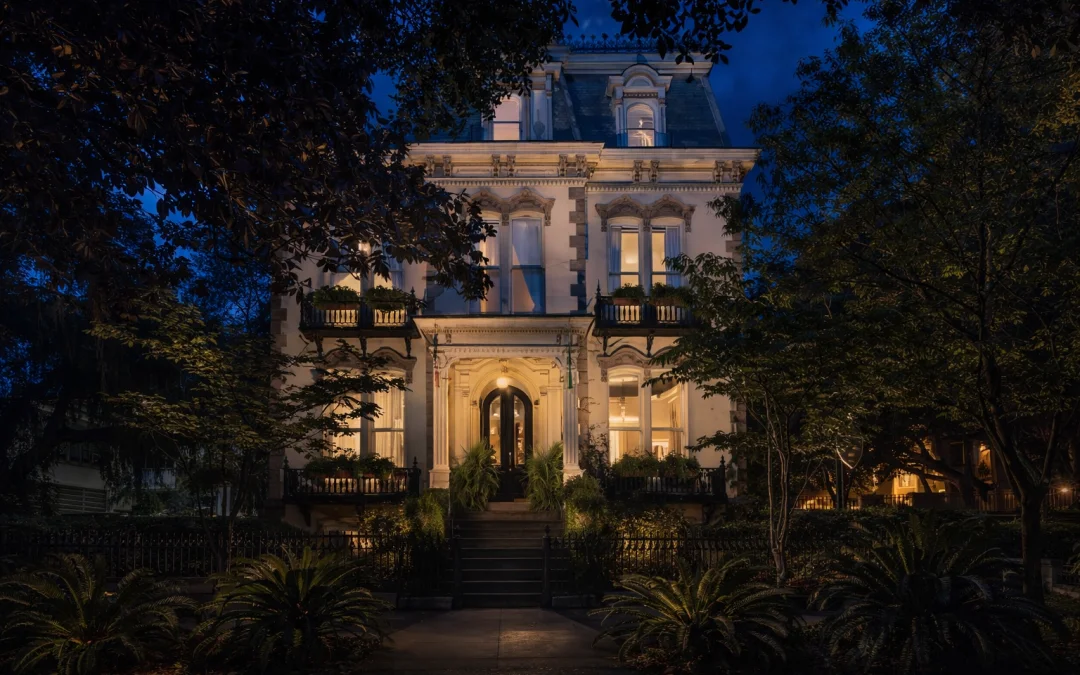
Savannah’s Lafayette Square has always been a place where history whispers through the branches of ancient oaks draped in Spanish moss. At its heart stands the Hamilton-Turner Inn, an architectural jewel wrapped in legend and lore.
Built in 1873 by Samuel Pugh Hamilton, this grand mansion was a spectacle of opulence, proudly illuminating the city’s first private electric lights and bearing witness to Savannah’s transformation through war, fire, and restoration. Built for Hamilton, a prosperous jeweler and influential civic leader, the mansion quickly gained fame for its grandeur, innovative technology, and extravagant social gatherings. Its high Victorian style — the elegant mansard roof, the ornate ironwork — became a testament to the prosperity and optimism of post-Civil War Savannah.
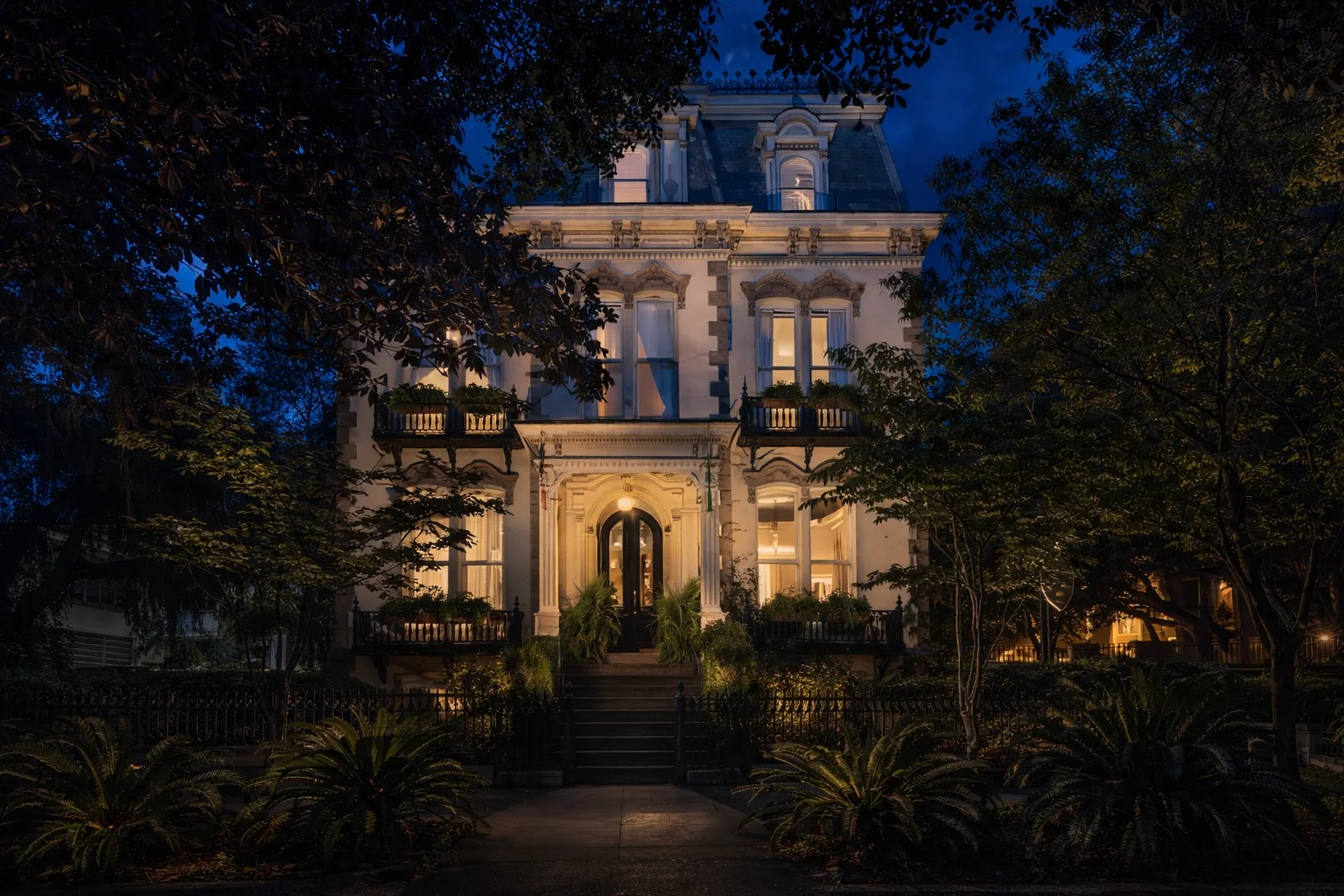
Yet beyond its sophisticated facade, the mansion has known its share of tragedy and mystery — from the loss of a Hamilton daughter to the unsolved murder of a rooftop watchman — and those shadows still linger, in the form of ghostly apparitions and unexplained phenomena reported by guests and staff for generations. The Inn is often rumored to have inspired Walt Disney’s Haunted Mansion, though, as we’ll see, historical records point elsewhere. From near-demolition to its rebirth as one of Savannah’s premier luxury inns, it remains a beloved monument to both the splendor and the mystery of the city’s past. Join us as we journey through its fascinating history and chilling tales.
Let There Be Light

Inside, the Hamilton home boasted 17 rooms of high Victorian elegance. In its heyday, one can imagine richly patterned wallpapers, heavy drapes, and gaslight and oil lamps casting a gentle glow on marble fireplaces and gilt-framed mirrors. A sweeping staircase rose from the entry hall, carrying guests to the upper floors where children peered down at the festivities below. No detail was overlooked — Samuel Hamilton was not content with mere contemporary standards. He wanted his house to be ahead of its time, a modern marvel in Savannah.
Electric lights were the newest invention of the age, and Hamilton was determined to have them. In the early 1880s, he became a founding investor — and later president — of the Brush Electric Light & Power Company of Savannah. In March 1883, as the city erected its first electric streetlamps, Hamilton pulled off an even more dazzling feat at home: he installed electric lights in his mansion’s salon, making it the first private residence in Savannah to be electrified — a mere four years after Thomas Edison patented a practical lightbulb.
Each evening in 1883, as dusk purpled the sky over Lafayette Square, curious citizens gathered outside to witness the magic. At the closing of a circuit, the mansion’s parlor would blaze with electric light, and gasps would ripple through the onlookers as the interior sprang to life with an otherworldly glow. Many Savannahians kept a safe distance, half-expecting the mysterious contraption to burst into flames at any moment. Hamilton’s bold experiment paid off — the house did not explode, and by 1886 he had wired the entire mansion. To this day, tour guides recount how 19th-century neighbors marveled (and perhaps trembled) at the sight of electricity coursing through the “Lord of Lafayette Square’s” home.
The mansion was modern in other ways, too. It featured indoor plumbing well before such conveniences were common in Savannah, with an indoor bath and water closet installed by 1886. By the late 19th century, the Hamilton House stood as a perfect union of Old World elegance and New World innovation — a point of pride for the city. But even great houses, and great lives, face trials. For the Hamiltons, the 1890s would bring a literal trial by fire, and personal tragedies that would add darker chapters to the home’s history.
Trials and Tribulations: Fire, Death, and an Unsolved Mystery
On February 6, 1898, disaster struck Savannah’s historic quarter. A raging fire broke out that threatened to consume Lafayette Square, leaping from building to building and gutting the nearby Cathedral of St. John the Baptist. As embers rained down on Abercorn Street, the Hamilton mansion stood squarely in the fire’s path, its tall mansard roof seeming like a beacon for sparks. But in a stroke of luck — or a smart architectural choice — the roof was made of tin and Connecticut limestone, far more fire-resistant than wood shingles. When the flames reached 330 Abercorn, the roof repelled the burning embers, and the structure was spared. The 1898 fire left much of the area in ashes, yet Hamilton’s home survived virtually unscathed — one of the only buildings in town to withstand the blaze. In later years, people whispered that protective spirits guarded the house, pointing to the cast-iron “bird” ornaments along the roofline as talismans that had saved it.
Tragedy found the Hamilton family in other ways. Their young son Fenton had died in infancy years earlier, and in 1898 — the same year as the fire — 24-year-old Virginia Lee Hamilton, one of Samuel’s daughters, passed away. The cause isn’t recorded in surviving accounts, but the loss cast a sorrowful shadow over the family. Through it all, Samuel Hamilton, then in his early 60s, maintained his vigorous involvement in business and civic affairs. He served for many years as a Savannah alderman and was Grand Commander of the Knights Templar in Georgia by 1875. (Some accounts mistakenly call him the Mayor of Savannah, but city records show he never held that office — he was a powerful alderman who sometimes acted with mayoral authority.)
It was around this time that one of Savannah’s most enduring mysteries unfolded on the mansion’s roof. By the late 1890s, Hamilton was an avid art collector who kept valuable paintings and artifacts in his home. To protect his treasures, he reportedly hired armed guards to patrol the mansion at night, even stationing a watchman on the mansard roof to survey the entire square. One quiet morning, so the story goes, the household realized the rooftop guard had not come down after his shift. When someone climbed up to check, they found a ghastly scene: the guard lay in a pool of blood, shot in the back of the head, his rifle still clutched in his hand. The murder sent shockwaves through Savannah’s polite society. Who would climb to the Hamiltons’ roof to kill a guard, and why? The police investigated, but the killer was never identified, and the crime went unsolved. (Later retellings even give the guard a name — “Dennis” — though contemporary newspaper reports of the incident are elusive.)
In the absence of answers, legend took over. Samuel Hamilton himself, distraught and unable to find a willing replacement, supposedly took up the vigil. Night after night, the 61-year-old climbed to his widow’s walk with the guard’s rifle, pacing under the moonlight to keep watch over his beloved home. It’s said the damp night air and strain took a toll. Hamilton fell ill in early 1899 — pneumonia, by some accounts — and died on June 22, 1899, at the age of 61. Savannah lost one of its foremost citizens, and the mansion lost its master. He was buried in Bonaventure Cemetery, where a stately plot holds the remains of Samuel and Sarah Hamilton.
Two deaths in quick succession, both tied to that iron-crested roof.
Whether Hamilton’s final illness was truly brought on by those chilly rooftop vigils or was simply fate, the coincidence was too delicious for storytellers to ignore. Ever since, people have wondered whether the rooftop is cursed — setting the stage for the ghost stories that would follow. But first, the mansion had to navigate a new century without the man who built it.
The Turner Era: A Doctor’s Home and Wartime Refuge
After Samuel Hamilton’s death, the mansion passed to his widow, Sarah (“Sallie”), who lived there for a time. By 1915, the Hamilton estate sold the property to Dr. Francis T. Turner, a prominent Savannah physician — an ideal new steward: successful, civic-minded, and raising a family. He made the mansion both a family residence and a place of work.
From 1915 through the 1920s, the house was known as the Turner House. Dr. Turner lived there with his wife and children and converted the mansion’s basement into his medical office; patients entered beneath the front steps into the lower level. Rumors later swirled that Dr. Turner even performed autopsies down there — likely more folklore than fact, but easy to imagine amid those brick walls and low arches. Like Hamilton before him, Turner had an enthusiasm for new technology: he is said to have owned the first electric car in Savannah, a battery-powered automobile that quietly hummed up to the mansion’s door.
By 1926, after about a decade, the Turners relocated and opened the house as a boarding house. Then, in 1928, it found a new purpose as a residence for the nurses of Savannah’s Marine Hospital. One can picture young nurses in starched white uniforms gathering in the dining room after long shifts. The grandeur may have faded — parlors partitioned into extra bedrooms, the ballroom filled with dormitory beds — but the house was full of life. In the 1940s, Dr. Turner reclaimed the property, moving his family back in and once again running his practice from the home.
By the mid-20th century, however, grand downtown houses were often seen as white elephants, expensive to maintain. The Turners eventually sold, and in 1965 the buyer was one who did not cherish the home’s history: the Cathedral of St. John the Baptist, just across the square, which intended to demolish the mansion for a playground or parking lot for its parish school. It was a pivotal moment for Savannah’s preservation movement. A decade earlier, in 1955, seven Savannah women had founded the Historic Savannah Foundation after watching other beautiful old homes fall. When they learned the Hamilton-Turner house — by then recognized as an excellent example of Second Empire architecture — was slated for the wrecking ball, they mobilized, and through years of advocacy the Foundation ultimately saved it.
One young man had a front-row seat to the mansion’s years of neglect. In 1969, Brent Berry, an 18-year-old airman stationed at Hunter Army Airfield, found the vacant house unlocked and decided to spend the night. As he stretched out on the dusty third floor, he heard strange bumping and shuffling, as if someone were creeping up the stairs toward him. Startled, he retreated all the way to the roof — that infamous roof — and waited until morning. Berry ended up spending many weekend nights in the empty mansion, usually climbing to the roof to sleep when the noises unnerved him, and even found a hiding spot in the cupola. Once he discovered a large red stain in a second-floor closet that looked frighteningly like blood (he was sure it was only paint). His nocturnal adventures only fueled the growing legend that the house was haunted.
Saved from demolition, the mansion entered a new chapter as Savannah awakened to its own historical value. Placed on the National Register as a contributing property of the Savannah Historic District, it reopened as apartments in the 1970s, carved into multiple units. A succession of owners came and went — some caring, some not — and by the 1980s the paint was peeling and the future uncertain again. Then a twist of fate, and of literature, put the house back in the spotlight.
A Star Turn: Midnight in the Garden of Good and Evil
In the early 1980s, a charming, roguish character named Joe Odom entered the story. An attorney-turned-piano-player and bon vivant, Odom had a knack for inhabiting historic homes he didn’t own. Around 1982, he became the resident manager of the Hamilton-Turner House, then operating loosely as a boarding house and event space. Known for throwing Gatsby-style parties, Odom held court at the parlor piano night after night, entertaining society folks and oddballs alike, and even gave informal tours to out-of-towners for a few dollars — turning the partly-vacant mansion into an impromptu attraction.
Odom’s antics caught the attention of writer John Berendt, who was soaking up local color in 1980s Savannah. Berendt featured Odom and the house prominently in his 1994 nonfiction novel Midnight in the Garden of Good and Evil, describing how Joe created “something new in the city of Savannah” — a private home operating as a full-time tourist attraction. In the book, the Inn is thinly disguised as the home of a character named “Mandy,” based on real-life Savannah socialite Nancy Hillis, who at one point co-owned the house and later stayed on as manager after it sold.
Midnight became a runaway bestseller, putting Savannah — and its ghosts — on the national map. Tourists flooded the city clutching dog-eared copies of “The Book,” and they found the Hamilton-Turner House on Lafayette Square. In 1997, as Clint Eastwood’s film adaptation hit theaters, the mansion’s then-owners, Charles and Sue Strickland, undertook a major renovation to convert it into a luxury inn. By year’s end it debuted as the Hamilton-Turner Inn, an upscale bed-and-breakfast with suites named for Savannah luminaries — and fans of Midnight could now not only see Joe Odom’s party house, but stay overnight in it.
Nancy Hillis, the “Mandy” of Midnight, fittingly moved into a basement apartment and served as the Inn’s first manager. Joe Odom, sadly, did not live to see it open — he died in 1991, three years before the book was published — but his spirit of irreverent, musical joy lingered in the popular imagination of the place. In the years since, a succession of owners has continued to restore and maintain the Inn, which has earned AAA Four-Diamond status and a place among Savannah’s finest boutique hotels. Everywhere, the history is palpable: the portrait of Samuel P. Hamilton in the hallway, the antique billiard table said to be original to the house, and the narrow service stairs down which a phantom child is rumored to roll marbles. Which brings us to the ghosts.
Ghost Stories and Legends of the Hamilton-Turner Inn
By the late 20th century, the Hamilton-Turner Inn had firmly secured its place in Savannah’s catalog of haunted locales. Its age, dramatic history, and Midnight-fueled fame made it a favorite stop on ghost tours. Shadows behind the lace curtains and faint piano strains at 3 a.m. have given many a guest goosebumps. Here are its most famous tales — and their possible roots.
The Children in the Attic and the Rolling Billiard Balls
Local legend links this phenomenon to the Hamilton children, who were said to be banished to the upstairs nursery while lavish adult parties unfolded below. To amuse themselves, the story goes, they would roll billiard balls (or marbles) across the floor — and one mischievous night sent them clattering down the grand staircase, perhaps hoping for an excuse to sneak a peek at the festivities. According to the tale, one little girl leaned too far over the top step and fell to her death. Ever since, her restless spirit is said to roam the house, still searching for her parents and still rolling balls in the dead of night.
It’s a heartbreaking story — though it doesn’t align neatly with documented family history, which records no such death down the staircase, marking it as more folklore than fact. Still, many guests and staff swear they hear childish giggling and the patter of small feet on the upper floors; more than a few bleary-eyed visitors have called the front desk to report children running in the halls at 2 a.m. when none were booked. Whatever the origin, the ghost children are among the Inn’s most often-encountered phantoms — described as mischievous rather than menacing, like invisible kids who simply want to play.
The Cigar-Smoking Guard on the Roof
Perhaps the most iconic ghost of the Hamilton-Turner Inn is a man seen on the roof at night, smoking a cigar and sometimes carrying a rifle. Guests strolling the square have looked up to see a silhouette pacing the mansard, a faint red coal glowing in the dark — a figure that vanishes when approached or hailed. Who could it be? The stories point to two possibilities: the murdered watchman of 1898, still eternally on guard, or Samuel P. Hamilton himself, unable to relinquish his beloved home and watching over it in death as he did in life.
This “Cigar Man” is sometimes accompanied by the inexplicable smell of cigar smoke on the top floor of the non-smoking Inn. One account tells of a guest who stepped onto Lafayette Square, clearly saw a man with a rifle on the roof, and alerted an employee — only to learn no real person was up there. Because both the guard and Hamilton are said to have patrolled that roof in 1898-99, some quip that the rooftop ghost is a “two-for-one.” Either way, he is viewed with more reverence than fear. As one writer put it: is he the guard looking for the man who shot him, or Hamilton still watching over his beloved home? Perhaps a bit of both.
The Civil War Soldier and Other Spirits
Another ghost occasionally reported is a Civil War-era soldier in a tattered uniform who knocks on guests’ doors as if checking rooms, then disappears. This one puzzles historians, since the house was built after the war and no soldiers lived or died there; one theory holds that the surrounding ground may harbor unmarked graves, another that witnesses simply misdate an 1880s frock coat as a military uniform. At least a few guests have sworn they saw a man of military bearing — one even claimed the figure politely tipped his hat before fading through a wall.
Staff have their own quiet tales: footsteps on the stairs when the Inn is empty, doors found unlocked (or locked), utensils falling in the kitchen at odd hours, and the occasional friendly pat on the back when alone. One housekeeper reported the smell of freshly baked brownies drifting through the dining room before any cooking had begun — an aroma she associated with a long-departed cook. The basement, where Dr. Turner saw patients, carries a heavier reputation, with reports of cold drafts, EVP recordings, and a shadow figure glimpsed from the corner of the eye. Even skeptics tend to admit the Inn simply “feels haunted” — not hostile, but heavy with the sense of history pressing in on the present. As a former owner once quipped, the spirits here are just “residents who never checked out.”
The Haunted Mansion Myth: Disney’s Inspiration or Savannah’s Tall Tale?
No account of the Hamilton-Turner House would be complete without addressing the ghost in the room: the widespread claim that it inspired Walt Disney’s Haunted Mansion. It’s a story that delights tourists — that Walt Disney once sat on a bench in Lafayette Square, sketching this very house as the model for his famous ride. Tantalizing, but is it true?
The connection likely arises because the house does bear a passing resemblance to the Haunted Mansion facade: both are grand old mansions with mansard roofs, ironwork, and Southern Gothic charm. The rumor holds that Disney, who did briefly consider building a park near Savannah in the 1950s, was so taken with the house that he based his design on it. But historians and Disney archivists have debunked this as apocryphal. The actual known inspiration for Disneyland’s Haunted Mansion exterior was an image of the Shipley-Lydecker House in Baltimore, Maryland — found by Imagineer Ken Anderson in a 19th-century book on Victorian architecture — which had a strikingly similar white portico, iron galleries, and mansard roof with a cupola.
What’s true is that both buildings share the architectural vocabulary of the Victorian Second Empire style — mansard roofs, iron railings, tall windows — features common to the era. So the resemblance is likely coincidental. Savannah’s tour guides, ever eager to sprinkle a little pixie dust on their tales, simply connected the dots. For clarity: Walt Disney’s Haunted Mansion was not directly based on the Hamilton-Turner House; the timeline and evidence don’t support it. Still, the legend persists, perhaps because it feels so fitting. Standing before the house at twilight, moss dangling from the oaks and the ironwork gleaming, you could easily imagine it as an enchanted mansion from a storybook. In that sense, it’s a spiritual cousin to the Haunted Mansion, if not its literal model — and around Halloween, the Inn has been known to lean into the comparison with festive flair.
A Living Landmark Where History and Mystery Meet
Today, the Hamilton-Turner Inn stands freshly painted and elegant as ever, welcoming visitors from around the world. Each of its 17 guest rooms is named for a figure from Savannah’s past, so a walk down its halls turns up names like Oglethorpe and Calhoun. Guests wake in four-poster beds to the smell of a gourmet Southern breakfast, and in the parlor, sunlight filters through stained-glass transoms into a space where 19th-century ladies once sipped tea — and where, in the quiet of the afternoon, you might feel a friendly unseen presence pass by.
As you wander from room to room, it’s easy to let the imagination run free. On the second floor, a faint scent of cigar smoke — a guest on the balcony, or something more? On the third floor, the light flickers for a moment, a nod from Samuel P. Hamilton, whose was the first house in Savannah to have such a light at all. In the hallway, a child’s giggle — a visiting family, unless it’s a Hamilton child playing hide-and-seek from 140 years ago. The Inn doesn’t trade in fright; it offers a gentle brush with the otherworldly, just enough to send a pleasant chill up your spine as you sit by the fire with a nightcap of port.
For history buffs, the Inn is a case study in preservation and adaptation — few houses have navigated such drastic changes, from opulent private home to wartime boarding house to near-demolition and finally to rebirth, and kept their character so intact. Step outside and look up at that magnificent facade, with its Connecticut limestone lintels and patterned roof tiles — the very same that survived the fire of 1898 — and it’s not hard to imagine a figure in a top hat at an upstairs window, watching the square as the Inn has watched it since Reconstruction.
Savannah is often called America’s Most Haunted City, and places like the Hamilton-Turner Inn are a big reason why. Within these walls you’ll find Civil War echoes, Gilded Age splendor, Jazz Age mischief, and modern hospitality all under one roof, where history and the supernatural dance hand in hand. So the next time you find yourself in Savannah, stroll over to 330 Abercorn Street at dusk. Gaze up at the mansard roof edged in cast-iron birds, picture Samuel P. Hamilton proudly switching on his electric lights to cheers from below — and, if you’re fortunate (or unfortunate), you just might glimpse a lonely figure pacing the roofline, or hear the faint roll of a billiard ball across the floor when no one is upstairs.
Meet the Ghosts of Lafayette Square
The Hamilton-Turner Inn sits right where our tours begin. Hear its full history — and its hauntings — on a walk through haunted Savannah with Destination Ghost Tours.
Book a Savannah Ghost Tour
Chris Allen is the founder of Destination Ghost Tours, a historian and storyteller with a lifelong fascination for the darker corners of history. He spends his time uncovering the true stories behind haunted legends, guiding guests through historic cities, and chasing down details that refuse to stay buried. When he is not working, he can usually be found with his partner Arissa, their dog Bear, and their two cats, Trouble and Covu, photographing old places, digging through archives, or disappearing into historical rabbit holes. He believes the best history is honest, atmospheric, and just unsettling enough to linger.