
The History and Hauntings of the St. Augustine Lighthouse
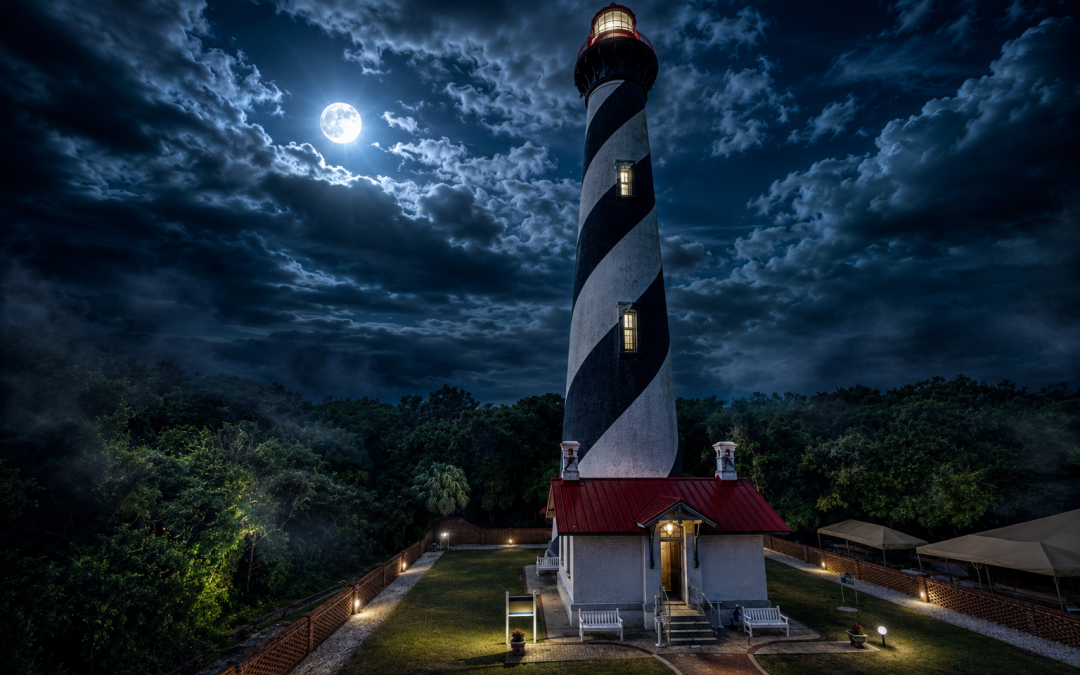
You can see it for miles, that black and white spiral with the red crown, standing 165 feet over Anastasia Island. Most people climb the 219 steps for the view. What they do not always realize is that they are climbing a monument built on top of a drowning, in a town that has been burying its dead longer than any other city in the country.
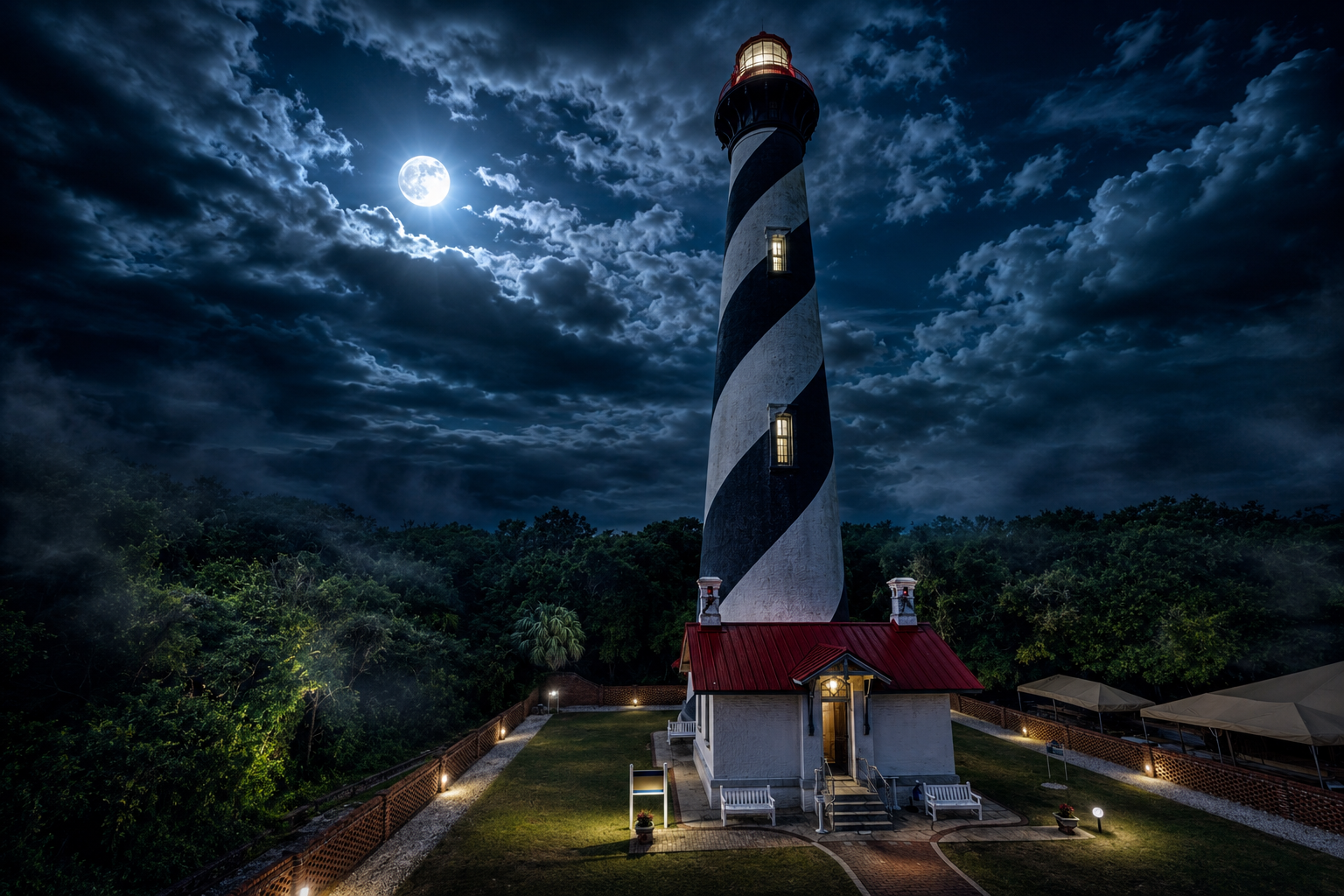
St. Augustine is the oldest continuously occupied European city in the United States, founded in 1565. That is a lot of years, and a lot of years means a lot of grief. The lighthouse is one of the places where all of it seems to gather. Paranormal investigators have called it one of the most haunted spots in America, and the television crews have come and gone with their cameras and their nervous grins. But strip the TV away and the reason people keep coming back is simpler and sadder than any of that. Real people lived and died here. Some of them, apparently, are not finished.
Before the Black and White Tower
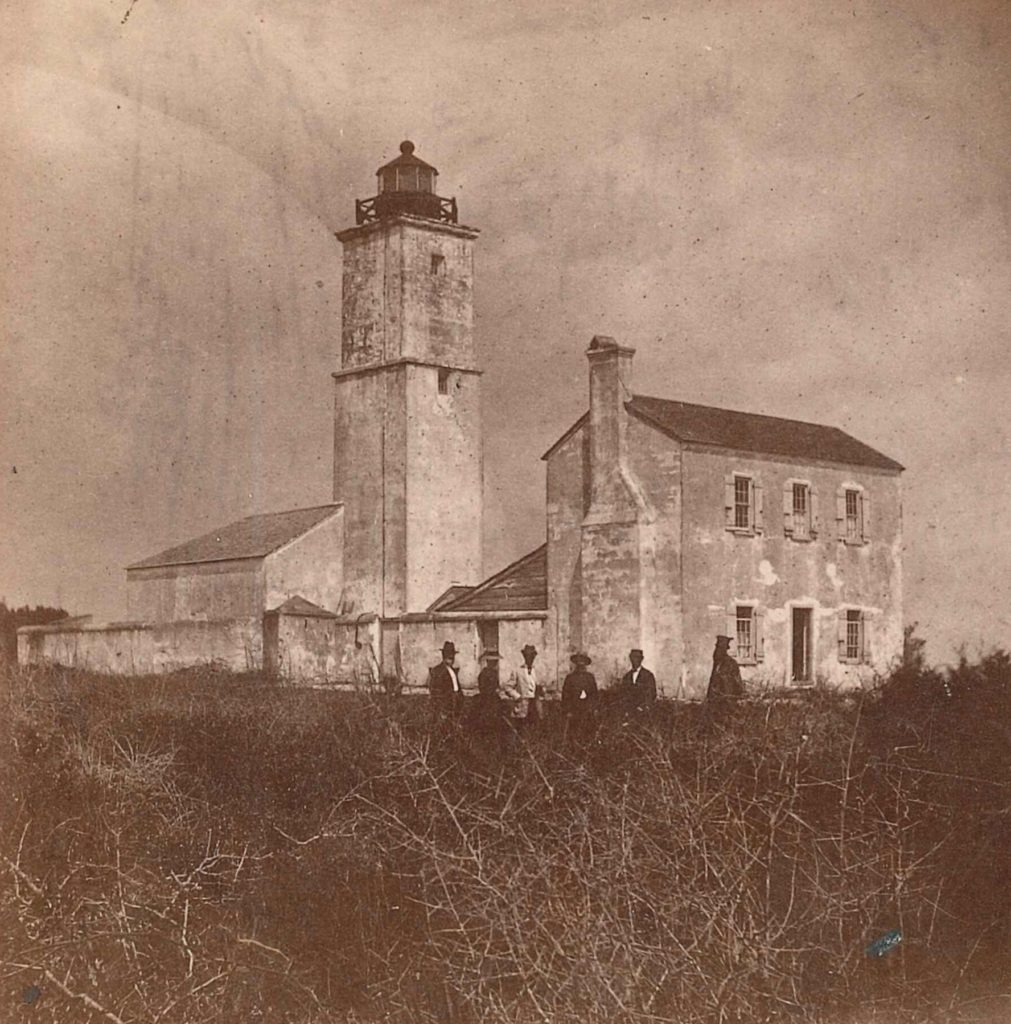
The tower you climb today is actually the second one. Long before it, there was a watchtower on this coast, and there had been some form of one for a very long time. The Spanish and later the British kept a series of wooden watchtowers and beacons here going all the way back to the 1560s, warning ships off the shoals and keeping an eye on the horizon for enemies and pirates. When Florida became a United States territory, the old Spanish coquina watchtower was fitted out and lit officially in May of 1824. That made it Florida's very first lighthouse.
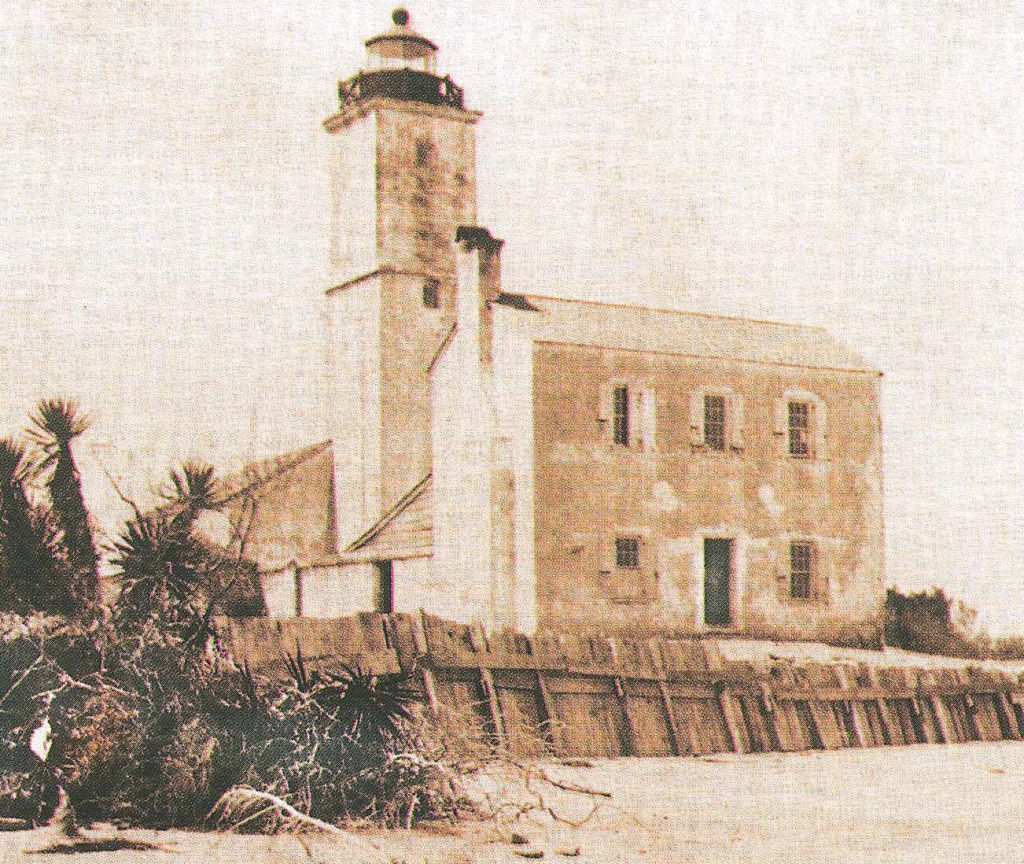
Coquina is a strange and lovely building stone, made of tiny shells cemented together over the ages, quarried right there on Anastasia Island. It is the same material that built the old fort in town. But coquina near the ocean has an enemy, and that enemy is the ocean. Year after year the sea crept closer to the old tower, chewing at the ground beneath it. Everyone could see where it was heading. The light that had guided ships for half a century was going to end up in the water, and long before the century was out, it did. The old tower finally toppled into the sea around 1880.
So the story of the current lighthouse begins as a race. A race against the tide, to raise a new tower before the old one fell.
The Keeper Who Fell
The people who tended these lights were called keepers, and it was not gentle work. A keeper hauled oil up the tower, trimmed the wicks, kept the lens clean, and stayed awake through the worst weather the Atlantic could throw at the coast, because a dark lighthouse could put a ship on the rocks and drown a crew. The lighthouse also had to be painted and maintained, and that is how St. Augustine got its first ghost story, years before the famous one.
In 1859 a keeper named Joseph Andreu was up on the old tower, painting it, working from scaffolding rigged against the coquina. The scaffolding gave way. Andreu fell roughly sixty feet to the ground and did not survive. That is the plain, documented fact of it. And ever since, people have told of a man seen up high on the tower, a shape at the very top where a keeper would stand, watching the water the way Andreu once did before the day the boards let go beneath him.
Building the New Light
Congress put up the money, and the work began around 1871. The design came from architect Paul J. Pelz, who would later help design the Library of Congress. To run the construction, the government brought in a superintendent named Hezekiah H. Pittee, who moved his whole family down from Cape Elizabeth, Maine, to do the job. He settled his wife Mary and their children right there on the site. When your father is building a lighthouse, the lighthouse becomes home.
The building method is worth picturing, because it matters to what happened next. The stone and supplies came in by ship and landed at the docks on Salt Run, down near the water. To get all that weight up the incline to where the tower was rising, the crews used a railway cart running on a track, hauling materials up and rolling the empty cart back down. By 1873 they had the foundation in and about forty-two feet of what would become a 165-foot tower. Slow, heavy, careful work.
And the Pittee children, like any children dropped into the middle of a giant construction site, found the one thing on it that was the most fun and the most dangerous. The cart. They rode it down the track toward the water and hauled it back up to ride again, over and over, a homemade Victorian roller coaster with the sea waiting at the bottom of the hill. There was a board at the end of the track meant to keep the cart from running off into the water. That detail is going to matter.
July 10, 1873
It was a summer afternoon. Four girls climbed into the cart the way they had done a hundred times. Three of them were Pittee daughters, Mary who was fifteen, Eliza who was thirteen, and little Carrie who was only four. The fourth was a young African-American girl, a friend of theirs whose father may have worked on the site, and whose name the records never even bothered to keep.
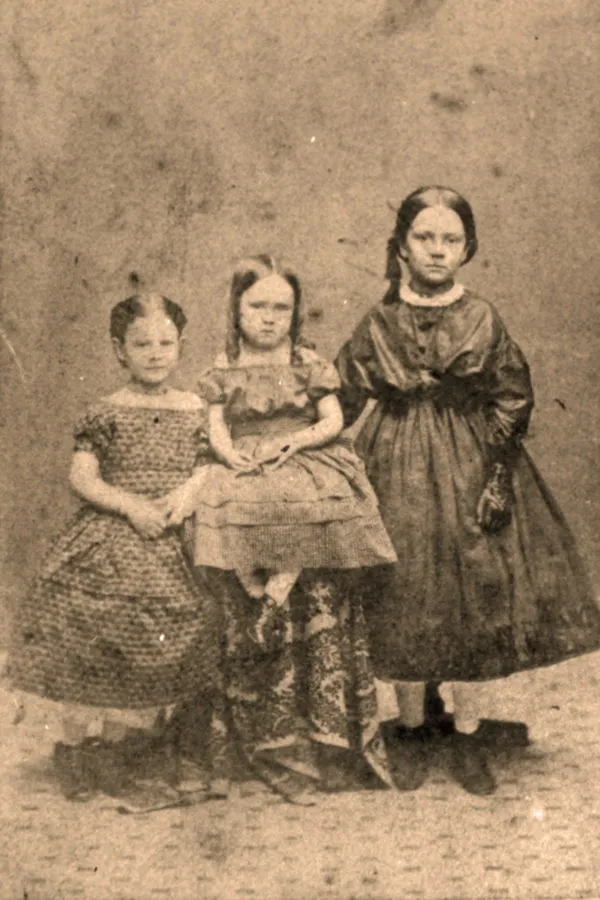
The board that was supposed to stop the cart was not in place that day. Nobody knows exactly why. The cart rolled down the track the way it always did, only this time there was nothing at the end to catch it, and it went straight off into the water and flipped, coming down on top of the girls and pinning them under the surface. A young worker named Dan Sessions saw it happen and ran. He got to the cart and, somehow, found the strength to lift the whole thing off of them. It was not enough. By the time he pulled it free, three of the four had drowned. Mary, Eliza, and the friend whose name was never written down. Only Carrie, the four-year-old, survived.
The town stopped. Construction halted, and St. Augustine shut down for the funeral, the whole community turning out to grieve for children who had died playing in plain sight of their own father's great work. Hezekiah Pittee finished the job he had come to do. But he had buried two daughters to do it, and the tower would stand forever as their headstone.
The Night the Light Came On
The new tower was finished in 1874. On the fifteenth of October that year, a keeper named William Russell climbed up and lit the lamp inside the new first-order Fresnel lens for the very first time. That lens is a giant, nine feet of hand-ground glass, and to light it Russell had to climb inside the thing itself. He was the first keeper of the new tower, and he holds a small distinction that no one else ever will. He worked both towers, the old and the new, the only keeper to bridge them. He is the man standing at the old watchtower in the photograph above, from back before the new light ever burned.
After Russell came a long line of keepers and their families, and the most notable was Major William Harn, a Union officer who had commanded a battery at Gettysburg. He and his wife Kate kept the light for around twenty years, raising six daughters in the keeper's house, which was built as a handsome Victorian duplex during his time. The Harns were remembered for something sweet, of all things, for serving lemonade to visitors out on the porches. For a while the lighthouse was simply a home, full of daughters and lemonade and ordinary life.
Ordinary does not last on this coast. In 1980, long after the keepers were gone and the house sat empty, a fire tore through the keeper's house and gutted it. The cause was called suspicious. The building was saved and restored in the years that followed, and today the whole station is a museum, open nearly every day of the year. People come for the history and the view. A fair number of them leave with a story they did not expect to be telling.
The Hauntings of the Lighthouse
Here is what makes the St. Augustine Lighthouse different from a lot of haunted places. The reports are not vague. People do not just say it "felt creepy." They describe the same specific things, over and over, across different decades and different visitors who never spoke to one another. That kind of consistency is hard to shrug off.
The Laughter on the Stairs
The one you hear most often is the laughter of children. Little giggles drifting through the tower, especially at night, coming from somewhere you cannot quite pin down. There is an old and unsettling version of the story from the keepers themselves. A keeper would hear a child laughing at the top of the tower and start climbing, all 219 steps, only to reach the lantern and hear the same giggling now coming from the bottom, as if a child had slipped past him on a staircase where no one could have passed. People point, understandably, to the Pittee girls. Whatever it is, it seems to like the stairs.
The Girl in the Victorian Dress
Along the paths near the tower, more than one visitor has reported a young girl in an old-fashioned Victorian dress. She is there, and then she is not. The sightings cluster near the water, which is exactly where the accident happened, and that detail tends to quiet a skeptic down more than anything else. Some have described a child standing at the foot of their bed after the lights went out. One has to remember that the youngest survivor of that cart was four years old, and that the ones who did not survive were only children too.
The Figure at the Top
Then there is the dark shape at the lantern. Visitors on the ground have looked up to see the outline of someone leaning over the railing on the catwalk at the very top of the tower, a figure that should not be there, that no one can account for when the guides check. Given the keeper who fell to his death painting the old tower, and given the long line of watchmen who spent their nights up in that high circle of glass, the top of the lighthouse is exactly where you would expect a keeper to linger.
Smoke, Doors, and Music Boxes
The smaller things pile up too. The smell of cigar smoke where no one is smoking, drifting through rooms and then gone. Doors that were locked and bolted at closing found standing open in the morning. Music boxes in the gift shop that open and begin to play on their own. Staff who feel a small hand or a tug while leading a tour. None of it is dramatic on its own. All of it together is why the place ended up on national paranormal television, including a well-known episode of the series Ghost Hunters, whose investigators famously caught a figure moving at the top of the tower during their overnight.
Why the Light Still Draws Them
A lighthouse is a machine built for one purpose. It calls things home through the dark. It throws a light across the water so that whatever is out there, lost and struggling in the night, can find its way back to shore. Sit with that idea for a minute in a place like this one, and the ghost stories start to feel less like entertainment and more like the natural conclusion of what the building was always for.
Because the history here is not made up, and it is not exaggerated. A keeper really did fall from the old tower and die. Three children really did drown at the bottom of that hill on a summer afternoon in 1873, in front of the work their father had come so far to build. Families really did live and love and lose inside that keeper's house before the fire took it. Whether you believe the giggling on the stairs belongs to Mary and Eliza, whether you believe the shape at the railing is a keeper who never came down, the grief that feeds those stories is completely real, and it is old, and it is heavy.
Maybe that is the whole answer. A lighthouse spends its life calling the lost back home. It would only make sense that some of them, having heard that call for a century and a half, would come.
Walk Ancient St. Augustine After Dark
The lighthouse is just one stop in the oldest city in America, a town with more than four centuries of ghosts to its name. Come walk its coquina streets and shadowed corners with a storyteller who knows the history beneath the hauntings. Join Destination Ghost Tours and let St. Augustine tell you its secrets in its own voice.
Book a St. Augustine Ghost TourSources & Further Reading
- St. Augustine Lighthouse & Maritime Museum, "Ghost Stories: The Pittee Girls." staugustinelighthouse.org (the museum's own account of the Pittee family, the July 10, 1873 cart accident, and Dan Sessions' rescue attempt).
- "St. Augustine Light." Wikipedia (1824 first official light, 1871 to 1874 construction, architect Paul J. Pelz, keeper William Russell, Major William A. Harn, and the National Register listing).
- "St. Augustine Lighthouse." ExploreSouthernHistory.com (history of the coquina watchtowers, the erosion of the old tower, and the construction-era tragedy).
- National Register of Historic Places, reference No. 81000668, added March 19, 1981 (official historic designation of the St. Augustine Light Station).
- Scott, Rick. "Spooky Sailing Stories: Spirits of the St. Augustine Lighthouse." Small Craft Advisor (keeper Joseph Andreu's 1859 fall, the 219-step tower, and reported apparitions).
Historical facts in this article are drawn from the sources above, with priority given to the lighthouse museum's own records. Where accounts are traditional or anecdotal, such as the reported hauntings, the text presents them as the widely told stories they are rather than as settled fact.