
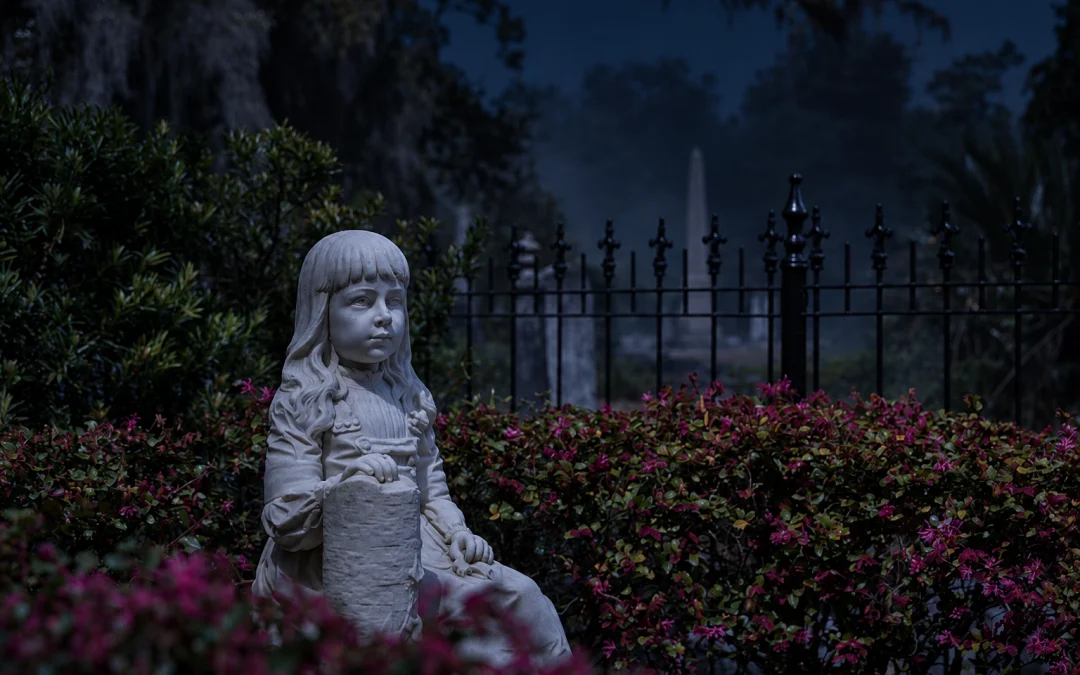
On a sultry Savannah evening, as the last blush of sunset fades behind moss-draped oaks, the city’s centuries-old squares come alive with whispers of the past. Among all the ghost stories Savannah has to offer, one stands out for its poignant blend of history and the supernatural — the tale of Little Gracie Watson.
Gracie’s story has become a cornerstone of Savannah folklore, told not only for its chills but for the touching humanity at its core. By day, visitors to Bonaventure Cemetery seek out her grave as a must-see sight; by night, her spirit is said to linger in the places she once knew. This is the life — and afterlife — of Gracie Watson: her happy childhood amid Gilded Age grandeur, the tragedy of her untimely death, the striking monument that guards her memory, and the legends that keep her spirit alive.
A Child of the Pulaski Hotel

In the late 1880s, the Pulaski House Hotel stood proudly on the corner of Bull and Bryan Streets, overlooking Savannah’s historic Johnson Square. This grand hotel was one of the city’s finest establishments — a hub of gilded Southern hospitality where gaslight chandeliers glowed against ornate wallpaper and the clink of crystal filled the air during society parties. Within its opulent halls lived a little girl whose warmth would leave an indelible mark on Savannah’s heart: Gracie Perry Watson, affectionately known as “Little Gracie.”
Gracie was born in 1883, the only child of W. J. Watson and his wife, Frances. Her father managed the Pulaski Hotel, and so Gracie quite literally grew up amid its bustle and charm. From the time she could toddle across the marble lobby, she was a darling of the guests, who would pause to smile at the rosy-cheeked girl playing on the grand staircase or peeking from behind a velvet drape. She had an infectious laugh and a precocious demeanor that lit up the halls, and she became the hotel’s unofficial greeter — Savannah’s sweetest little hostess.
Savannah’s elite and travelers alike grew fond of the child who brought a family touch to the grand hotel. It wasn’t uncommon for Gracie to pick out melodies by ear on the lobby piano, or to dance about in her frilly dress inventing games to entertain weary visitors. During lavish soirées in the Pulaski’s parlors, guests would spot her mingling among the adults with charming innocence — curtsying politely, offering a plate of sweets, giggling at a well-told joke. She became a kind of living mascot for the hotel, and well-heeled patrons would tip their hats to her, drawing a cheerful wave or a little bow in return.
Despite her popularity, Gracie remained a humble, playful child. When the formalities of high society grew tiresome, she had a favorite hiding spot beneath the back stairwell, where she would play pretend with her dolls or simply watch the grown-up world from her secret nook. Her periodic disappearances became a source of gentle amusement; it became a running quip at late-night parties for someone to ask with a smile, “Where’s Gracie gone off to?” — a sign the hour was growing late. Moments later she might reappear from under the stairs with a mischievous grin, eliciting affectionate laughter.
Outside the Pulaski’s doors, Johnson Square sprawled like a lush communal front yard. By day, Gracie skipped beneath the live oaks, chasing butterflies in her white lace dress while her parents attended to business inside. Locals knew her by sight; some would stop to chat or offer a peppermint from their pockets. In an era when Savannah was blossoming as a travel destination, Little Gracie became a tiny goodwill ambassador — a bright-eyed child who might greet arriving travelers with a shy “Hello,” bridging the gap between stranger and friend. Unbeknownst to anyone, this period of happiness was painfully short-lived.
Easter of 1889: Tragedy Strikes
As the winter of 1888 melted into a mild spring, Savannah prepared for Easter with flower-draped altars and festive bonnets. At the Pulaski, young Gracie had been eagerly counting down the days, excited about pastel eggs and sweet hot cross buns. But fate intervened cruelly. In early April 1889, Gracie fell ill. What began as a simple fever and cough quickly worsened into pneumonia — a formidable foe in the 19th century, especially for a child. The high-ceilinged rooms that had so often echoed with her laughter now fell silent, save for the sound of her labored breathing and her mother’s hushed prayers.
Despite the efforts of doctors — who likely prescribed steam inhalations or mustard plasters, the best treatments of the time — Gracie’s condition deteriorated. The little girl who had once bounded across Johnson Square was now confined to bed, cheeks flushed with fever. Regular guests and staff tiptoed around the corridors, well aware that their beloved little mascot was gravely ill. A pall of anxiety hung over the Pulaski; the grand hotel that had so often hosted jubilant celebrations now hosted a family tragedy in slow motion.
Two days before Easter Sunday, on April 22, 1889, Little Gracie Watson passed away. She was just six years old. News of her death swept through Savannah, bringing an outpouring of sorrow; the city that had watched her play and grow felt as though it had lost a member of its own family. Contemporary accounts noted the cause as a severe case of pneumonia leading to blood poisoning that no medicine could halt — clinical words that did little to convey the heartbreak of a vibrant child snatched away in the bloom of youth.
Gracie’s funeral was a sorrowful affair, attended by both the elite of Savannah and everyday townsfolk who had come to know her. Her small coffin, adorned with lilies and roses, was a tragic contrast to the lively child who had danced through the hotel’s parlors. One imagines the procession moving through the streets to Bonaventure Cemetery, the warm brightness of a Savannah spring a poignant irony as grieving parents laid to rest the light of their lives.
In the wake of Gracie’s death, the Pulaski Hotel was hushed. The corner of the lobby piano bench where she often sat was a painful reminder of what had been lost. Her mother, Frances, was said to be inconsolable, and her father, W. J. — a man known for his capable management and affable nature — was utterly devastated. As Easter Sunday came, church bells rang out hymns of resurrection across Savannah, yet inside the Watsons’ quarters all hope seemed, for a time, lost. In time, this tragedy would become an inseparable part of Savannah’s lore — but first it was a deeply human story of love and loss. And in the face of it, Gracie’s parents sought a way to preserve the memory of their cherished child in a form more enduring than even their broken hearts could hold.
A Grieving Family and a Marble Memorial
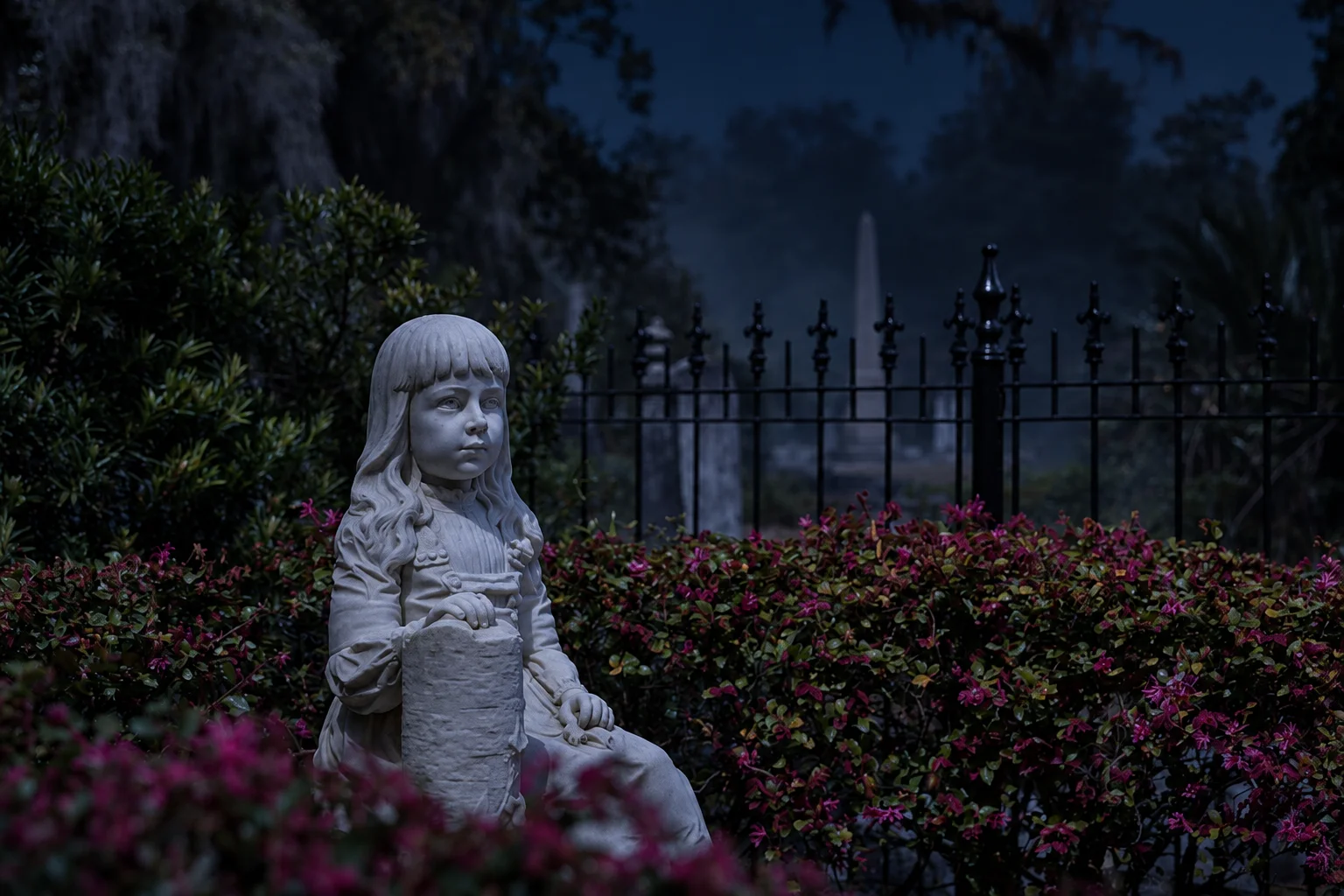
Wales J. Watson and his wife Frances found themselves engulfed in grief. In the quiet weeks after the funeral, an idea took root: they would commission a special monument for Gracie’s grave. If they could no longer hold their daughter, they could at least create something beautiful and lasting to honor her short life. Fortunately, a talented young sculptor named John Walz had just moved to Savannah in 1890. The German-born artist was building a reputation for exquisitely detailed marble work, and W. J. approached him with a singular request: create a life-size statue of Little Gracie, carved in her exact likeness.
Walz accepted, working from a cherished photograph taken not long before her illness. One can imagine him in his studio, late light catching motes of marble dust, as he carved each curl of Gracie’s hair and every fold of her Sunday dress. It was a labor of both art and empathy, and the result was extraordinary: an uncannily lifelike statue that seemed to capture the very essence of the child.
In 1890, the completed monument was erected at Gracie’s gravesite in Bonaventure Cemetery. The marble figure depicts her seated demurely, her hands resting in her lap, with a tree stump at her side — perhaps symbolizing a life cut short. Her face is carved with remarkable realism; visitors often remark that it looks as if Gracie herself might gaze up at them at any moment. Locals began simply calling the monument “Little Gracie,” as if the girl and the statue were one.
At the foot of the statue, an inscription tells her story to all who pass:
“Little Gracie Watson was born in 1883, the only child of her parents. Her father was manager of the Pulaski House, one of Savannah’s leading hotels, where the beautiful and charming little girl was a favorite with the guests. Two days before Easter, in April 1889, Gracie died of pneumonia at the age of six. In 1890, when the rising sculptor, John Walz, moved to Savannah, he carved from a photograph this life-sized, delicately detailed marble statue, which for almost a century has captured the interest of all passersby.”
For W. J. and Frances, the statue was a source of both comfort and pain — it immortalized their daughter’s image, yet it also concretely marked her absence. In time, the weight of memory at every turn drove the family from the city. W. J. remained connected to Savannah for years after Gracie’s death, going on to manage the old DeSoto Hotel and even serving as a city alderman, but eventually the Watsons returned to their home region in the Northeast, carrying their heartbreak with them.
Tellingly, though, they left Gracie’s monument standing guard in Bonaventure. They could not take their child with them, but they ensured she was not left unattended — the marble Gracie became the ever-vigilant guardian of the real Gracie’s resting place. W. J. was eventually laid to rest in Vermont, and Frances in upstate New York, their final resting places states apart from their little girl’s. In death as in life, Gracie remained in Savannah — except she was never truly alone. The city adopted her grave as its own, and to this day locals and visitors continue to care for it, decorate it, and share her story.
The Little Angel of Bonaventure Cemetery
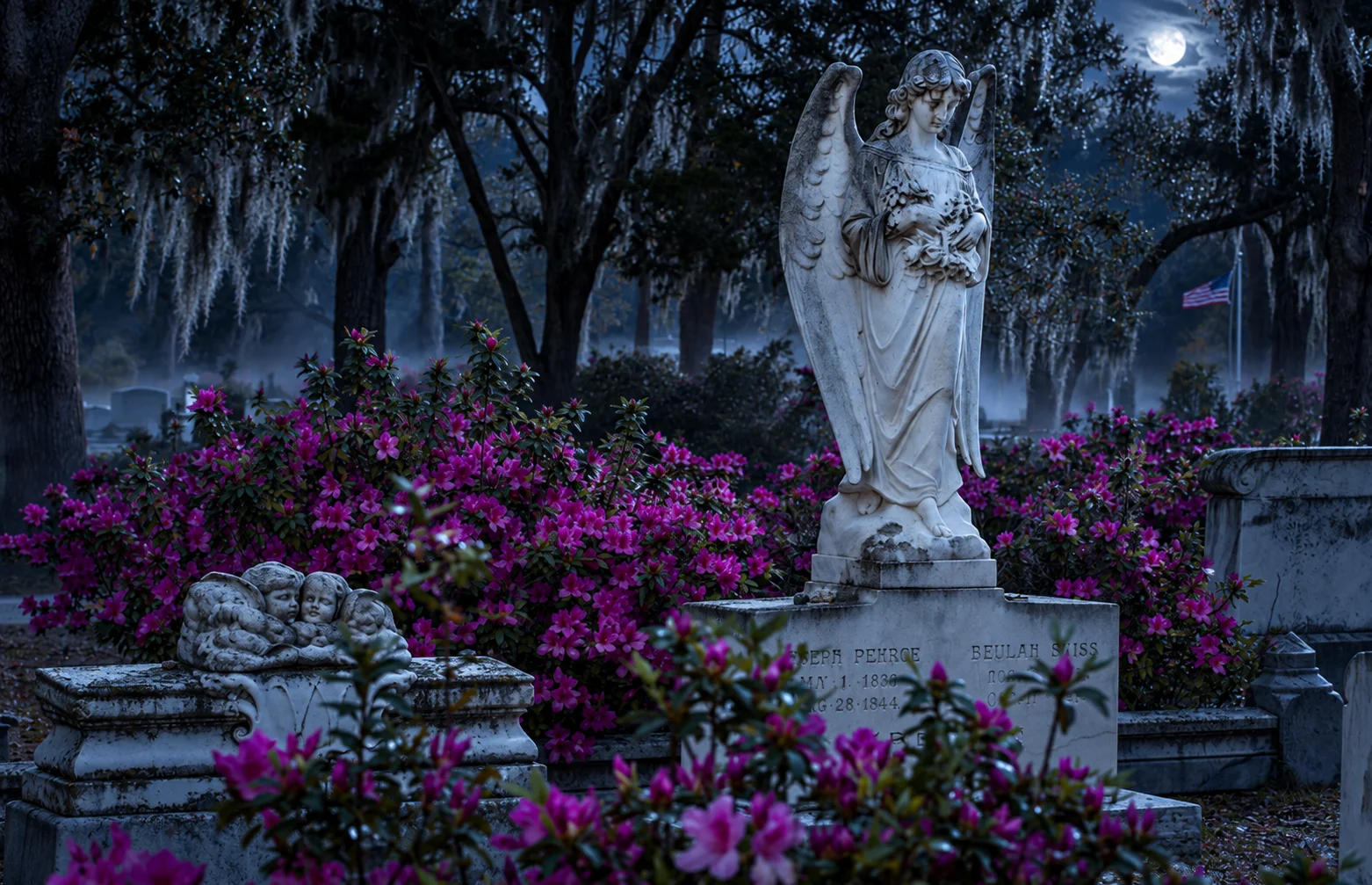
Bonaventure Cemetery, where Gracie lies, is often called one of the most beautiful and haunting burial grounds in the world. Set on a bluff overlooking the Wilmington River, it is a place where nature’s beauty and the sorrow of loss intertwine — ancient live oaks veiled in Spanish moss, magnolias and camellias, the scent of spring azaleas mixing with the salt of the marsh. By day, sunlight filters through the green canopy; by twilight, long shadows stretch between the monuments and the whole cemetery takes on an otherworldly, eerie ambience. It is here — in the cemetery that helped inspire Midnight in the Garden of Good and Evil — that Little Gracie’s grave became both a shrine and a legend.
For decades, her grave was tended quietly, known mostly to Savannahians. Bonaventure itself became famous only in the 1990s, thanks to John Berendt’s bestseller, whose cover featured the haunting “Bird Girl” statue that once stood here. Readers flocked to Savannah to glimpse it, and to protect the sculpture from the crowds, the Bird Girl was eventually moved to a museum — leaving tourists in search of another emblematic monument. It was Little Gracie’s time to shine. Unlike the anonymous Bird Girl, Gracie’s statue represented a real child with a real, tragic tale, and before long her resting place became one of the most visited graves in the world. A 2017 Condé Nast Traveler list ranked it among the top ten most-visited worldwide — remarkable for a girl who was neither a celebrity nor a political figure, but simply a beloved local child.
What draws people in such numbers? Part of it is the sheer visual impact — many do a double-take, half expecting the marble to breathe. Surrounded by a protective wrought-iron fence (installed in 1999 to prevent damage), the statue sits in a small plot that has become an outdoor shrine, its base often heaped with toys, beads, ribbons, flowers, and coins left by visitors. It has become a tradition to bring a gift for Gracie — as if to see that a little girl who died with so many Christmases and Easters unlived might still share in the joy of them. Around Christmas, especially, the pile of toys grows tall.
That love has left its marks. Admirers once reached in to touch Gracie’s face, gradually wearing the marble; one local legend even held that rubbing the tip of her nose brought good luck on exams. The statue’s nose was damaged at one point and had to be repaired, which is part of why the iron fence and surrounding shrubs now keep the sculpture safe from handling. Still, the connection people feel remains intimate. Many stand at the fence quietly, almost expecting the marble girl to turn her head. Some say sunlight always seems to find her statue through the branches, and that on cloudy days the area falls into an extra hush. Each year on her birthday, July 10th, local guides make a point to stop by with their groups, sometimes even singing a quiet “Happy Birthday” in her honor.
Ghostly Tales and Legends of Little Gracie
Gracie Watson’s story might have ended with her burial in 1889, but according to countless locals and visitors, her spirit had other plans. In Savannah, where the line between past and present so often blurs, the ghost stories surrounding Little Gracie are both plentiful and goosebump-inducing — and, whether one believes in ghosts or not, they have become an inseparable part of her legacy.
Whispers at the Pulaski Hotel Site
The first reports of Gracie’s ghostly presence centered on the place she held dearest in life: the Pulaski Hotel. In the months after April 1889, staff and residents began to speak of uncanny occurrences. Frances Watson herself reportedly confided that on quiet evenings she could still hear her daughter’s playful laughter echoing from the back stairwell — Gracie’s favorite hideaway. Several employees admitted they, too, heard a little girl laughing or singing softly in empty rooms. At first they dismissed it as grief playing tricks; but as the incidents persisted, a chilling thought set in — perhaps Gracie’s spirit had never left.
As time passed, guests occasionally reported the sensation of being watched, or glimpsed a small figure in a white dress darting around a corner or at the top of the stairs — always brief and peripheral, gone when they looked twice, yet oddly consistent: a little girl in period clothing, moving silently through the shadows.
The Pulaski Hotel itself did not survive the ravages of time; it closed around 1948 and was demolished in the mid-1950s, replaced by a modern building on the corner of Bull and Bryan. But if the tales are true, even tearing down the walls that housed her could not dispel Gracie’s spirit — and Johnson Square, the park the Pulaski once overlooked, became the new stage for her appearances.
By the late 20th and early 21st centuries, numerous people claimed to encounter Little Gracie’s ghost in and around Johnson Square. Security guards and cleaning crews have described the inexplicable sight of a young girl wandering the deserted square at night. One story tells of a night watchman who spotted a lone child on a bench under the moonlight; concerned she was lost, he approached, only to watch her stand, skip lightly away, and simply fade into the darkness. Others sitting in the square on warm nights have reported a petite girl in a pale dress running among the oaks, chasing something unseen, always in eerie silence. Tour guides sometimes suggest that if you find yourself alone there, you might softly call “Gracie” — and listen for a giggle on the wind.
Perhaps the most striking account came from a veteran tour guide in 2002. Pausing in Johnson Square to tell Gracie’s story, she glanced at the dark windows of the modern building on the historic lot and saw, in the reflection, the distinct outline of a four-story building behind her group — an old-fashioned structure with warm-lit windows, like a hotel from another time. When she turned to look directly, there was nothing but the night and the park. The phantom building persisted in the reflections until she finished the tale, then vanished. Later, researching in the archives, she found photographs of the long-gone Pulaski Hotel and recognized it exactly. It’s as if, in the telling, the past briefly came back into focus.
Interestingly, unlike almost every other square in Savannah, Johnson Square’s oaks are notably bare of Spanish moss. Local lore offers various explanations — the soil, the influence of General Nathanael Greene’s tomb, which also occupies the square — but some whisper a more poetic theory: that the absence of moss is a mark of respect for Little Gracie, as if the trees themselves refuse to cast their usual shrouds over the child spirit who plays beneath them.
A Watchful Presence at Bonaventure Cemetery
If Gracie’s spirit lingers near her old home, many believe it also keeps close to her final resting place. One common story comes from caretakers and guides doing early-morning rounds, who have found the toys and trinkets at Gracie’s grave mysteriously rearranged from the evening before. Animals or mischievous visitors could explain it — but some quietly wonder if Gracie herself had been “playing” with her gifts when no one was watching.
More spine-tingling are the reported sightings of an actual girl among the graves — a little girl in a white dress, seen skipping between the headstones down a long, oak-lined avenue, only to vanish when anyone approaches, leaving no footprints in the dew. One tourist on a guided walk reportedly snapped a photo of what they swore was a child standing beside Gracie’s statue; the figure wasn’t visible in person but appeared, semi-transparent, in the digital image.
Another famous legend is that of the weeping statue: it’s said that if anyone is disrespectful enough to remove an offering left at the grave, Gracie’s statue will shed tears of blood. There are no confirmed reports of anyone witnessing it, but the story persists as a stern warning — and no doubt helps discourage vandalism. Then there is the tale of the disappearing coin: place a coin in the statue’s open hand, walk around the grave three times, and it will vanish. (For the record, the fence means visitors can no longer touch the statue, so this one now lives mostly in the imagination.)
Even among seasoned guides, Gracie’s ghost is considered one of Savannah’s friendliest phantoms — benign, even endearing. Encountering her is said to leave one with melancholy rather than terror: an empathic sadness at a young life lost, coupled with a strange comfort that she’s still around. There are touching anecdotes of children who visit and later tell their parents that “the little girl” played with them while the adults saw no such child. One little boy reportedly asked his mother if he could give his ball to his “new friend Gracie,” who was “sad because she can’t leave this garden.” The puzzled mother let him leave the toy at the gate. These stories reinforce Gracie’s image not as a fearsome ghost, but as a lonely little soul reaching out for a playmate.
The Lasting Legacy of Little Gracie Watson
Savannah’s most cherished ghost is, paradoxically, one of its brightest symbols of life and love.
More than a century has passed since Little Gracie took her last breath, yet her presence in Savannah feels as alive as ever — and not only through ghostly lore. When visitors stand before her grave, they’re reminded of the universality of grief and the timeless bond between parent and child. It’s common to see a stranger reach through the fence to leave a bouquet or a small toy; in those moments, Gracie represents all children who left the world too soon, and all parents who have mourned an unimaginable loss. It’s a quiet, persistent legacy of empathy.
Her tale has also become the “heart” of Savannah’s ghost lore. It’s not the scariest story by any means, but it’s the one that can bring a tear to the eye even as it sends a chill down the spine, which is why many guides save it for the end of an evening walk. Her story humanizes the very idea of a ghost: she is not an otherworldly aberration, but Savannah’s eternal child, cared for and spoken of with affection. The Bonaventure Historical Society and cemetery curators have embraced the legend as part of the site’s rich tapestry, while gently reminding visitors that she was a real little girl and that her statue is a genuine treasure of Georgia funerary art, deserving of protection.
From an educational standpoint, Gracie’s story is an engaging doorway into Savannah’s Victorian era — hotel life in the 1880s, how communities coped with illness before modern medicine, 19th-century mourning customs, and the art of memorial sculpture. She puts a very personal face on broader history. And she has shaped the way Savannah approaches storytelling itself: many local guides cite her tale as the one that made them fall in love with the craft, because holding a lantern beneath an oak and lighting the face of her statue in the distance — and seeing the wonder on listeners’ faces — is a special kind of magic that merges entertainment with remembrance.
Walk through Johnson Square today and you might see busy professionals hurrying past and tourists photographing the old City Hall dome nearby. Few notice the spot where the back steps of the Pulaski once stood — but pause there, and you may feel a peculiar lightness, as if an unseen friend is near. Come nightfall, the square might play tricks on your ears and eyes. Is that the tap of a child’s dress shoes on the pavement? Did a shadow under the oaks move a little too independently of the breeze? In Bonaventure at dusk, visitors gather quietly at Gracie’s fence, speaking in lowered voices as if the figure might stir. In those silent moments, one might argue that Gracie’s “ghost” is indeed present — not as a specter in a white dress, but as the invisible thread connecting all those moved by her story.
Little Gracie’s laughter may have fallen silent in 1889, but it echoes still — in Johnson Square, in Bonaventure, and in the hearts of everyone who hears her tale beneath the moss-draped moonlight. Savannah’s most cherished ghost is, paradoxically, one of its brightest symbols of life, love, and the enduring power of story.
Meet Savannah’s Most Beloved Ghost
From Johnson Square to the oaks of Bonaventure, Little Gracie’s story is one of the most moving on any haunted Savannah tour. Come hear it where it happened.
Book a Savannah Ghost Tour
Chris Allen is the founder of Destination Ghost Tours, a historian and storyteller with a lifelong fascination for the darker corners of history. He spends his time uncovering the true stories behind haunted legends, guiding guests through historic cities, and chasing down details that refuse to stay buried. When he is not working, he can usually be found with his partner Arissa, their dog Bear, and their two cats, Trouble and Covu, photographing old places, digging through archives, or disappearing into historical rabbit holes. He believes the best history is honest, atmospheric, and just unsettling enough to linger.