
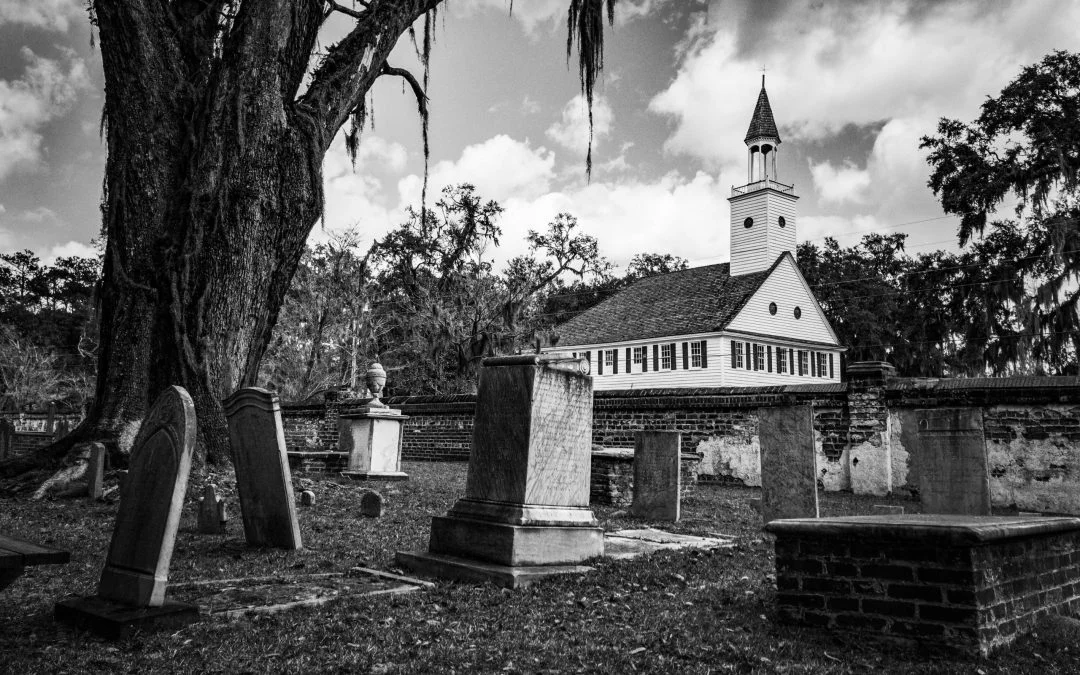
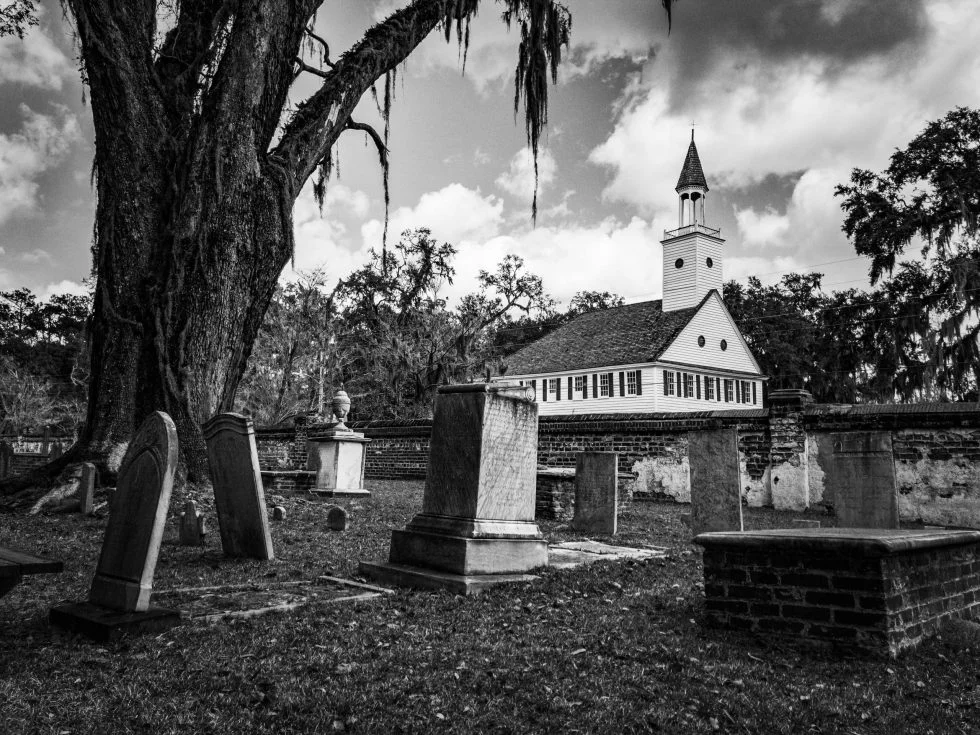
A short drive south of Savannah, in Liberty County, stands one of the most historically significant — and most haunted — sites in all of Georgia: Midway Cemetery, and the white clapboard church that keeps watch across the road.
Midway Cemetery is a landmark of Southern history, its graves predating the American Revolution. It was added to the National Register of Historic Places in 1973, and sits off Highway 17 at Martin Road, across from the historic Midway Congregational Church. Established in 1752 as a burial ground for the Congregationalists who settled the Midway district, it holds patriots who helped found the United States, veterans of the War of 1812 and the Civil War — and, if the stories are true, more than a few restless spirits.
A Cradle of the Revolution
The Congregationalists who founded Midway were a remarkable, tight-knit community — Puritan-descended settlers who had migrated from Dorchester, South Carolina (and, generations before that, from Massachusetts) to establish a new society in the Georgia lowcountry. They organized their church in 1752 and laid out their burial ground the same year, and they would go on to play a role in the birth of the nation far larger than their small numbers suggested.
It was at Midway Church that the citizens of the area gathered in 1775 to elect a representative to the Continental Congress. Lyman Hall, a member of the congregation, was chosen, joining Button Gwinnett of nearby Sunbury and George Walton of Augusta as Georgia’s delegates — giving this one small parish an outsized share of the state’s representation. Hall became one of three Georgians to sign the Declaration of Independence. The Congregationalists of Midway were fierce advocates for American independence, and many of them would pay for that support with their property and their lives.
Fire and War: The Revolution Comes to Midway
In November 1778, British forces moved north from East Florida to invade Georgia. Savannah would soon fall, and the focus turned to Midway and Sunbury. British Lt. Col. James Mark Prevost ordered widespread destruction and looting of the farms and plantations along his route. In the fighting near Midway, the Georgia patriot General James Screven was mortally wounded. And as the British withdrew, Prevost’s men put the torch to Midway Church itself. The congregation would not be so easily silenced: they rebuilt, and the graceful white meeting house that still stands today was raised in 1792.
A Tragedy in the Cemetery: A Murder in the Wall
The brick wall that surrounds Midway Cemetery was built long before the Civil War, and local legend holds that it was constructed with enslaved labor — and that it was the scene of a tragic encounter between two of its builders.
As the story goes, an argument broke out between two of the enslaved workers, and in the heat of it, one struck and killed the other with a brick. Fearing discovery, the killer hid his victim’s body inside the wall he was building. Years later, the wall cracked, and the bones of the missing man were found within it. The wall has been repaired many times since — but, so the legend says, each time the crack returns to the very same spot. Some believe the murdered man still walks the cemetery, unable to rest.
Forbidden Love and Untimely Death
Another of Midway’s ghost stories involves two young people in antebellum-era dress that visitors say they have glimpsed among the graves. According to the legend, the pair had fallen into a forbidden love and would meet in secret in the cemetery: a seventeen-year-old named Sylvia Brown, and a young man named Anthony, who was enslaved by Sylvia’s father.
When her father learned of the affair, the story says, he had Anthony killed, hanged from the very tree where the two had met. Sylvia found him there and, in her grief, took her own life at the scene. To this day, visitors report seeing shadow figures beneath that tree — two young souls, the legend holds, still bound to the place where their story ended.
The Civil War Reaches Midway
When Georgia seceded from the Union in 1861, the men of Liberty County turned out in solid support of their state. Though Union warships blockaded St. Catherine’s Sound, the war itself did not reach the county until 1864, when General William Tecumseh Sherman closed in on Savannah at the end of his March to the Sea.
Sherman ordered Major General Judson Kilpatrick’s cavalry to screen his right flank as he took Savannah and Fort McAllister. Kilpatrick — a commander Sherman himself reportedly called “a hell of a damned fool,” if the right kind for the job — and his men showed little respect for the living or the dead of Liberty County. Murray’s Brigade of Kilpatrick’s division occupied Midway on November 13, 1864, and Kilpatrick set up headquarters in Midway Church the next day. His troopers turned the cemetery into a corral, using the old brick wall to pen their horses among the graves — and, by many accounts, slaughtering livestock among the headstones. It was a desecration the community never forgot.
Some Notable Burials
Among the most famous people resting at Midway is General James Screven, the Revolutionary War hero mortally wounded near Midway in 1778. Georgia honored him by naming Screven County in his memory.
Also buried here is General Daniel Stewart, who served in the Revolution as a boy under legendary partisan leaders like Francis Marion — the “Swamp Fox” — and Thomas Sumter, and who later distinguished himself in the Indian Wars that followed. Fort Stewart, Georgia’s sprawling Army post in Liberty County, bears his name to this day. Stewart holds one more distinction: he was an ancestor of President Theodore Roosevelt.
Georgia governor Nathan Brownson is also reported to be buried at Midway. A physician and Continental Congress delegate, Brownson was elected governor after the fall of Augusta in early 1781. Though he served only about four and a half months, his brief term is generally judged a success: he confiscated Loyalist property and sold it to buy food and supplies for the Georgia militia and the people of the state.
A Zombie Movie Filmed Here?

Midway’s moss-draped, brooding atmosphere has drawn more than pilgrims and historians — it also caught the eye of a horror legend. In 1980, the Italian director Lucio Fulci came to Georgia to shoot City of the Living Dead (also released as The Gates of Hell), using Savannah and the surrounding lowcountry to stand in for his fictional New England town of “Dunwich,” a nod to the horror writer H. P. Lovecraft.
The film famously opens with a priest, Father Thomas, taking his own life in a cemetery — an act that tears open the gates of hell and looses the dead upon the world. It’s one of the most iconic openings in Italian horror, and Midway’s church and cemetery, with their ancient live oaks and weathered brick, provided exactly the eerie backdrop Fulci was looking for. (A quick note for film buffs: this is not the 1960 British film “The City of the Dead” — a common mix-up — but Fulci’s gory 1980 cult classic, the first entry in his unofficial “Gates of Hell” trilogy.)
A place where American history and the gates of hell were filmed on the same ground.

It’s a fitting bit of trivia for a place this steeped in the past. Where two Declaration signers’ countrymen once gathered, where a church was burned and a cemetery turned into a cavalry corral, where legends of murder and doomed love still cling to the oaks — a filmmaker came looking for a doorway to the underworld, and found it here at Midway.
Discover More of Haunted Georgia
Midway is one of the lowcountry’s most haunted historic sites — and Savannah, just up the road, is called America’s Most Haunted City. Come explore its dark history with Destination Ghost Tours.
Book a Savannah Ghost Tour
Chris Allen is the founder of Destination Ghost Tours, a historian and storyteller with a lifelong fascination for the darker corners of history. He spends his time uncovering the true stories behind haunted legends, guiding guests through historic cities, and chasing down details that refuse to stay buried. When he is not working, he can usually be found with his partner Arissa, their dog Bear, and their two cats, Trouble and Covu, photographing old places, digging through archives, or disappearing into historical rabbit holes. He believes the best history is honest, atmospheric, and just unsettling enough to linger.
Maybe you can help me. Back in 1982, I was stationed at Fort Stewart and I lived in Hinesville. One weekend I was out driving, not too far from Hinesville as I remember, and I came upon a white-washed church that looks just like the church in this picture. Behind the church was a small cemetery (no more than thirty headstones) and one of the gravestones that I came across said that the person that was buried there was a graduate of the United States Military Academy from one of the classes in the early 1800’s (possibly around 1830.) I have traveled back to that area several times looking to find that cemetery, but I have and I have been unable to find it. I do not have a name or the actual class that the man graduated from, but his marker indicated that he had been an officer in the US Army when he passed away. Any help you can give me in finding this gravesite would be so appreciated!!!