
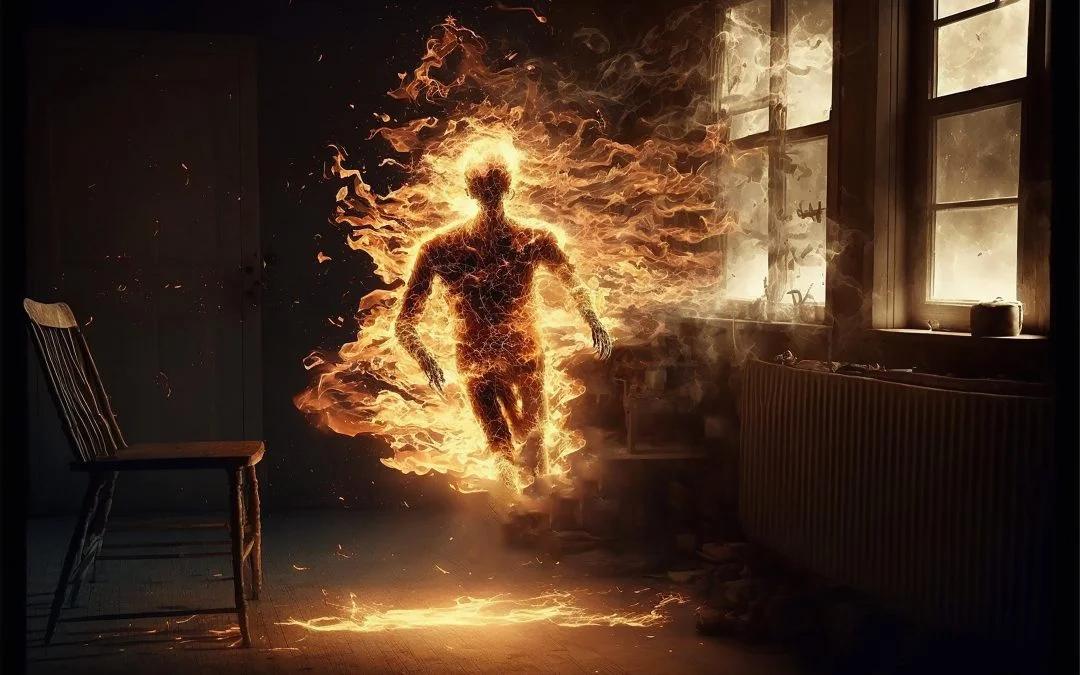
On a mild November night in 1974, Jack Angel settled in for some rest in his motorhome, parked at a Savannah, Georgia motel. Hours later, the 66-year-old traveling salesman awoke to a living nightmare — his skin seared with burns, blisters bubbling across his chest and limbs, yet no flames or smoke anywhere in sight.
The air was still. His pajamas and bedding were untouched by fire, and the RV’s interior showed no scorch marks. Dazed and in agony, Angel stumbled out into the cool night and collapsed on the hotel lobby floor, seeking help. What happened to him that night in Savannah remains one of the strangest cases in the long, smoldering history of a phenomenon called spontaneous human combustion.
A Survivor Amid the Flames

Jack Angel’s fiery ordeal defied all conventional explanation. He later described feeling “this big explosion in my chest,” which left a raw hole in his torso. Burns mottled his legs, groin, ankle, and back — but strangely, he hadn’t felt the pain until he woke up. By the time he was rushed to Savannah Memorial Hospital, his right arm had become gravely infected and had to be amputated below the elbow. Doctors were baffled: the burn patterns suggested the fire had started from within his body, seeming to originate deep within his arm.
Angel himself was haunted by the mystery. Once recovered enough to speak, he and his wife scoured the motorhome for any sign of an electrical short or stray flame — nothing. The sheets, sofa, and wiring were pristine. “Something had to have caused all of the injuries,” he insisted, yet every normal cause had evaporated without a trace.
Investigators faced a puzzle worthy of the X-Files. A lightning strike? Unlikely — weather records showed clear skies. A power-line surge? None detected. Only after dismantling the RV’s plumbing did a clue emerge: the hot water heater’s safety valve was found open. A theory formed that Angel might have woken to find the shower water cold, gone to fix the heater’s water pressure, and inadvertently released a jet of scalding, pressurized water onto himself. Such an eruption could cook human tissue with intense heat while leaving clothes and surroundings unharmed. In fact, Angel eventually admitted in court that he had been sprayed by hot water while trying to adjust the valve.
Despite the damning evidence, Angel had initially pursued a different story. With a prominent law firm behind him, he filed a $3 million lawsuit against the manufacturer, blaming a faulty water heater. But as the case dragged on, his narrative shifted. In legal depositions he described the hot-water accident, only to later revert and sell his tale as a survivor of spontaneous human combustion on TV shows like That’s Incredible! The lawsuit collapsed for lack of proof — dropped by his attorneys a week before trial — leaving Jack Angel with a lost arm, a failed marriage, and a mystery that shadowed his remaining years. He died in 1986, never fully learning what had nearly turned him to ash.
Spontaneous Human Combustion: A Fiery Phenomenon
Angel’s case was extraordinary — he lived to tell the tale. Most alleged victims of spontaneous human combustion (SHC) do not survive. SHC is the idea that a living human body can suddenly catch fire from within, without any external ignition source. The concept has appeared in lore and literature for centuries, typically involving people found reduced to ashes with their surroundings eerily unburnt. In classic cases, investigators find an “impossible” fire: the body incinerated at high temperature while nearby furniture, floors, and clothing remain relatively untouched. Often the only remnants are charred limbs or a shrunken skull, and a greasy soot clinging to the walls — as if the fire had a selective appetite, consuming the body but little else.
The idea is both compelling and terrifying: could a person burst into flames for no reason? Over the last 300 years, there have been a few hundred reported cases worldwide, and they follow a haunting pattern. Typically the victim is alone, often elderly or infirm; the combustion almost always occurs indoors; and witnesses often report a sweet, smoky odor afterward. In Jack Angel’s scenario, the lack of external fire damage and his delayed pain fit the mold — as if his body burned quietly from the inside out while he slept.
Historical Cases and Haunted History

Strange cases of human combustion date back to at least the 17th century. One early account from the late 1400s tells of an Italian knight, Polonus Vorstius, who allegedly drank two ladles of strong wine and promptly vomited flames before bursting into fire. In 1725, a Parisian innkeeper’s wife, Nicole Millet, was found reduced to ashes on her kitchen floor. Suspicion fell on her husband for murder, but at trial he invoked spontaneous human combustion as the cause — and, remarkably, the court accepted it, ruling that her fiery end was “a visitation of God” and exonerating him.
Perhaps the most famous historical case occurred in northern Italy in 1731. Countess Cornelia di Bandi was discovered one morning as a pile of ashes on her bedroom floor, only her lower legs and three fingers remaining. The scene was bizarre: two candles in the room had melted, leaving their wicks intact, and a soot film coated the furniture and even a piece of bread on a table. Throughout the 18th and 19th centuries, SHC was often viewed as divine punishment — many alleged victims were heavy drinkers, and moralists suggested they literally “burned from within” due to alcohol and sinful living.
By the 19th century, spontaneous combustion had gained an impressive literary pedigree. Herman Melville and Nikolai Gogol dispatched characters via SHC, but the most notorious fictional account came from Charles Dickens, who in Bleak House (1853) killed off the rag dealer Mr. Krook by spontaneous combustion, leaving behind a heap of ashes and an oily residue on the walls. The depiction caused an uproar among critics who found it scientifically implausible. Dickens responded in the preface by citing real cases and eminent doctors, stubbornly writing that he would “not abandon the facts until there shall have been a considerable Spontaneous Combustion of the testimony.”
Mysterious burn deaths continued into the 20th century. On July 2, 1951, in St. Petersburg, Florida, the case of Mary Hardy Reeser rattled investigators. Reeser, a 67-year-old widow, was found almost entirely incinerated in her armchair, yet the rest of her apartment had only minimal fire damage. All that remained of her were a charred liver, a piece of spine, and one intact foot still in its slipper — a grim signature of alleged SHC cases. The scene baffled the FBI and forensic experts; with no evidence of accelerants and no sign of crime, the FBI eventually attributed her death to an accidental fire, likely started when she fell asleep with a lit cigarette.
A similar enigma struck in December 1966 in Coudersport, Pennsylvania. Dr. John Irving Bentley, a 92-year-old retired physician, was discovered burned to death in his home. In his bathroom, a two-foot hole had been burned through the floor, and inside it lay the ashes of his body — except for one leg, intact from the knee down, still wearing a slipper. The rest of the house had only light smoke damage. His death certificate cautiously cited “90 percent burning of the body” and asphyxiation, sidestepping the question of what had started the fire. Such macabre tableaux — a pile of ash and a lone body part — fueled public fascination and fear, keeping the legend alive.
Scientific Theories: A Smoldering Truth?
Is there a prosaic explanation for these fiery mysteries? Modern forensic science points to yes. Researchers have found that many SHC incidents likely result from a perfect storm of unfortunate factors rather than an inexplicable internal fire. The leading theory is the “wick effect,” in which the human body unwittingly acts like an inside-out candle. An external ignition source — a dropped cigarette, a spark — ignites the victim’s clothing or hair. If the person is immobilized by age, infirmity, or intoxication and the fire burns slowly, the body’s fat can liquefy from the heat and soak into the clothing or upholstery, which then functions as a wick, continuously feeding the flame with melted fat. The fire smolders at a relatively low temperature but for hours, rendering the body to ashes while producing little flame — explaining how a body can be mostly cremated without a roaring fire, and why the damage is often confined to the victim and their immediate surroundings.
Experiments have repeatedly demonstrated the wick effect’s devastating efficacy. In 1998, the BBC conducted a test in which a pig carcass (similar in fat content to a human body) was wrapped in a blanket and ignited to simulate SHC conditions. The pig burned for many hours, reduced to char, while the rest of the room remained relatively unscathed — reproducing the localized destruction seen in cases like Reeser’s and Bentley’s. Investigators also note that many suspected victims were found near open flames: Mary Reeser was smoking before bed; Dr. Bentley was a pipe smoker with his heater on. The initial small flame then set off the fatal wick effect — and any evidence of that ignition could be destroyed in the blaze or lost in the ash.
Notably, alcohol itself doesn’t make a body spontaneously ignite; the human body isn’t flammable enough to just catch fire. But being very inebriated or otherwise incapacitated might prevent a person from responding to and extinguishing a small fire on their clothing. Thus intoxication and age are seen as risk factors — matching the profile of many cases: elderly, often impaired individuals, alone and unable to save themselves.
Not everyone is satisfied with the wick effect. Some point to the blue flame reported in a few cases (suggesting a chemical fire), or odd reports of internal organs surviving while the outer body burns. Still, to date no case of alleged spontaneous combustion has been proven to lack an external ignition source. The renowned skeptic Joe Nickell examined three decades’ worth of cases and concluded that “all had believable explanations,” from dropped cigarettes to smoldering embers. In Jack Angel’s case, the evidence pointed to superheated water, not an occult fire.
Speculation and the Supernatural
Despite the scientific consensus leaning toward normal causes, the mystique of SHC persists, occupying a hazy borderland between science and folklore. Over the years, paranormal enthusiasts have floated exotic theories: could spontaneous fires be triggered by geomagnetic forces or ball lightning — the floating sphere of electricity some witnesses claim to have seen before a fire? Others have wondered whether an unusual electrostatic buildup could ignite flammable gases in the gut, or whether a rare reaction of digestive gases like methane might turn a person into a human Bunsen burner. None of these has strong evidence, but they highlight the lengths we’ll go to in order to explain the seemingly inexplicable.
A more metaphysical line of thought links SHC to stress, extreme emotion, or a so-called kundalini effect — an overload of the body’s spiritual “energy” combusting from within. Larry E. Arnold, who wrote Ablaze! about the phenomenon, even coined the term “pyrotron” for a supposed subatomic particle that could spontaneously ignite living tissue — a highly speculative idea with no scientific backing, but one that shows the allure of finding something beyond the mundane.
Then there are those who nod to divine or supernatural intervention. In 2011, a coroner in Galway, Ireland made headlines by officially recording a man’s death as “spontaneous human combustion.” The 76-year-old victim, Michael Faherty, had burned almost completely in his home with no clear source, and the coroner felt no accident or crime had occurred. Some saw this as vindication; others noted that an ember from the nearby fireplace likely ignited Faherty’s clothing. The very next year, a coroner in Donegal faced with a similar fire explicitly ruled out SHC, calling it “probably an urban myth.” Such is the divide between believers and skeptics.
The Legacy of a Mystery
Initially unexplainable, later all too explainable — that is exactly how many SHC cases unfold.
In the end, Jack Angel’s story captures both the drama and the prosaic reality behind spontaneous combustion lore. On one hand, we have the image of an older man dozing peacefully in his camper, only to awaken in horrific pain as invisible flames consume him from the inside out — a scenario straight out of the tabloids. On the other, we have the likely truth: an unfortunate accident with a blast of scalding water, a man too stunned to feel pain until it was too late, and a series of human misperceptions that transformed a routine burn injury into a supernatural tale. The legend lives on because, like a fire, it feeds on uncertainty and wonder.
Spontaneous human combustion remains a fringe phenomenon, but it refuses to fully flicker out. Every so often, a new report surfaces and captures headlines, reminding us of our enduring fascination with the idea that something as familiar as fire could strike us from within. The curious case of Jack Angel in Savannah adds to that eerie archive — inviting us to imagine the unimaginable, while also serving as a cautionary tale about jumping to paranormal conclusions. Some fires may start for reasons we don’t yet grasp, but more often the explanation is hidden in plain sight, waiting to be uncovered by careful science. Until the next bizarre incident, the debate smolders on.
Explore Savannah’s Strangest Mysteries
From unexplained fires to restless spirits, Savannah’s history is full of the eerie and the inexplicable. Come hear the strangest true stories on a walk through the haunted city.
Book a Savannah Ghost Tour
Chris Allen is the founder of Destination Ghost Tours, a historian and storyteller with a lifelong fascination for the darker corners of history. He spends his time uncovering the true stories behind haunted legends, guiding guests through historic cities, and chasing down details that refuse to stay buried. When he is not working, he can usually be found with his partner Arissa, their dog Bear, and their two cats, Trouble and Covu, photographing old places, digging through archives, or disappearing into historical rabbit holes. He believes the best history is honest, atmospheric, and just unsettling enough to linger.
An impact of ball lightning