
Looking down on Oglethorpe Square stands one of the finest examples of Regency architecture in Savannah — a house of astonishing beauty, quiet innovation, and, on one of our Savannah Ghost Tours, a few residents who never checked out.
The Owens-Thomas House is more than a pretty facade. Behind its elegant walls lies a story of ambition and ruin, of a founding-era hero and the enslaved people whose labor made it all possible — and, some say, of spirits who linger still.
A Regency Masterpiece on Oglethorpe Square
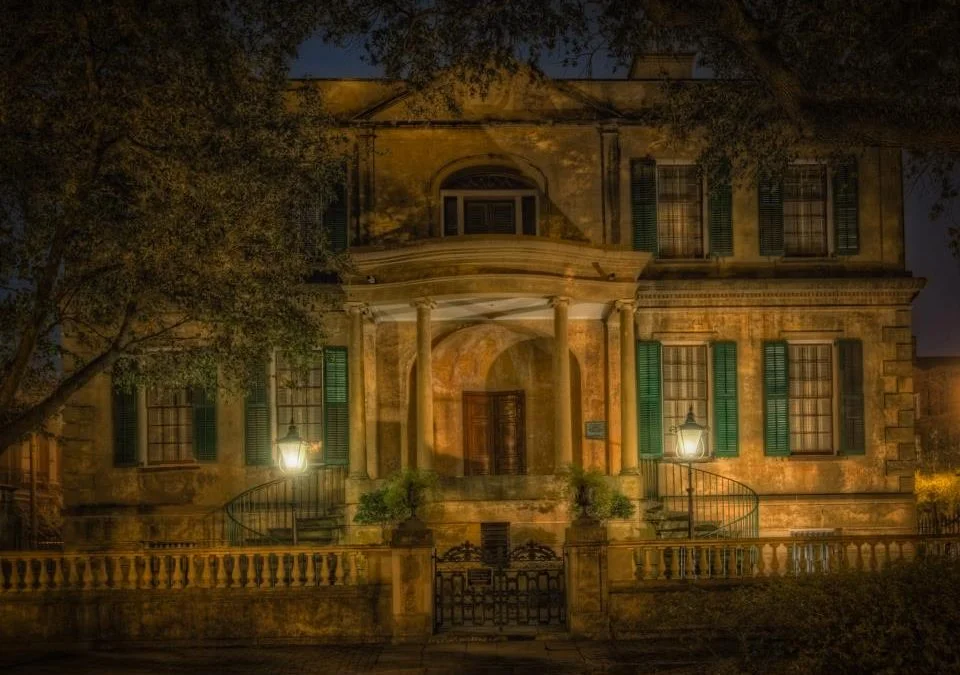
The Owens-Thomas House was designed by the English architect William Jay and completed in 1819 for the cotton merchant and banker Richard Richardson. It is widely considered one of the finest examples of English Regency architecture in the United States — and remarkably, Jay had drawn up its designs before his twenty-first birthday. The commission brought the young architect across the Atlantic to Savannah, where he would also design the Telfair mansion, the Scarbrough House, and the original 1818 Savannah Theatre.
What truly set the house apart, though, was its plumbing. The Owens-Thomas House was the first home in Savannah with an indoor plumbing system, fed by a rooftop cistern — complete with running water, a flush toilet, and a marble bath. It was a marvel of its age, installed years before the White House itself had running water. Add the elegant cast-iron side veranda — among the earliest large-scale uses of cast iron in America — and Richardson’s home was, quite literally, ahead of its time.
Fire, Fever, and Ruin
Richardson had little time to enjoy it. Just after the home was completed, Savannah suffered one of the greatest tragedies in her history. In January 1820, a catastrophic fire tore through the city, destroying more than 400 homes and businesses between Broughton and Bay Streets. That same year, a devastating Yellow Fever epidemic swept the city, claiming the lives of hundreds of Savannahians.
Against that backdrop — and the financial shockwave of the Panic of 1819 — Richardson’s fortunes collapsed. His bank failed, and personal grief compounded the loss, as he suffered the deaths of his wife and children. Only three years after the house was built, he lost it, and by 1824 the property had passed to the Bank of the United States. Richardson left for New Orleans and eventually died at sea.
For the next eight years, the house served as an elegant boarding house, run by a widow named Mary Maxwell — and it was during this chapter that it welcomed its most famous guest of all.
A Visit from Lafayette
In 1825, the Marquis de Lafayette — the French general who had been a hero of the American Revolution and remained beloved across the young nation — came to Savannah on the southern leg of his grand farewell tour of the United States. He and his son stayed at the house as guests of the city.
During the visit, Lafayette stepped out onto the cast-iron veranda on the south side of the house and addressed the crowd gathered below — delivering his remarks, by tradition, once in English and once in French. That balcony still stands, and standing beneath it today, it isn’t hard to picture the throng of cheering Savannahians who once filled the square to glimpse a living legend.
The Owens Family
In 1830, George Welshman Owens — a lawyer, planter, and politician who served as Mayor of Savannah and later as a U.S. Congressman — purchased the house at auction for $10,000. It would remain in the Owens family for the next 120 years.
That long chapter finally closed in 1951, when Owens’ granddaughter, Margaret Gray Thomas, bequeathed the home to the Telfair Academy of Arts and Sciences. It has served as a house museum ever since, today operated by Telfair Museums — a rare survival of an entire early-19th-century Savannah estate, preserved intact.
The Slave Quarters and Haint Blue

For all its elegance, the Owens-Thomas House was built and sustained by the labor of enslaved people, and their story is now central to how the site is understood. Behind the mansion stands the carriage house, which preserves a rare and remarkably intact example of urban slave quarters. Since 2018 the museum has been known formally as the Owens-Thomas House & Slave Quarters, reinterpreted to center the lives of the men, women, and children held in bondage here.
Step into the carriage house and look up, and you’ll find something unexpected: the second-floor ceiling is painted a soft blue-green known as haint blue. It is the largest surviving swath of original haint blue paint in North America — a Gullah Geechee tradition believed to ward off restless spirits, applied by the very people who lived beneath it. To understand the history and meaning behind the color, read my article on the colorful history of Haint Blue.
Ghosts of the Owens-Thomas House
Not all sits quiet in the Owens-Thomas House. There are said to be lingering spirits of former inhabitants who still roam its halls and rooms — as our guests learn on a Savannah Ghost Tour.
Usually seen standing in the corner of the front parlor, a gentleman in 1830s clothing watches visitors move through the home — then turns and walks straight through a wall, at the spot where a guest room once stood. Objects, too, have a habit of moving on their own. Staff have long reported a particular dining room chair, part of a table set with period dishes, that is found pushed away from the table again and again. Perhaps someone is still trying to sit down to a meal.
But the most famous spirit of all is the Lady in Gray. Margaret Thomas — the last of the family to live here — was devoted to her garden, and would step out nightly for a stroll and a cup of tea, dressed in her customary gray shawl and a large hat. To this day, the Lady in Gray is said to be seen wandering the courtyard as the light fades and night takes over the square.
The Owens-Thomas House is Savannah at her finest — no wonder her past residents never want to leave.
Meet the Spirits of Oglethorpe Square
The Owens-Thomas House is a highlight of our walk through haunted Savannah. Hear its full history — and its ghosts — where it all happened, after dark.
Book a Savannah Ghost Tour
Chris Allen is the founder of Destination Ghost Tours, a historian and storyteller with a lifelong fascination for the darker corners of history. He spends his time uncovering the true stories behind haunted legends, guiding guests through historic cities, and chasing down details that refuse to stay buried. When he is not working, he can usually be found with his partner Arissa, their dog Bear, and their two cats, Trouble and Covu, photographing old places, digging through archives, or disappearing into historical rabbit holes. He believes the best history is honest, atmospheric, and just unsettling enough to linger.