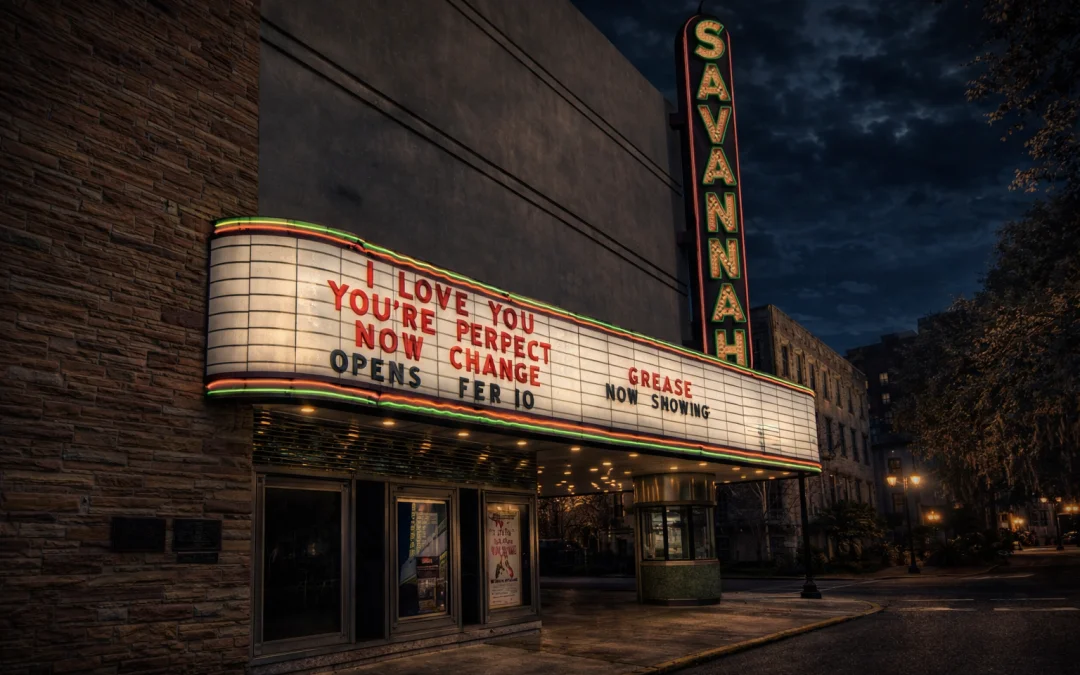
The stage lights dim, and a hush falls over the empty auditorium. I stand in the center of Savannah’s oldest theater — the Savannah Theatre — and I can almost feel the history breathing around me.
The faded scent of powder and perfume lingers in the wooden floorboards, and somewhere in the rafters I imagine the ghostly echo of applause from performances long past. As the owner of Destination Ghost Tours and a devoted historian, I’ve spent many nights exploring this grand old theater on Chippewa Square, delving into its 200-year story. Consider this my guided tour through time, unraveling the historical milestones and eerie hauntings that make the Savannah Theatre a cornerstone of haunted Savannah lore.
Our Savannah ghost tours often include this legendary venue, and for good reason. Few places in the city capture Savannah’s blend of Southern charm, dramatic history, and supernatural intrigue quite like it. By day, it’s a beautifully restored historic theater still hosting live performances. But by night — or when the crowds have gone home — an uncanny atmosphere settles in, and many swear that unseen spectators remain in the balconies and backstage. Grab a seat front and center. The curtain is about to rise.
Setting the Stage: Construction and Opening Night (1818)

Our story begins on a crisp December evening in 1818. The War of 1812 was a recent memory, James Monroe sat in the White House, and in the bustling port city of Savannah, a brand-new theater prepared to welcome its first audience. On December 4, 1818, the Savannah Theatre opened its doors for the very first time, dazzling the town with a double bill: a comedy called “The Soldier’s Daughter” followed by a lighthearted farce, “Raising the Wind.”
Carriages clattered along the square outside as ladies in silk gowns and gentlemen in tailcoats filed into the lobby. The theater was a marvel of its time. Designed by William Jay, a respected British architect, the original building was an elegant three-story structure that immediately became a point of pride for the city. Jay was already making his mark on Savannah — within a year he would also complete the Regency-style Telfair Mansion and the Owens-Thomas House, iconic buildings that still stand today.
For the theater, Jay envisioned a grand façade with ornate wrought-iron detailing and tall arched windows that glowed with lamplight on show nights. Inside, the decor was lush and artistic, with murals said to have been painted by the English artist William Etty, framed by gilded eagles, green wreaths, and rich crimson panels. From the moment you stepped inside, you were transported into a world of glamour and drama. Local craftsmen lent their talents too: master mason Amos Scudder, known for his work on Savannah’s Independent Presbyterian Church, oversaw the construction, ensuring it was as sturdy as it was beautiful.
Yet even a splendid building couldn’t guarantee success. The first couple of decades were rough. Financial troubles struck early; within twenty years of opening, the theater changed ownership numerous times and was even auctioned off twice. I sometimes picture those empty-seated nights in the 1820s — the quiet auditorium, the heavy velvet curtain drawn over a dark stage as yet another manager’s ambitions faded. It’s a poignant reminder that this now-celebrated institution came close to an early demise.
One bright spot arrived in 1838, when a stable stock company of investors took over. By December of that year, the Savannah Theatre was incorporated, setting it on a path to profitability and prestige. Soon the once-troubled playhouse was drawing larger audiences, and Savannah’s society came to consider the theater the place to see and be seen — a jewel in the city’s social scene, perfectly timed for the golden age of American live theater to come.
The Spotlight Shines: Golden Years, Famous Faces, and Civil War (1830s–1860s)

By the mid-19th century, the Savannah Theatre had hit its stride, blossoming into Georgia’s premier destination for live entertainment. Night after night, the footlights glowed and the seats filled. Its stage became a magnet for talent, drawing many of the most celebrated performers of the era — the legendary Sarah Bernhardt, the great comedian W. C. Fields, and the British Shakespearean actors Ellen Terry and Henry Irving. In fact, during an 1896 engagement here, Irving and Terry’s manager was a man named Bram Stoker — the future author of Dracula. One likes to wonder whether the gothic ambience of Savannah at night gave Stoker any inspiration.
Another renowned name to grace the venue was Oscar Wilde. The witty Irish playwright toured America in the 1880s lecturing on aesthetics and the arts, and local tradition holds that he appeared at the Savannah Theatre, dazzling the crowd with his sharp tongue and flamboyant style.
Not only actors took the stage. On one fateful night in March 1861, the theater hosted a political event that etched its name into American history: Alexander H. Stephens, soon to be Vice President of the Confederate States, delivered his infamous “Cornerstone Speech” from this stage, openly declaring slavery and the supposed inferiority of African Americans to be the “cornerstone” of the new Confederacy. It was a chilling moment, a venue devoted to art turned into a pulpit for division. As a historian, I often reflect on how that speech, echoing off the ornate walls, contrasts with the joy and unity the theater usually brought people. The Civil War erupted weeks later, and Savannah would face Union troops by the end of 1864 — yet the theater stood through it all.
One figure ties the world of theater to that national conflict: Edwin Booth. A prominent Shakespearean actor, Edwin performed here multiple times in the 1850s and 1870s, playing roles like Hamlet and King Lear to great acclaim. His connection is made all the more intriguing by his family ties — Edwin was the older brother of John Wilkes Booth, the actor-turned-assassin who shot President Lincoln in 1865. There’s no evidence John Wilkes ever performed in Savannah, though rumors persist that he may have visited. It’s one of those tantalizing “what ifs” of history. What we do know is that Edwin Booth’s performances left an impression so deep that an old playbill bearing his name still hangs in the theatre’s lobby museum today.
Trials by Fire and Storm: Disasters Strike (1820s–1900s)

The first hint that the Savannah Theatre might be cursed — or at least extraordinarily unlucky — came not long after it opened. It was a cold night in 1827, just nine years into the theater’s life, when fire struck for the first time. Gas lamps and open flames were a constant hazard, and, as the story goes, a blaze ignited near the stage during a performance. The flames were mercifully contained before the whole building was lost, but not everyone escaped. A beloved young actress — whose name has been lost to time, but whom we remember now as “Betty” — became trapped beneath the stage and perished. Savannah newspapers lamented the loss of life. The show would go on, but a seed was planted: the theater had claimed its first victim, and whispers of ghosts likely began that very year.
The theater prospered through the mid-century, but in the late 1800s Mother Nature tested its resilience. August 31, 1898 is a date any Savannah historian can recount with a shudder. A massive hurricane roared into the Georgia coast and pummeled the city — one of the worst storms in its history. As gale-force winds tore through downtown, they ripped the very roof off the theater as easily as peeling the lid off a tin can. Rain poured into the auditorium, turning it into an indoor pond where wooden seats and orchestra instruments bobbed in the flood. Fortunately the brick walls held, sparing total collapse, and the theater was painstakingly repaired and reopened, determined to defy the odds.
If it truly had nine lives, fate seemed determined to spend them quickly. In 1906, a far worse fire engulfed significant portions of the building, devouring the wooden interior. When the smoke cleared, the theater still stood, but much of William Jay’s original decor was gone. As part of the renovations, the ornate original façade was replaced with a far more utilitarian brick face, and the grand 1818 look was lost. Still, the city rebuilt the interior once more, and live performances resumed. A new competitor arose in 1916 when the Municipal Auditorium opened on Orleans Square, drawing some big touring acts — but the resilient old playhouse wasn’t finished, not by a long shot.
The 1948 Inferno and the Curse of the Lucky Penny
By the 1940s, the Savannah Theatre had endured multiple fires and a hurricane, but time had otherwise been kind. Then, in October 1948, the theater’s luck ran out again. Late one night, a fire ignited inside — some say in a projection booth, some backstage — and this blaze was ferocious and swift. Flames devoured the stage, seats, and draperies as the sky above Chippewa Square turned an eerie orange. The fire department fought tirelessly, but by the time the inferno was doused, the theater was a smoldering ruin, only its brick walls and a few charred elements surviving. As far as records tell, there was no audience inside, though one death often linked to the theater’s fires is that of a boy named Ben — whose ghost we’ll meet soon.
In the aftermath, an eerie explanation began to circulate — one involving a simple penny and a supposed curse. The legend goes that back at the theater’s construction in 1818, a worker sealed a penny from that year inside a wall for luck. It stayed hidden for over a century until, during a 1940s renovation, workers discovered it. Realizing it dated to 1818, the theater’s then-owner, Fred Weis, decided to carry it as a lucky charm, believing it protected the building. But in 1948, Weis took a trip to New York City and realized to his horror that he’d lost the penny. Almost immediately after, the Savannah Theatre caught fire and nearly burned to the ground.
Lose the 1818 penny, and the theater burns. Coincidence?
Was it mere coincidence, or had removing that penny broken a spell of protection? Some say the coin kept calamity at bay; others claim hiding it in 1818 was itself a curse that needed the penny to remain in place. It’s the kind of tale that is impossible to prove but hard to ignore in a town that loves a good yarn — and it turns the 1948 fire into something more than an accident in the eyes of storytellers.
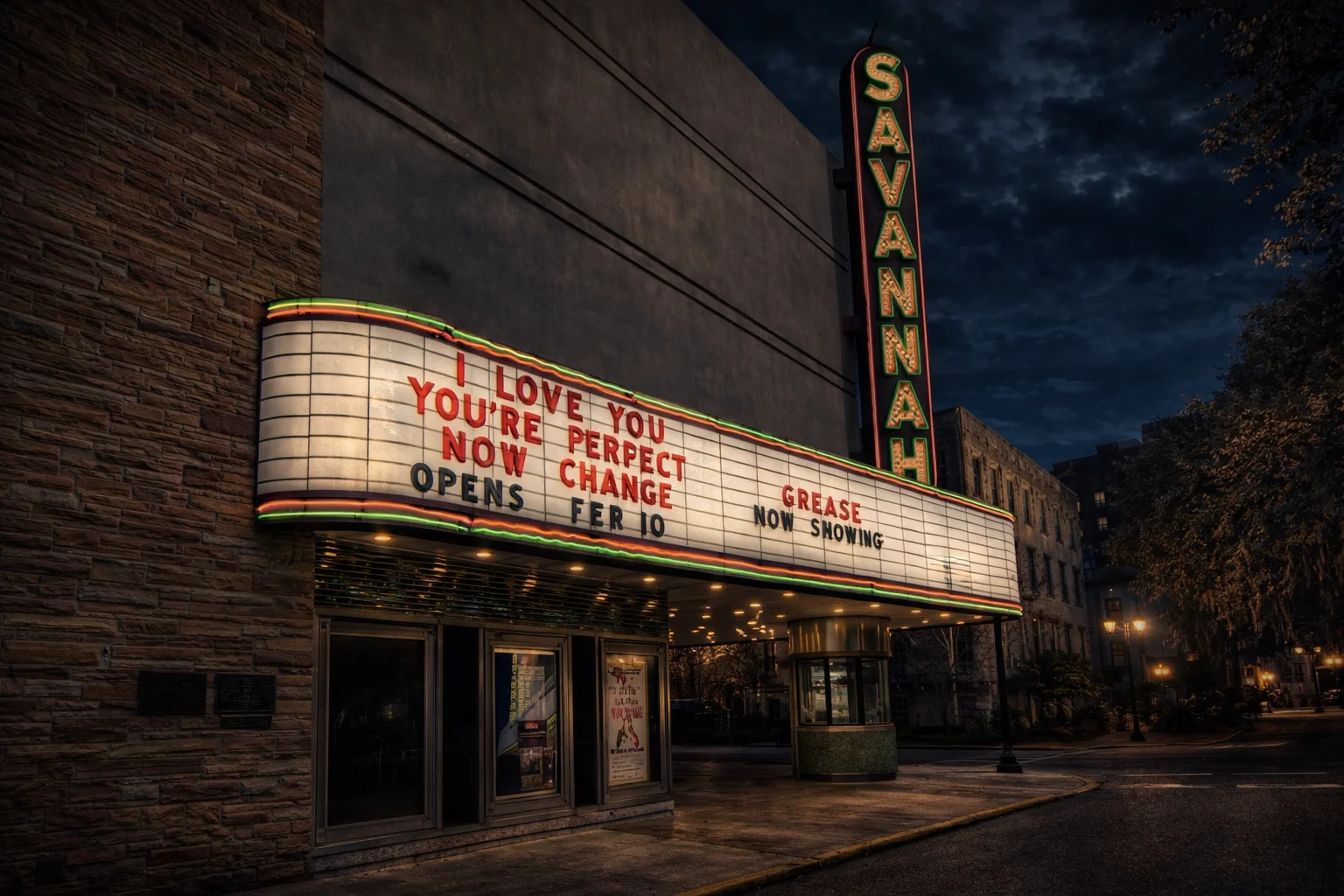
Savannah once again rebuilt its cherished theater, this time embracing the style of the era. When it rose from the ashes, it did so with a sleek, modern Art Deco façade and a brilliant neon marquee that still lights up Chippewa Square today. By October 1950, the Savannah Theatre reopened as a movie house; its first screening was Mister 880, starring Burt Lancaster and Dorothy McGuire. For decades it operated primarily as a cinema, though the ghosts of its stage days never truly left. It even had one more brush with stardom: in the fall of 1993, it served as the wardrobe and makeup headquarters for the production of Forrest Gump, whose famous bench scenes were filmed just outside in Chippewa Square. By the end of the 20th century, the theater was heralded as one of the oldest continually operating theaters in America, and a 2002 restoration finally returned it to its roots as a live-performance house, where a resident company performs to this day.
Ghosts of the Savannah Theatre: Legends in the Limelight

Every old theater has its ghost stories, and the Savannah Theatre may have more than its fair share. Over the years, whispers of apparitions and inexplicable happenings have become part of the theatre’s identity as much as its brick and mortar. The spirits said to linger here are often described as performers and patrons who just couldn’t give up the spotlight, even in the afterlife.
Betty — The Lady in the Long White Dress
The most frequently mentioned ghost is lovingly known as Betty — the actress said to have died in the fire of 1827, likely the first person to lose her life within these walls. She is often described as a woman in a long, flowing 19th-century dress, seen just out of the corner of one’s eye backstage or in the wings. Cast members report that she appears especially on opening nights, as if drawn out by the surge of energy; more than one performer has glimpsed a woman in period costume peeking from just offstage, only to blink and find no one there.
One former stage manager told me of locking up after a late rehearsal and seeing a pale woman in a white gown near the footlights. His first thought was a prankster or a cast member who’d stayed behind — but when he called out and walked closer, the figure faded into the shadows. “I won’t lie,” he admitted with a chuckle, “I left the auditorium pretty fast after that.” Betty’s presence isn’t only visual: people describe sudden cold spots, and an old-fashioned floral perfume that wafts through the air when no one is around. She is, in the language of paranormal investigators, a classic residual spirit — a talented young woman whose passion for the stage was so strong that not even death could dim her desire to be in the spotlight.
Ben — The Mischievous Boy in the Balcony
High up in the dark recesses of the balcony lurks a playful spirit known as Ben, believed to be a young boy who died in one of the theater’s fires — likely the 1948 blaze. As the story goes, Ben was in the upper balcony when fire broke out, and in the panic he became separated from his family and was lost in the crush at a narrow exit. Whether or not that exact history is true, those who’ve encountered him agree on one thing: he’s a bit of a prankster.
The most famous manifestations occur in the spotlight booth and balcony. Technicians working the spotlight often feel someone standing right behind them, tugging gently on their shirt or hair. One former house manager, a woman named Dru who became the theater’s unofficial “ghost liaison,” grew so used to the little yanks on her blouse that she’d simply turn and say, “Not now, Ben, I’m busy” — and, like a reprimanded child, he’d stop for the night. Audience members in the balcony have felt a small hand touch their hair or heard a child’s giggle echo from above when no children were present. On one investigation, we left a rubber ball on the balcony floor as an invitation, and each time we looked away, it seemed to roll a little on its own. Ben’s antics are ultimately harmless, and many who work here find them endearing — when equipment acts up for no reason, the staff will half-jokingly blame Ben.
The Director — The Phantom in the Wings
If Betty is the heart of the theater’s ghostly troupe and Ben is its funny bone, the third spirit is its guiding hand. We call him The Director, believed to be a former director or stage manager who spent much of his life behind the scenes here — some staff nickname him George. According to one account, an early-20th-century director died of a heart attack in the theater, possibly during a stressful rehearsal, and the persona fits: a soul so devoted to the craft that even death didn’t cue his exit.
The Director makes himself heard more than seen. Actors and crew rehearsing in the empty house often hear a slow, solitary clap from the back of the auditorium, or a deep male voice interjecting. One actress recalled a quiet pause in a scene when a clear voice boomed “Bravo!” from above — the seats were empty. Stagehands have heard a man muttering about “timing” and “lights” with no director present. Often the voice comes from a particular spot in the balcony, near an old exit door out of the performers’ sightline; the staff checked it for a living trespasser more than once and never found one. Eventually they simply accepted their resident director. Now, when a stray “Encore!” rings out from the emptiness, they just smile and say, “Oh, that’s George chiming in.”
Other Ghostly Guests and Encounters
Beyond the three headliners, the theater has a reputation for happenings that can’t be so neatly identified. Some describe a little girl spirit glimpsed in the shadows backstage; janitors cleaning late at night have heard the faint melody of a piano or a singing voice from the empty stage, as if an invisible rehearsal were underway. One of the earliest recorded encounters comes from an 1895 Savannah Morning News report: police on night patrol repeatedly heard what sounded like a full audience inside — laughter, clapping, the din of a lively show — only to unlock the doors, peer in with lanterns, and find the hall utterly empty and silent. It happened so often that the officers eventually stopped chasing the phantom applause.
The dressing rooms have their own legends. In one late-19th-century incident, the owner opened the building one morning to find a large, perfectly round hole burned through the middle of a dressing-room floor — nothing else touched, no logical explanation, and no wiring in the gaslight era to blame. On another occasion, a group of chorus girls getting into costume were overcome by a sudden, oppressive feeling of being watched by something in a dark corner; one screamed and bolted, and the rest fled after her, half-dressed, refusing to return for their things. In more recent years, paranormal teams have recorded faint EVPs — a whispery “I’m here,” a soft sigh — and motion sensors triggering in empty rows. None of it is conclusive on its own, but together it lends the Savannah Theatre a vibe that can’t easily be explained away as old-building noise. Comfortingly, the ghosts here don’t seem to wish anyone harm; if anything, they feel woven into the fabric of the place.
The Curtain Falls
Sometimes on my tours, I’ll conclude our stop outside the theater by inviting everyone to simply look at it. Under the draping Spanish moss of Chippewa Square, with the neon letters of the marquee glowing, the building seems to pulsate with life unseen. I ask people to peer up at the dark windows of the top floor and just absorb the atmosphere. Do they feel a slight electric charge in the air? Does a shadow in the balcony seem to move? It’s amazing how many nervously laugh and admit that, yes, they feel something.
Ultimately, the Savannah Theatre remains what it has always been: a place of entertainment and community, where stories are told and memories are made — only now some of those storytellers and audience members happen to be ghosts. So the next time the curtain rises at this old theater, take a good look beyond the footlights. Perhaps, just out of the spotlight’s glare, you’ll see a lady in a bygone costume, smiling as she finally hears the applause she lived and died for. Or a little boy in the balcony, swinging his legs as he watches with eternal wonder. Or maybe you’ll sense an unseen director in the wings, arms folded with pride, content that the show will indeed go on.
Meet the Ghosts of the Savannah Theatre
The historic theater is a highlight of our walk through haunted Savannah. Hear its fires, its curses, and its restless performers where the stories happened, after dark.
Book a Savannah Ghost Tour
Chris Allen is the founder of Destination Ghost Tours, a historian and storyteller with a lifelong fascination for the darker corners of history. He spends his time uncovering the true stories behind haunted legends, guiding guests through historic cities, and chasing down details that refuse to stay buried. When he is not working, he can usually be found with his partner Arissa, their dog Bear, and their two cats, Trouble and Covu, photographing old places, digging through archives, or disappearing into historical rabbit holes. He believes the best history is honest, atmospheric, and just unsettling enough to linger.