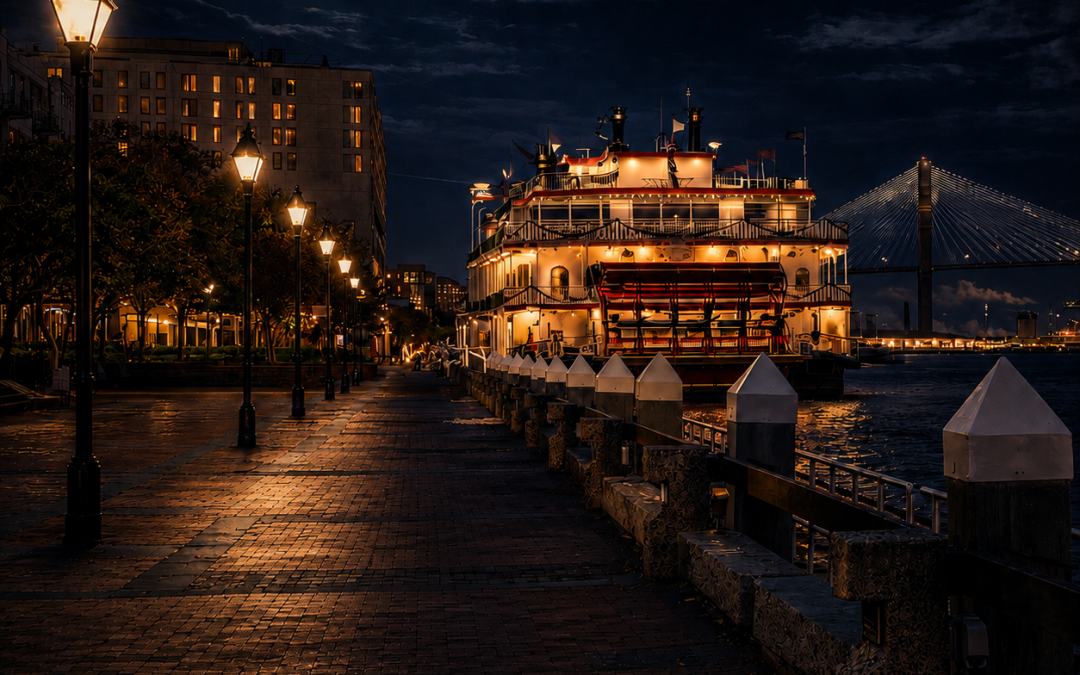
By the cobblestones of Savannah’s iconic River Street, history isn’t just remembered — it lingers. In the hush between laughing tourists and distant ship horns, you might catch something uncanny: a whispered name when no one’s there, a fleeting shadow between the old brick warehouses, or the faint clink of phantom chains echoing off the Savannah River.
River Street is one of the oldest and most haunted corners of Savannah, Georgia — a place where colorful history and eerie legend walk hand in hand on the worn cobblestones. This long waterfront has seen colonial dreams and Civil War fires, cotton fortunes and decades of decay, and through it all, ghost stories have rooted themselves as deeply as the live oaks on the bluff above.

We’re about to take a journey through time — and perhaps through the veil between worlds — exploring the history of River Street and the ghosts said to haunt it, arranged chronologically so you can see how each era’s events sowed the seeds of its hauntings. You’ll smell the tar and salt of an 18th-century wharf, feel the oppressive heat of cotton bales under an 1850s sun, and perhaps sense a chill on your neck as we recount the spirits of sailors, laborers, and merchants who may still roam here. This is a deep dive into the soul of River Street, where America’s past isn’t dead at all — just restless.
Yamacraw Bluff: A Sacred Ground Before the City (1733 and Earlier)
Long before anyone called it River Street, this stretch of riverbank was part of the homeland of the Muscogee Creek people. When General James Oglethorpe arrived in 1733 to found the Georgia colony, he was quick to note the strategic advantages of the high bluff (later known as Yamacraw Bluff), which offered a natural defense above the river’s bends. The Yamacraw, a Creek band led by Chief Tomochichi, lived nearby, and Oglethorpe met Tomochichi close to the water’s edge to broker the peace that made the colony possible.
Local legend holds that the bluff itself was sacred ground — a Native burial place that the newcomers built over as they cleared timber and laid out the city above. Whether or not the archaeological record supports that (historians treat “built on an Indian burial ground” as more folklore than documented fact), the story has become foundational to Savannah’s reputation as “America’s most haunted city.” The idea that the city’s very origins disturbed the resting places of the dead is, after all, practically the start of every ghost story — and on River Street especially, people whisper that the spirits of the Muscogee still wander, unsettled.
In the earliest colonial days, River Street as we know it did not yet exist — more of a sandy landing connecting to paths up the bluff. But it quickly became the colony’s lifeline, as ships from England moored in the river to unload goods and passengers. There’s an old legend, told by some guides, that late at night in those first years a few colonists reported eerie drumbeats echoing from the bluff, like a funeral rhythm carried on the wind, and the sensation of unseen eyes watching from the trees. It’s not in the history books, of course. But visitors still remark on an uncanny vibe near the river after dark.
One personal aside: I once spoke with a local Gullah Geechee storyteller who told me matter-of-factly, “Child, this whole city’s built on graves. Don’t you think those old souls mind? They mind, alright. Especially down by dat river.” She wouldn’t walk River Street at night without an offering of tobacco to the ancestors. I laughed it off then, but now I sometimes wonder if the goosebumps I get on certain moonlit nights by the water are more than just the breeze.
Colonial Port and Early Legends (1730s–1790s)
In the 18th century, Savannah blossomed into a busy colonial port, and the riverbank evolved accordingly. What began as a rough landing zone became a rudimentary “River Street” — sailing ships anchored offshore, longboats ferrying cargo ashore, wooden warehouses rising along the bank, and a dirt road worn in by constant wagon wheels. By the mid-1700s, Savannah exported timber, deerskins, rice, and indigo, and imported manufactured goods, rum, and — after Georgia lifted its early ban on slavery in 1750 — enslaved Africans.
Ghostly lore from this era is scarce compared to later periods, but a few legends endure. One involves a “shadowy sailor” said to roam near the water, sometimes traced to a 1773 accident in which a seaman fell from the dock and drowned. For decades after, sailors swore they saw a forlorn figure in soaked 18th-century clothes pacing the riverbank, as if searching for his ship, vanishing if anyone approached.
Then there are the pirate tales. Pirates and privateers did prowl the Georgia coast, and River Street (and the nearby bluff) had some of the city’s earliest taverns catering to sailors — including the still-standing Pirates’ House, a tavern open by 1754 one block from the river. Legend holds that a tunnel led from its cellar toward the water, and that drunken patrons would sometimes vanish, only to wake up forcibly enlisted on a ship at sea — the cruel practice of shanghaiing. The historical evidence for such tunnels is debated (the likeliest “tunnel” was probably an old rum or storage cellar), but it’s enough that the story is woven into River Street’s haunted tapestry: in the Pirates’ House basement, people claim to hear moaning and cries, as if kidnapped sailors relive their abduction, and on River Street, visitors report phantom footsteps on empty cobblestones and disembodied voices from the alleys.
By the late 1700s, the American Revolution brought war to the waterfront. British forces captured Savannah in 1778; a bloody 1779 siege to retake it failed; and the British occupied the city until 1782. One anecdote holds that during the occupation, a young Patriot was hanged as a spy on the docks, and that his ghost was later seen dangling from a phantom rope on foggy mornings. After the Revolution, Savannah recovered and grew, and by the 1790s cotton had emerged as a lucrative crop — thanks in part to Eli Whitney’s cotton gin, invented in 1793 at a plantation just upriver. The stage was set for River Street’s golden age, and for some of its darkest chapters.
(Side comment: I often wish I could travel back to that time for a day — minus the disease and lack of plumbing, of course. Just to see Savannah in knee-breeches and tricorn hats, to hear the British accents mixing with Creek and Gullah on the street. But given my luck, I’d probably end up accidentally shanghaied onto a schooner bound for Bermuda.)
King Cotton and Tragedy on River Street (1800–1860)
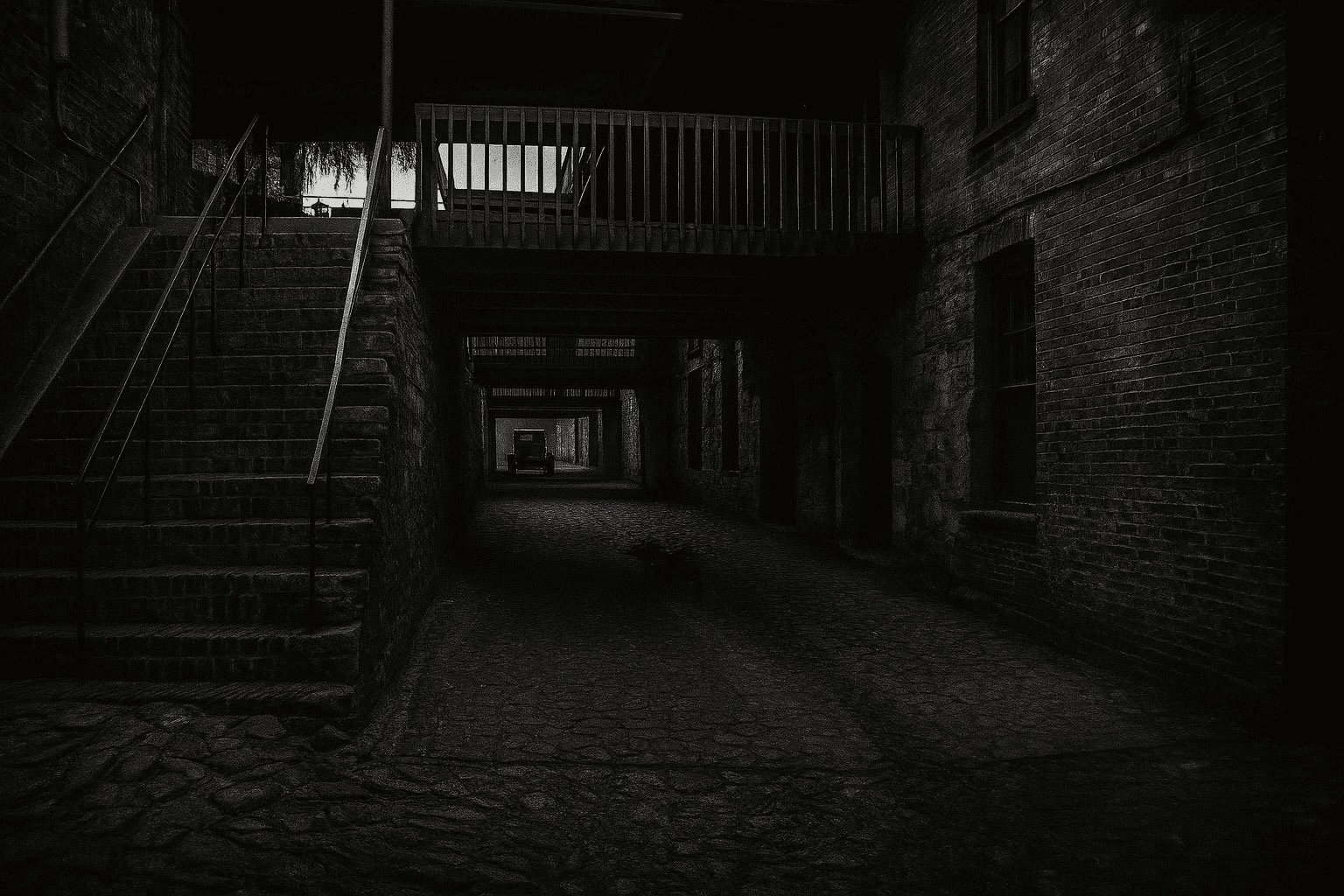
The 19th century dawned with Savannah booming, and River Street became the throbbing heart of the city’s economy. By 1817, the first of the iconic brick warehouses had been built along the waterfront — some from the very ballast stones that ships discarded on these shores. Cotton was becoming king, and Savannah was one of its thrones. An interconnected network of ramps, bridges, and an alley called Factors’ Walk emerged to connect Bay Street atop the bluff to the warehouses below, and by 1853 many warehouses were expanded upward to handle the flood of cotton bales. The street was paved with cobblestones — those rough “Belgian blocks” and ballast stones you still tread today, each one a piece of another place embedded in Savannah’s story.
Yet behind the prosperity lay unimaginable human misery, for River Street’s wealth was inseparable from slavery. Enslaved Africans were trafficked, sold, and worked along this waterfront in appalling conditions, and the suffering here was staggering and real. A popular legend, repeated on many tours, holds that the warehouses doubled as holding pens where enslaved people were shackled in chains, with iron rings still bolted into the old bricks as silent witnesses. The documented history is more complicated: the importation of enslaved people was banned in 1808, and historians and archaeologists have found little hard evidence that these specific buildings were used to confine people in that way. What is beyond dispute is the depth of suffering slavery inflicted here. Enslaved dockworkers labored and died on these docks in appalling numbers — crushed by heavy bales, drowned in the river’s currents, felled by heat exhaustion under a brutal sun — and many were buried in unmarked graves, their names lost to history.
Is it any wonder River Street is considered one of the most haunted areas in Savannah? People speak of seeing apparitions of workers still toiling — men “dressed in old-style clothing, moving through the shadows,” a figure carrying a heavy sack who fades into nothing, or the dark, featureless “shadow people” that trail visitors briefly before melting into the dark. Given the history, many believe these are the restless spirits of the enslaved and the laborers who died here.
Perhaps the most harrowing are the sounds. In the dead of night, with no one around, people report the echo of chains dragging on brick and stone, and faint cries or moans wafting from the old warehouse entrances. A famous incident at The Shrimp Factory — a restaurant in a 19th-century warehouse — involved an employee in the wine cellar who reported hearing disembodied voices chanting in what sounded like an African dialect, an encounter later recounted in the book Georgia Ghosts. Whatever one makes of such stories, they speak to how deeply the tragedy of slavery is felt along this waterfront.
To walk River Street in the mid-1800s was to be at once impressed and appalled: towering walls of brick and archways bursting with “white gold” on one side, the busy river on the other, and, above, the fine offices where cotton factors struck deals and made fortunes. As the story goes, enslaved people were sometimes marched along Factors’ Walk — a claim more legend than documented, but one that captures the real cruelty of the era. It’s little wonder people feel chills in those alleys today; the very stones seem soaked in sorrow.
One specific sighting tied to this era is a man in a top hat and coat seen in the upper floors of certain buildings. Staff at the historic River Street Inn (in an 1817 cotton warehouse) have reported an apparition of a well-dressed 19th-century gentleman roaming the halls — perhaps one of the old cotton factors, still fretting over his ledgers. A long-time administrator there recounts seeing this figure walk past a doorway; an employee ran to redirect the “stranger” from a closed area, only to find no one there at all.
Tragedy was not confined to workers. In 1820, Savannah was struck by a catastrophic yellow fever epidemic and a great fire — the fever killed roughly a tenth of the population and the fire leveled over 400 buildings. On steamy riverfront nights, some ghost enthusiasts claim you might glimpse a faint lantern glow and the shape of a horse-drawn hearse cart along River Street, a residual haunting from the fever year, replaying like a broken record.
One evening, after writing about these things all day, I took a walk down River Street to clear my head. The tourist crowds were gone; it was near midnight. I found myself drawn to one of those cavernous brick entrances, where a single yellow bulb cast more shadow than light. “I’m sorry for what happened to you here,” I whispered on impulse. Suddenly, a clatter — a loose cobblestone had shifted underfoot, or so I tell myself. I jumped a mile. There was no one around but a stray cat. Yet in that moment I truly felt I wasn’t alone. Call me sentimental, but I like to think maybe some long-suffering soul heard a bit of empathy and answered with a little startle, just to say, “We hear you.”
War, Fire, and Renewal: River Street in the Late 1800s (1860–1890s)
When the Civil War broke out in 1861, Savannah’s waterfront faced an uncertain fate. Union blockades choked off commerce, and River Street’s bustle quieted to a trickle. Yet the city itself avoided destruction: in December 1864, Union General William Tecumseh Sherman arrived after his March to the Sea and, rather than burn Savannah, occupied it peacefully and famously presented it to President Lincoln as a “Christmas gift” — including some 25,000 bales of cotton stored in the warehouses. During the occupation, blue-coated soldiers patrolled the cobbles where enslaved workers had stood not long before. A few people have since reported a spectral Union soldier along the waterfront, sometimes holding a lantern and rifle as if on guard duty.
After the war, recovery was slow, but by the 1870s the cotton trade resumed with vigor, now worked by free Black laborers and Irish immigrants, and by 1887 the city boasted a grand Cotton Exchange on Bay Street. River Street received upgrades too: re-paving in 1875, and streetcar tracks by 1889, whose iron rails you can still spot in the stones today.
The late 1800s were not tranquil. Yellow fever struck again in 1876, killing over a thousand Savannahians, and the hurricane of 1893 brought catastrophic storm surge to the coast. There’s even a ghost story of a “weeping woman” in drenched 19th-century dress who supposedly appears by the river after violent storms, forever searching for her family.
One of the most dramatic events of the era was the Great Fire of January 2, 1892, which ignited in a wooden warehouse on the eastern end of Factors’ Walk. Fueled by 500 barrels of kerosene stored there by the Tide Water Oil Company, the fire roared through the riverfront, consuming the oil building and several adjacent warehouses. Remarkably, no lives were lost. But ghost lore has a twist — enter one of River Street’s most famous ghosts: Hank.
The Olde Harbour Inn, today a lovely boutique hotel on East River Street, sits on the site of that 1892 fire. After the blaze, the site was rebuilt with over 730,000 bricks and became a Standard Oil facility. When the inn opened in 1987, guests and staff began noticing odd occurrences — the smell of cigar smoke when no one was smoking, belongings moving on their own, even the sensation of a ghostly figure climbing into bed beside them. The playful spirit was nicknamed Hank, and legend has it he was a worker who died in the 1892 fire. Historically, there’s no record of a death in that fire — but legends fill gaps, and one story even claims Hank set the blaze himself out of a grudge, only to perish in it. Guests in rooms 405 and 406 have particular tales; one woman, feeling someone sit on the bed, murmured “Not now, dear,” only to realize later that her husband had never been there. The inn embraces Hank’s legend, even leaving out the occasional treat as a peace offering. He’s a relatively friendly ghost — more prankster than poltergeist.
A note on child spirits: oddly, among the tales of sailors and laborers, there are whispers of children on River Street. The River Street Inn is rumored to host a few; in one investigation, a psychic sensed two young boys and a little girl playing on an upper floor, and staff have heard giggling or running footsteps when no children were checked in. One local tale says a young girl fell from the bluff into the river in the late 1800s, and that her spirit, soaked and sad, can be seen near the base of the old stone steps, looking up toward where she fell.
Decay, Darkness, and Revival (1900–1970s)
The early 20th century was not kind to River Street. As the cotton economy collapsed (the boll weevil devastated crops in the 1910s) and shipping modernized, the old warehouses closed one by one. By 1956, the last cotton warehouse on Factors’ Walk shut its doors, and River Street turned into a ghost street — almost literally. From the Depression through the 1960s, the stretch was largely abandoned: buildings crumbled, weeds grew between the cobblestones, and locals avoided the area after dark.
Any ghosts present had prime real estate through those quiet years — Sherman’s troops, enslaved souls, drowned sailors, cotton clerks, take your pick, all with the run of the place. Folklore from mid-century is hazy but persistent. One tale tells of a “Lantern Man” seen walking the deserted street in the 1930s, a lone bobbing light making its way slowly down River Street that would vanish if you tried to catch up. There are also whispers of Prohibition-era smuggling and violence along the riverfront, and, inevitably, the ghost stories that follow violent death.
In 1966, the historic district (including River Street) was designated a National Historic Landmark District, but the street itself remained derelict. The renaissance began in the 1970s: in 1977, the city and local entrepreneurs invested around $7 million to transform the waterfront into a pedestrian plaza of shops, restaurants, and galleries, culminating in the dedication of the John P. Rousakis Riverfront Plaza that June. Crumbling warehouses were cleaned out and reborn as boutiques and pubs.
It’s often said in paranormal circles that renovations stir up spirits — and sure enough, as the new River Street reopened, ghost stories began to proliferate in earnest. One of the first businesses was The Shrimp Factory, which opened in July 1977 in a renovated warehouse. Staff soon heard strange noises from an upstairs liquor storage room — bottles clinking, a door locking itself — and an employee reportedly died of a heart attack on the staircase that very year, adding to the activity. Over the decades, diners have reported cold spots near that stairwell, and employees still attest that glasses sometimes fly from shelves; in one incident, a glass shelf simply exploded while a manager was cleaning it, with no logical cause.
Another spot, an antique jewelry shop called Cassandra’s at 115 East River Street, became known for playful poltergeist antics — surveillance cameras famously caught a spinner rack turning by itself and silver rings leaping from a case as if flung by an unseen hand. The owner just shrugged: “This stuff happens all the time.” Once awakened, the ghosts of the revived River Street were not shy.
Several historic inns opened in this era too, bringing overnight guests — and more witnesses. Beyond the Olde Harbour Inn and Hank, the River Street Inn (reopened in 1987 across a complex of connected old warehouses) quickly earned a haunted reputation, with staff reporting their names called when no one is there, the man in the black coat, guests feeling someone sit on their beds, and taps on the shoulder when alone. The ghosts there seem quirky rather than menacing.
By the 1990s, River Street was fully reborn as a top destination, and the ghost lore ballooned with the crowds — nearly every business seemed to have a resident spirit. Savannah’s branding as “America’s Most Haunted City,” spurred by the 1994 bestseller Midnight in the Garden of Good and Evil, only accelerated things. Ghost tours multiplied, and River Street, with its concentration of haunted sites, became a highlight on virtually every one.
Not every legend is frightening. From 1887 to 1931, Florence Martus — the “Waving Girl” — greeted nearly every ship entering or leaving Savannah from her home on Elba Island, and a statue of her stands near the east end of River Street, eternally waving a handkerchief. She died peacefully in 1943, but one tour guide once mused that maybe her friendly ghost still waves to the enormous container ships gliding by. And in 2002, the city installed the African-American Monument on River Street — a family embracing with broken shackles at their feet, inscribed with Maya Angelou’s words. Many say the memorial brought a measure of peace to River Street’s troubled spirits: an acknowledgment, long overdue.
The River Street Experience Today: Living History and Lingering Spirits
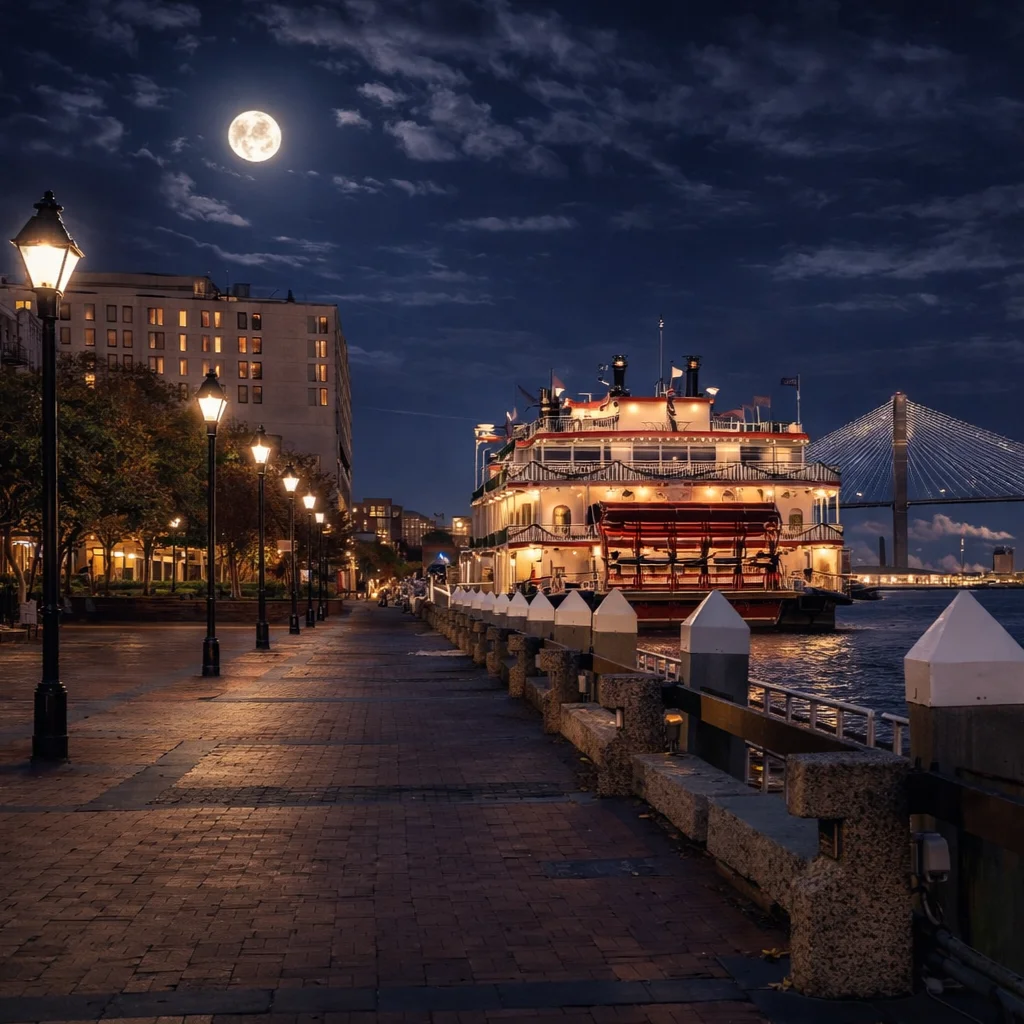
Step onto River Street today and you’ll find it hard to imagine it was ever empty. The cobblestones bustle with visitors popping into sweet shops for pralines, artists selling Gullah paintings, and street musicians playing under gaslamp-style lights, while a massive cargo ship might slide past on the river — a futuristic contrast to the old-world charm on land. Yet even amid the modern crowd, the past asserts itself. The centuries-old buildings tower overhead; plaques tell of cotton, slavery, and the lives lived here. Tune out the present for a moment, especially after dark, and you might feel that not everyone on River Street is among the living.
For many, River Street is the start of their Savannah ghost adventure — it packs in more ghost stories per square foot than perhaps anywhere else in town. To experience its haunted side, a bit of advice from a seasoned local: go late. By midnight the foot traffic dies down and you may have parts of the street nearly to yourself. Walk slowly from one end to the other, listen to your footsteps on the stones, and peer into the Factors’ Walk alleys between the buildings, notoriously spooky. Stand by the “Stone Stairs of Death” on the west end — 33 steep granite steps worn since the 19th century, so treacherous they carry a warning sign — and look up. Some claim to see a figure at the top beckoning.
Savannah doesn’t hide its dark past; it remembers it. And River Street is the ultimate example.
As you walk, don’t be surprised by a sudden cold breeze on a warm night, sometimes carrying the scent of cigar smoke (Hank, out for a stroll?) or musty river water. If you feel a tap on the shoulder or a whispered word behind you, well — a rude passerby, or something else. River Street’s real power is how it marries beauty and tragedy: couples laughing over wine on a balcony that once held cotton fortunes, children licking ice cream steps from where other children were once sold away from their parents. Savannah doesn’t hide that history; it memorializes it. Perhaps that’s why the spirits seem at peace enough to coexist — because they are remembered, and their stories are told.
In 2020, the west end saw a new chapter with the opening of the Plant Riverside District, a former 1912 power plant converted into a dazzling complex of hotels, restaurants, and a riverside park. It extended River Street’s magic another few blocks — and, naturally, has ghost stories brewing already, with workers reporting unexplained footsteps on the catwalks during renovation. River Street, it seems, keeps on creating legends.
So if you go — and you absolutely should — take in the charm by all means: enjoy the music, sip a to-go cocktail, watch the ships. But also take a moment in the quiet dark, away from the neon and noise. Run your hand along the old brick, feel the roughness of history under your fingers, and look down the moonlit street where the rails gleam faintly. The past will whisper to you here if you’re willing to listen. And if you do encounter something ghostly, don’t be afraid — in Savannah, our Southern hospitality seems to extend even to our ghosts. Treat them with respect, maybe raise a quiet glass in their honor, and you’ll be just fine. You’re walking among friends on River Street, from many eras, with many tales.
Walk Haunted River Street With Us
From the old cotton warehouses to the Stone Stairs of Death, hear River Street’s ghost stories where they happened. Join Destination Ghost Tours after dark.
Book a Savannah Ghost Tour
Chris Allen is the founder of Destination Ghost Tours, a historian and storyteller with a lifelong fascination for the darker corners of history. He spends his time uncovering the true stories behind haunted legends, guiding guests through historic cities, and chasing down details that refuse to stay buried. When he is not working, he can usually be found with his partner Arissa, their dog Bear, and their two cats, Trouble and Covu, photographing old places, digging through archives, or disappearing into historical rabbit holes. He believes the best history is honest, atmospheric, and just unsettling enough to linger.