
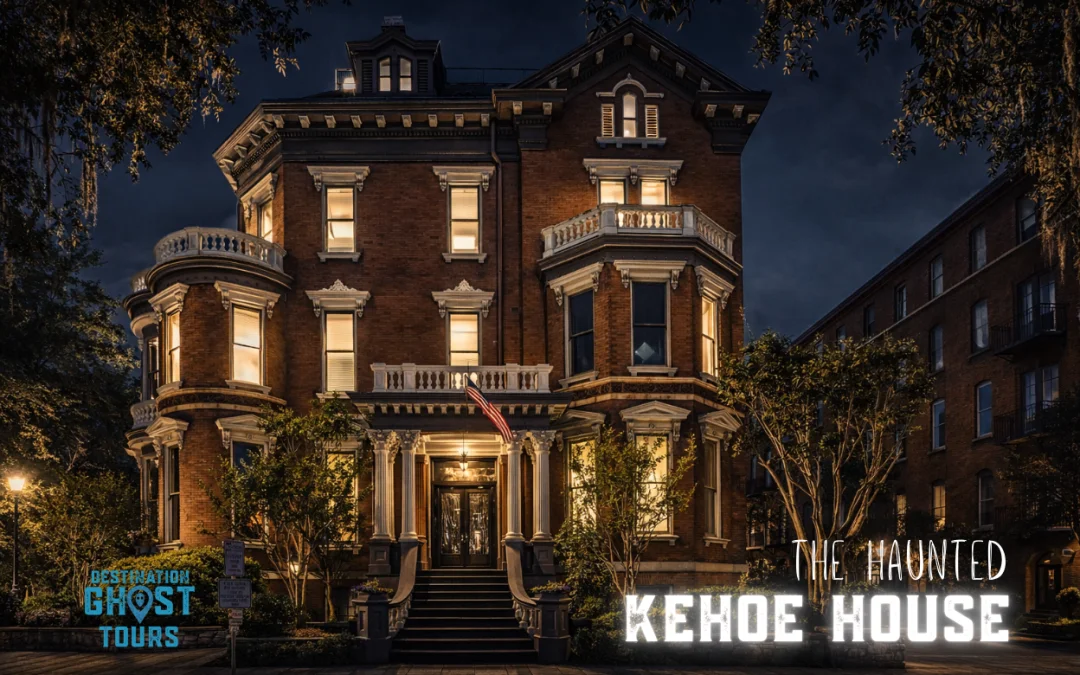
Savannah has a way of changing after sunset. The same streets that feel bright and postcard-perfect at noon can turn velvety and uncertain at night, when the gaslight glow pools on brick, the Spanish moss turns black against the sky, and every footstep seems to carry just a little farther than it should. On those evenings, Columbia Square feels like a stage set for memory itself, quiet, elegant, and watchful. And there, facing the square with its ironwork pride and late-19th-century grandeur, the Kehoe House stands like a sealed letter from another era, handsome on the outside, heavy with stories on the inside.
People come to Savannah looking for atmosphere. They leave talking about moments: a sudden chill in a hallway, the faint sound of movement where no one is walking, the uncanny sense that a room is occupied even when it is empty. The Kehoe House has long been one of those places where visitors and locals alike insist the past does not fully let go. Not because of cheap thrills or manufactured scares, but because the building has lived many lives, and Savannah’s oldest truth is this: the city remembers.
This is the story of the Kehoe House, its neighborhood, and the legends that cling to it like fog off the river, told with the care Savannah deserves: grounded in documented history where history exists, and presented as folklore and reported experiences where the supernatural begins.
Columbia Square: Savannah’s Quiet Jewel With a Long Memory
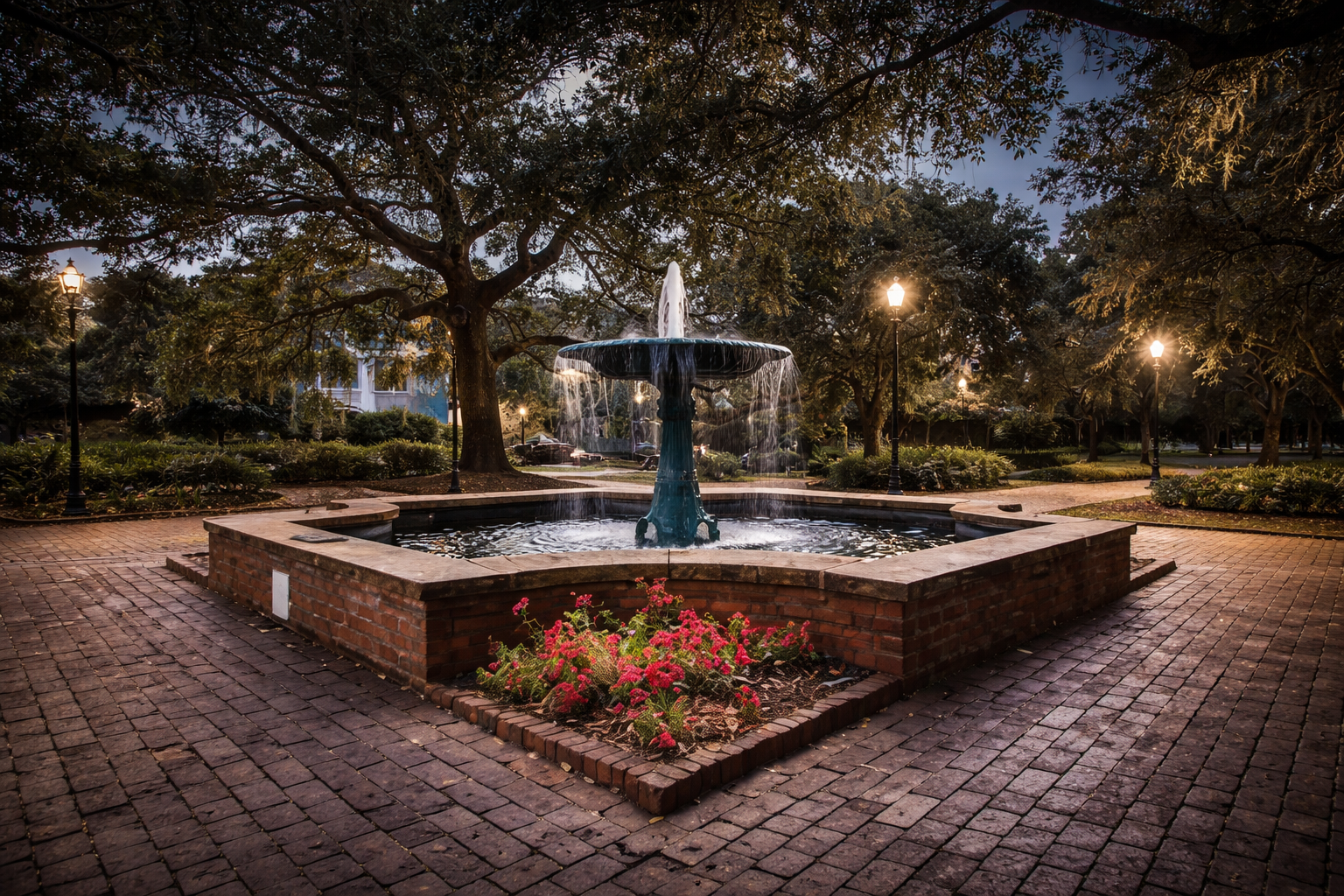
To understand the Kehoe House, it helps to begin where it stands: Columbia Square, a small, gracious square in Savannah’s Historic District that feels almost deliberately composed. The city’s famous layout, its wards, its squares, its tidy geometry, was never accidental. Savannah was designed to be walked, to be lived in, to give people public green space framed by private lives. Columbia Square, laid out in 1799, belongs to that intention, and it carries the personality of Savannah’s east side: calmer, more residential, and sometimes more intimate than the bustling corridors closer to City Market.
In the center of the square sits the Wormsloe Fountain, rustic in style, decorated with vines and floral motifs, a piece that feels like it belongs in a woodland clearing rather than a formal city plan. It is a focal point that rewards slow attention, the kind you only give when you are not rushing. Around it, the square is bordered by some of the most photographed and storied buildings in the city, including the Isaiah Davenport House nearby, an important landmark in Savannah’s architectural and preservation story.
Columbia Square also sits in a part of town that has shifted identities over time. Like so much of Savannah, this area has seen waves of immigration, changing industries, changing fortunes, and changing uses for the same beautiful structures. That layering matters. When people talk about “haunted Savannah,” they are often responding to that layered feeling, the sense that the present is just the latest coat of paint over something older, and that you can still see the brushstrokes beneath.
And then there is the iron.
Savannah’s cast iron is not just decorative. It is biography. It is evidence of labor and craft, of foundries and shipping, of money earned and money spent, of a city that dressed itself in metal lace. Few stories capture that better than the story of William Kehoe.
William Kehoe: Iron, Ambition, and a House Built to Last
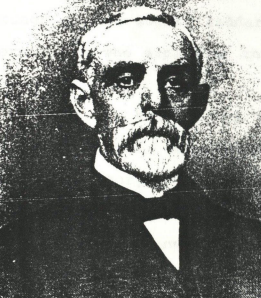
The Kehoe House is strongly associated with William Kehoe, an Irish immigrant who became one of Savannah’s successful industrialists through his ironworks business. That detail matters because it helps explain why the house feels the way it does. This was not a modest home. It was a statement, built with the confidence of someone who intended to be remembered.
Before the famous house at 123 Habersham Street, Kehoe built an earlier home on the square at 130 Habersham Street in 1885. As his business and family expanded, he built the larger, more prominent residence diagonally across the square, completed in 1892. Architecturally, the building is often described as Renaissance Revival, and even without a guidebook in hand, a visitor can feel the deliberate elegance in the design: the symmetry, the massing, the sense of craft.
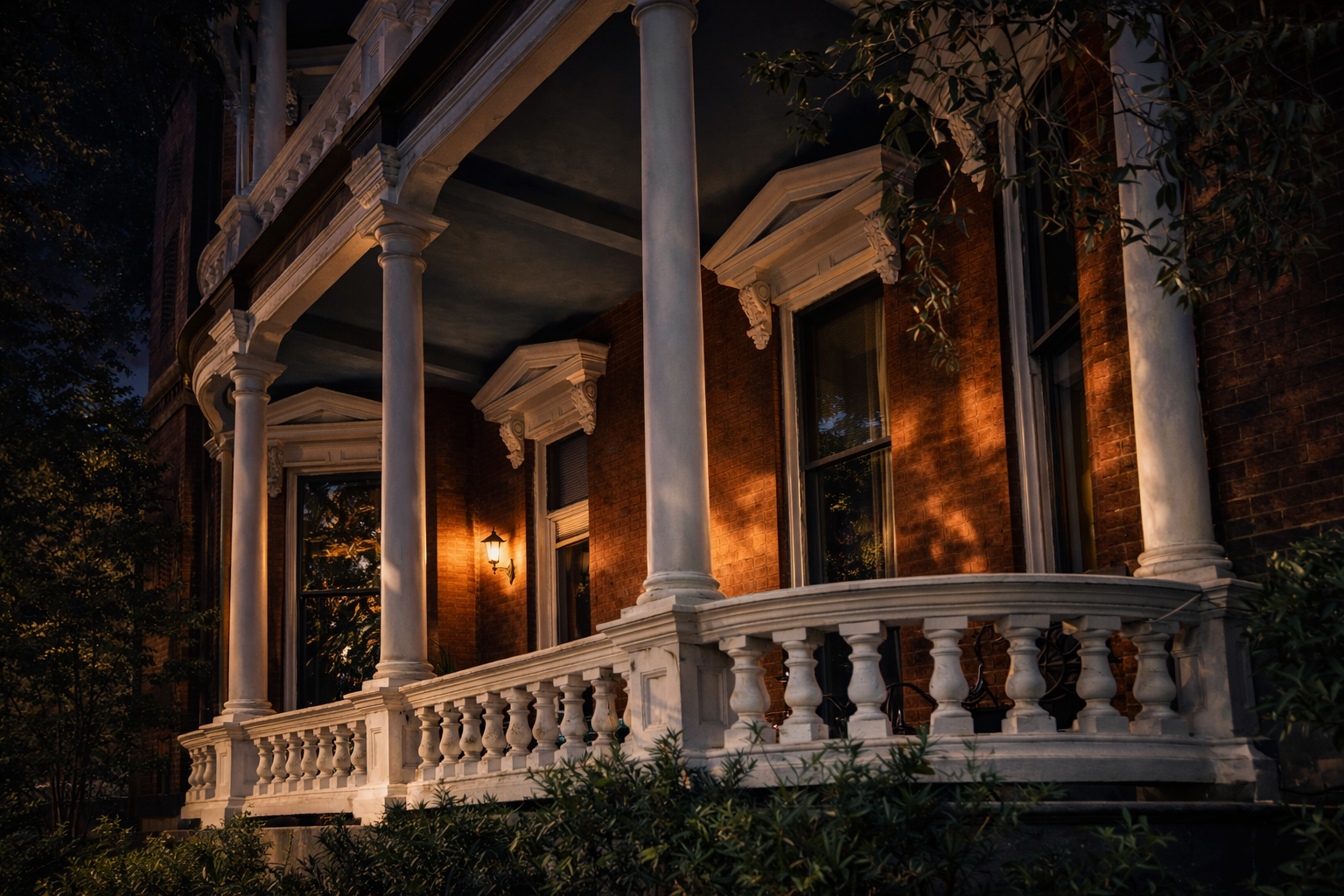
And then there is what people love to point out, because it feels so perfectly Savannah: many of the architectural details on and around the building that look like wood are cast iron, a kind of signature flourish that ties the house directly to Kehoe’s work and identity. In a city full of iron, the Kehoe House makes iron personal.
In its first life, the building was a private home, and like any home, it would have held the full range of ordinary and extraordinary moments: celebrations, illnesses, arguments, quiet mornings, late nights, the shuffle of servants and staff, and the simple rhythms that never make it into official records. Those rhythms are often what hauntings attach themselves to in the popular imagination, not the dramatic events, but the repeated motions of daily life, replayed like a worn groove.
After the Kehoe era, the building entered the long, familiar Savannah pattern of reinvention. Over the decades, it served different functions, including periods as a boarding house and, according to commonly repeated local accounts, a funeral home. In Savannah, the line between residence and institution can be thin, especially in historic structures that outlive their original families. Buildings adapt, and the city keeps going.
Eventually, the Kehoe House became what many modern visitors know it as today: a boutique inn where guests can sleep inside a piece of Savannah history, surrounded by antiques, high ceilings, and the particular hush that only old buildings possess.
That hush is one reason ghost stories thrive here. Old houses sound alive. They settle. They creak. They breathe with temperature changes. They carry voices through corridors. They make footsteps ambiguous. And in Savannah, where storytelling is practically a civic tradition, ambiguity becomes narrative very quickly.
The Ghosts and Legends of the Kehoe House
Savannah ghost stories are best handled with a steady hand. The city has no shortage of legends, and some are repeated so often they start to sound like proven fact. But a responsible haunting story draws a line between what is documented history and what is reported experience, folklore, and local tradition.
At the Kehoe House, the most persistent claims fall into a few categories: reports involving children, reports involving former residents or workers, and reports tied to the building’s later uses.
The Children: Laughter, Small Footsteps, and the Unseen Presence
The most frequently repeated theme associated with the Kehoe House is the presence of children. Guests and staff have long shared stories of hearing childlike laughter, light running footsteps, or playful sounds when no children are present. Some describe the sensation of small hands, a brush against an arm or a tug at clothing, the kind of detail that sticks in the mind because it is so specific and so intimate.
In Savannah’s folklore ecosystem, child-spirits tend to appear in places that once held family life, which the Kehoe House certainly did, and they also appear in places where later uses were emotionally charged. A house that served as a funeral home, even for a period, naturally invites stories like this, because people connect grief to place.
There is also a notorious tale that circulates widely in Savannah’s ghost-tour world involving the deaths of children in a chimney. This story is often repeated as if it were historical fact. It is not. Responsible tellings of the Kehoe House legend make it clear that this specific claim is unproven and frequently treated as folklore rather than documented event. The reason it persists is not evidence, it is narrative power. It has the shape of a Victorian tragedy, and Savannah’s old houses can make any Victorian tragedy feel plausible if you are standing in the right hallway at the right hour.
What remains, when the sensational story is set aside, are the quieter reports: the sounds, the impressions, the odd little moments that guests tend to share in low voices because they do not want to sound dramatic. Those are the stories that keep the Kehoe House in the conversation among people who seek haunted Savannah experiences.
The Workers: The House That Never Quite Empties
Another common thread is the sense of “staff energy,” for lack of a better term. Large historic homes like this were not maintained by one family alone. They were maintained by labor, much of it unseen and uncelebrated. Kitchens ran, fires were tended, laundry was carried, floors were scrubbed, and a household of this stature would have had a steady choreography of work.
Many reported experiences at the Kehoe House revolve around movement where no one is visible: footsteps in service areas, the sense of someone passing behind a guest, the sound of activity when the building should be quiet. Some guests describe hearing faint voices that do not resolve into words, or a presence that feels attentive, as if the house is still being managed.
Whether one interprets these moments as paranormal or simply as the personality of a living historic building, the effect is the same: the Kehoe House rarely feels vacant.
The Resident Spirits: A House Built Around Identity
Ghost stories sometimes attach themselves to a name, and in this case, the Kehoe name itself adds gravity. When people stay at an inn that was once a private showplace, they often imagine the original owners still holding a kind of claim. It is not unusual for guests to describe a feeling of being observed in a way that is not threatening, more like a stern curiosity, as if a former resident is assessing whether the house is being treated properly.
These accounts can be hard to pin down because they are impressions, not measurements. But impressions are exactly what hauntings are made of. A soft footfall on a stair, a door that seems to close too gently, a shift of temperature in a doorway, a faint scent that feels out of place, these are the details people remember.
The Kehoe House, with its ironwork signatures and carefully crafted structure, makes those impressions stronger because it feels purposeful. It feels like a home built with pride. Pride, in ghost lore, often becomes persistence.
The Later Lives: Boarding House, Funeral Home, and the Weight of Transition
Savannah’s historic buildings often cycle through uses that leave emotional residue in the collective imagination. A boarding house implies constant turnover, strangers passing through, lives intersecting briefly and then vanishing. A funeral home implies grief brought through the front door and carried out again, day after day. Even if a person does not believe in hauntings, they can understand how those associations change the atmosphere of a building.
In ghost storytelling, transitions matter. A private home becomes a public space. A family house becomes a business. A place of daily life becomes a place where people arrive at their most vulnerable. Those shifts become the fuel for reported hauntings because they give the mind something to hold onto. They provide a reason, even when the evidence is only a story someone heard from someone who heard it from someone else.
At the Kehoe House, the haunting reputation tends to feel less like a single dramatic incident and more like an accumulation, a slow layering of “something happens here” moments over many years.
A Brief Glance Around the Square: Other Haunts, Same Savannah Mood
Columbia Square is one of those places where ghost stories cluster, not because every building is proven haunted, but because the setting invites imagination. Nearby, other historic properties have their own reputations. The 17Hundred90 Inn, for example, is often mentioned in Savannah’s haunted-hotel conversations, and its own folklore includes named spirits and specific guest reports. The Isaiah Davenport House, too, is a cornerstone of local history and a frequent subject of haunted lore.
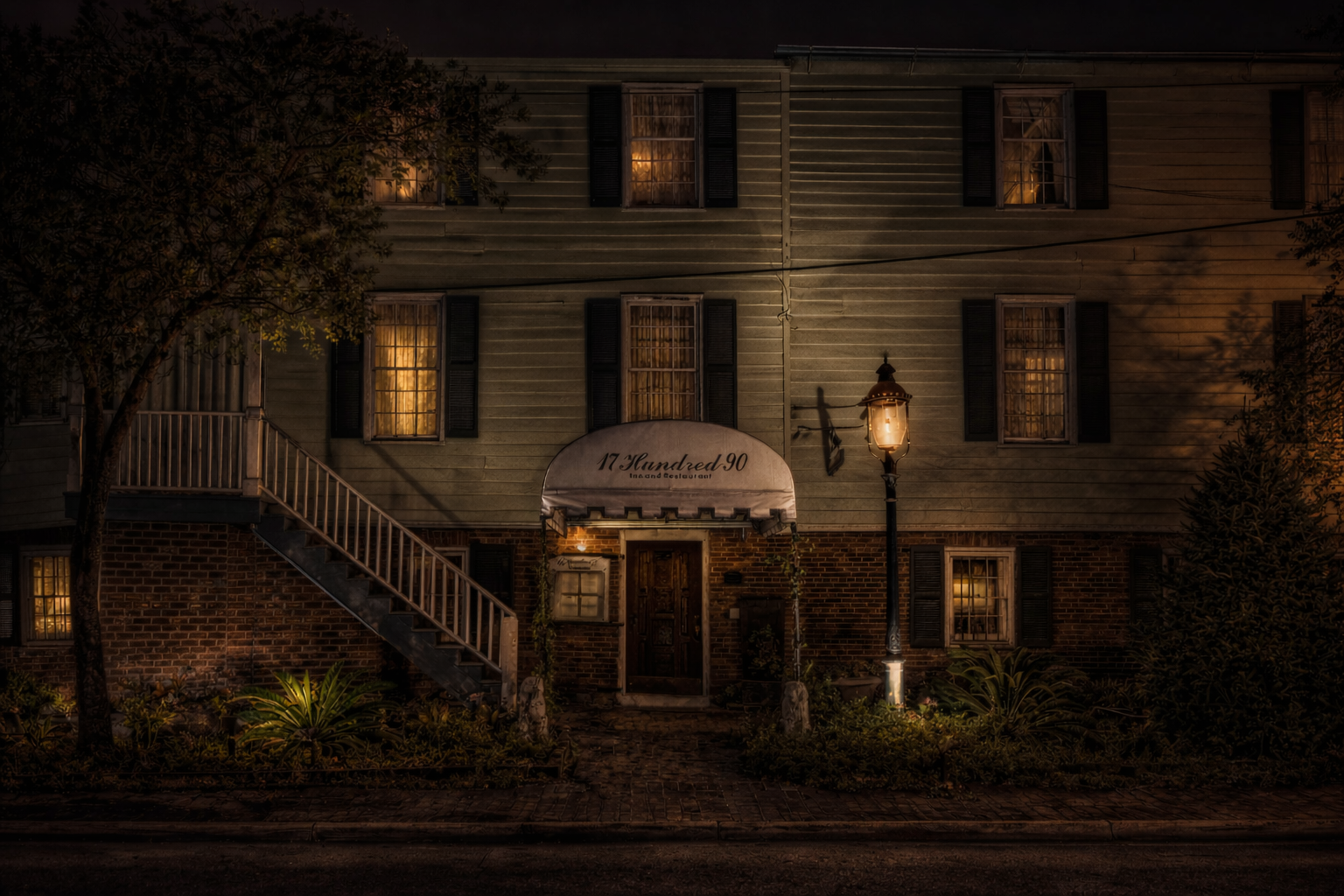
But the Kehoe House remains distinct in the way it blends elegance with unease. It is not a crumbling ruin. It is not a gimmick. It is refined, polished, and deeply Savannah, which is exactly why the stories feel so believable to the people who experience them. In a city like this, the most unsettling places are not the ones that look scary, they are the ones that look perfectly normal until they do not.
Why the Kehoe House Feels So Haunted, Even in the Daytime
Some locations only feel eerie at night. The Kehoe House can feel “charged” even in bright daylight, and there are practical reasons for that.
Old buildings have sensory quirks. High ceilings change acoustics. Thick walls muffle sound, then suddenly carry it. Narrow corridors create drafts. Sunlight shifts across stained or textured glass in ways that mimic motion. Hardwood expands and contracts with the weather, making the building speak in pops and creaks.
Then there are psychological reasons, and Savannah is a city that amplifies them. When a person knows they are standing in a house built in 1892 for a prominent iron magnate, on a square laid out in 1799, in a city founded long before the United States existed, the brain naturally reaches for story. It is what brains do. They fill in the gaps.
Ghost tours work not because they force belief, but because they give structure to that feeling, the sense that a city like Savannah is full of invisible chapters. That is why Destination Ghost Tours and other Ghost Tours in Savannah thrive: visitors are not just looking for frights. They are looking for meaning. They want history they can feel.
The Kehoe House offers that in abundance.
What Savannah Keeps, and What It Gives Back
There is a certain question that hangs over the Kehoe House, and over Savannah itself: what does it mean for a place to remember?
Some people will say the hauntings are real, that spirits linger, that children laugh in empty rooms and the past still walks the halls. Others will say it is the building settling, the mind interpreting, the power of suggestion in a city that tells stories for a living. Both camps, strangely, often agree on the experience: being in a place like the Kehoe House makes time feel thin.
And that may be Savannah’s true haunting, whether one believes in ghosts or not. The city refuses to be only present tense. Its squares are designed like memory boxes. Its ironwork is a signature. Its brick has absorbed centuries of footsteps. When visitors come seeking Haunted Savannah, Haunted Savannah Tours, and Savannah Ghost Tours, they are often seeking a brush with something older than themselves, something that makes their own lives feel briefly connected to a longer human story.
The Kehoe House, standing steady beside Columbia Square, offers that connection. It does not need exaggeration. It does not need spectacle. It only needs a quiet evening, a slow walk, and a listener who is willing to notice what the city has been saying all along.
Visiting Kehoe House Today
For travelers exploring Savannah Ghost Tours and deciding where to spend an evening, Columbia Square is an easy choice, beautiful, walkable, and packed with atmosphere. The Kehoe House remains one of the square’s signature landmarks, admired for its architecture, its ironwork character, and its reputation as one of Savannah’s most intriguing places to stay.
A few tips for experiencing the area in a way that feels true to Savannah:
-
Visit Columbia Square at two different times, once in daylight for the architectural details, and once after dark for the mood. The square changes completely.
-
Move slowly. Look at the ironwork, the balconies, the gates, the stair rails. The Kehoe story is written in metal as much as it is written in paper.
-
Keep the ghost stories in perspective. Treat them as reported experiences and local legends, and let your own senses decide what the building feels like.
-
If a ghost tour is on the itinerary, Destination Ghost Tours is a strong way to experience the city’s haunted history with storytelling that respects the line between documented past and enduring legend.
Savannah is never just one thing. It is history and hospitality, beauty and grief, elegance and shadow. The Kehoe House sits right in the middle of that contradiction, which may be exactly why people keep whispering about it long after they have checked out.
Ready to Explore Savannah's Dark Side?
Don't miss out on Savannah's most immersive ghost tour experience. Book your night with Destination Ghost Tours today.
Why Book With Destination Ghost Tours?
Multiple Tour Options
Choose from family friendly, adults only, and self guided ghost tours, all designed around Savannah's most haunted stories.
Top Rated Experience
4.9 average rating from thousands of guests who loved the history, the hauntings, and the storytelling.
Tours 7 Nights a Week
Rain or shine, we run tours throughout the year so your ghost adventure fits your schedule.
Trip Protection Available
Add Trip Protection for flexible rescheduling when plans change.
Book Online Now
Choose your date, time, and ghost tour in just a few clicks.
- See all available tour times in real time
- Instant email confirmation
- Secure, encrypted checkout
- Trip Protection available at checkout
Prefer to Call?
Our team is available 7 days a week to help you pick the perfect ghost tour.
Call 844-941-1203 8pm – 10:30pm Eastern
Chris Allen is the founder of Destination Ghost Tours, a historian and storyteller with a lifelong fascination for the darker corners of history. He spends his time uncovering the true stories behind haunted legends, guiding guests through historic cities, and chasing down details that refuse to stay buried. When he is not working, he can usually be found with his partner Arissa, their dog Bear, and their two cats, Trouble and Covu, photographing old places, digging through archives, or disappearing into historical rabbit holes. He believes the best history is honest, atmospheric, and just unsettling enough to linger.