
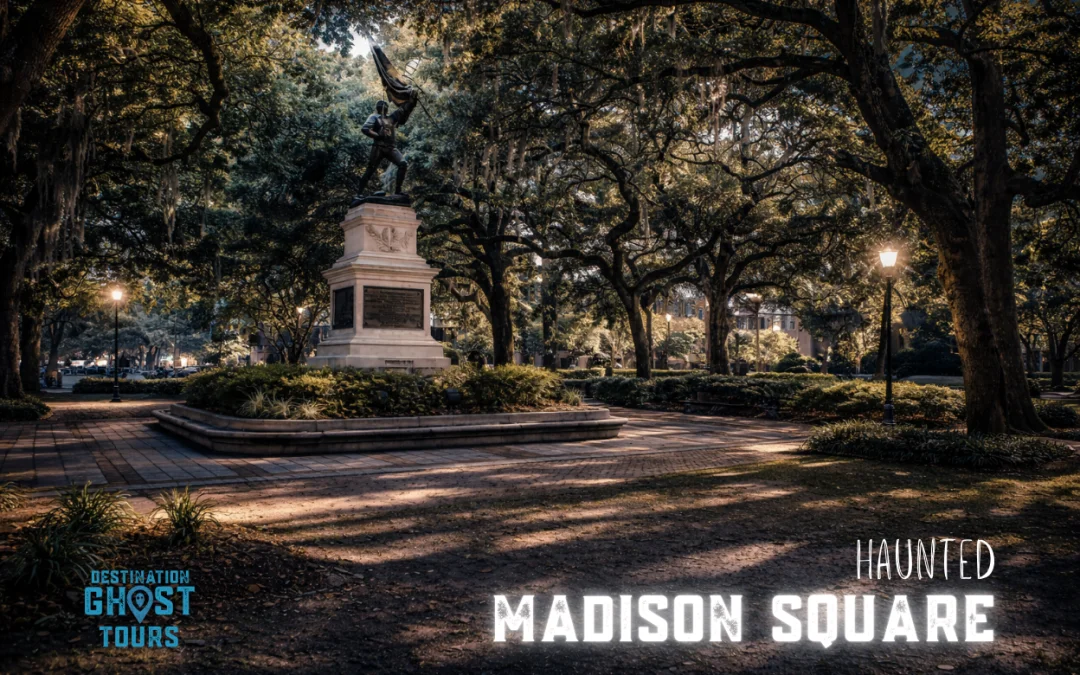
At night, Madison Square does not announce itself. There is no spectacle, no overt drama, no obvious invitation to fear. Instead, the square waits. The air feels heavier beneath the live oaks, the silence deeper than it should be for a place so close to downtown Savannah.
Streetlights glow softly through curtains of Spanish moss, illuminating pathways that have been walked for nearly two centuries. It is here, amid careful symmetry and quiet beauty, that Savannah’s past lingers most patiently. Madison Square is not haunted in the theatrical sense. Its stories are not loud — they are layered, restrained, and deeply human. The weight visitors feel comes not from spectacle but from memory: this ground has witnessed war, suffering, and resilience, and its ghosts, if they exist, are bound not to legend alone but to history itself.

The Birth of Madison Square
Madison Square was laid out in 1837 as part of Savannah’s expansion southward, following the city’s carefully planned ward system. Named for President James Madison, the square reflects the era in which it was created — a period of growth, ambition, and unease. Savannah was prospering, but it also stood on the edge of enormous social and political change.
From the beginning, Madison Square was intended as both a civic and residential space. Elegant homes surrounded it — occupied by prominent citizens, military officers, and families tied to Savannah’s economic and political life — while the square itself was a place of leisure and order, a green refuge meant to reinforce the city’s reputation as refined and controlled. At its center rose a monument that would tie this quiet green space to one of the bloodiest days in Savannah’s history. But history, as always here, had more than one chapter in mind.
War on This Ground: From Revolution to Occupation
Madison Square’s connection to war runs deep — though not quite in the way it is sometimes told. The ground here saw its bloodiest hour long before the square itself existed. During the Revolutionary War Siege of Savannah in 1779, this was the very edge of the British defensive lines; the square’s own historical marker notes that it defines the southern limit of those defenses. It was in the failed assault nearby, on October 9, 1779, that Sergeant William Jasper — the South Carolina hero who had famously rescued his regiment’s colors at Fort Moultrie — was mortally wounded. The soaring bronze monument at the center of the square, unveiled in 1888, honors him, and the two old cannons on its southern edge mark the beginnings of Georgia’s first highways.
The Civil War touched Madison Square more quietly, but unmistakably. Savannah was spared the torch: when General William Tecumseh Sherman reached the city at the end of his March to the Sea in December 1864, the merchant Charles Green offered his grand Gothic Revival mansion on the western side of the square as Sherman’s headquarters. From December 22, 1864, until February 1, 1865, the Green-Meldrim House — right on Madison Square — was the nerve center of the Union occupation. The tension of those weeks filled the surrounding streets; legend holds that the ladies of neighboring St. John’s Episcopal Church rang its bells through the night in protest, until Sherman had them removed. And just off the square, the Sorrel residence had been visited two years earlier by General Robert E. Lee himself, in 1862, when he commanded the Confederate coastal defenses in the region.
War, in other words, has stood on and around this square across more than one century. The land absorbed grief, anxiety, and uncertainty — and for those who believe places can remember, Madison Square has much to hold.
A Century of Memory: The Square in Savannah’s Social Fabric
After the Civil War, Madison Square returned to civilian life, but the echoes of conflict did not vanish. Veterans lived nearby. Widows passed through the square. Children played where their grandparents had once watched armies come and go, unaware of what history lay beneath their feet.
The surrounding homes reflected Savannah’s postwar transformation. Wealth shifted — some families prospered, others declined — but the square remained a constant, watching as generations came and went. The churches nearby added another layer to its emotional landscape. Funerals passed along its edges. Bells rang out for weddings and mourning alike. Life and death shared the same space, as they so often do in Savannah.
This long continuity of human experience is central to understanding the square’s haunted reputation. Madison Square is not associated with a single tragedy or sensational event. Instead, its unease comes from accumulation — from the sheer weight of everything that has happened here, and everyone who has passed through.
The Ghosts of Madison Square
The Soldiers Who Never Left
One of the most persistent legends tied to Madison Square involves the spirits of soldiers. Accounts date back decades and remain consistent in tone, if not in detail. Visitors and residents alike have reported seeing figures in period clothing — often described as soldiers — standing beneath the trees or moving quietly along the pathways. These figures are not aggressive. They do not interact. Most vanish as quickly as they appear, leaving witnesses questioning what they saw, usually late at night or in the early morning hours, when the square is nearly empty.
Given the square’s layered military past — Revolutionary siege ground at one end of the centuries, a Union occupation headquarters at the other — it is little wonder such stories take root here. If any place in Savannah were to inspire soldier legends, it would be this one. Whether one believes these are true hauntings or simply the mind’s response to history, the stories persist because they fit the square so perfectly.
Sounds in the Silence
Another frequently reported phenomenon involves sound: footsteps where no one is walking, low voices carried on the breeze, the distant rhythm of marching feet heard only for a moment before fading away. These experiences are most often described by locals who pass through the square regularly — and familiarity seems to make the moments more unsettling, not less, because when a place is well known, deviations stand out. There are no records tying these sounds to any modern activity: no nearby construction, no late-night events. They simply come and go without explanation. Among a city full of haunted-tour legends, Madison Square’s auditory reports are some of the most understated, and perhaps the most effective. They do not demand belief. They simply exist.
The Weight of Emotion
Unlike many haunted locations, Madison Square is rarely associated with a single named ghost. There is no tragic heroine or violent villain bound to its story. Instead, visitors often describe a feeling — a sudden heaviness, a wave of sadness, or a sense of being watched. These emotional responses are well documented in personal accounts, though they resist precise explanation. Some experience them briefly, others more intensely, and the sensations often fade once a person leaves the square.
Both the skeptic and the believer tend to agree on one thing: Madison Square affects people.
Psychologists might attribute this to environmental factors — low light, quiet, and historical awareness. Paranormal researchers might suggest residual energy, the imprint of past emotions lingering where so much once occurred. Both interpretations acknowledge the same truth: Madison Square affects people. And the historic homes and institutions that frame it — their windows dark at night, their facades unchanged by modern life — only deepen that effect, standing as silent witnesses to war, reconstruction, prosperity, and decline. The square does not belong to one story. It belongs to all of them.
Why the Legends Endure
Savannah is often described as a city built on its dead — a phrase that resonates deeply at Madison Square. Unlike cemeteries, which openly acknowledge death, the square integrates memory into daily life. People picnic where soldiers once stood. Dogs nap beneath trees that shaded grieving families. This blending of past and present is why Madison Square plays such a vital role in Savannah’s ghost lore: it shows how a haunting does not always require spectacle. Sometimes it requires only time.
Legends survive when they resonate with place and history. Madison Square’s stories persist because they align with what is known — war was here, grief was here, waiting and uncertainty were here. The stories do not contradict the record; they complement it. In a city filled with haunted homes and dramatic tales, Madison Square stands apart by offering something quieter, and perhaps more unsettling. It asks visitors to slow down, to listen, and to consider the lives that once passed through its pathways. Destination Ghost Tours approaches the square with respect for that subtlety — its power lies not in sensational claims, but in what can be proven and what can be felt.
Visiting Madison Square Today
Today, Madison Square remains one of Savannah’s most beautiful and contemplative spaces. By day, it is serene, elegant, and inviting. By night, it transforms — becoming introspective and hushed. Visitors interested in the city’s ghost tours often find it unexpectedly affecting. It may not frighten, but it lingers, settling into memory like a half-remembered dream.
Madison Square does not demand belief in ghosts. It asks something deeper: to acknowledge that places remember, that human experience leaves traces, and that sometimes the past does not need to announce itself to be felt. In that quiet understanding, Madison Square becomes one of Savannah’s most haunting spaces of all.
Feel the Weight of Savannah’s Past
Madison Square is one of the quietly powerful stops on a walk through haunted Savannah. Come experience the city’s history — and its hauntings — with Destination Ghost Tours.
Book a Savannah Ghost Tour
Chris Allen is the founder of Destination Ghost Tours, a historian and storyteller with a lifelong fascination for the darker corners of history. He spends his time uncovering the true stories behind haunted legends, guiding guests through historic cities, and chasing down details that refuse to stay buried. When he is not working, he can usually be found with his partner Arissa, their dog Bear, and their two cats, Trouble and Covu, photographing old places, digging through archives, or disappearing into historical rabbit holes. He believes the best history is honest, atmospheric, and just unsettling enough to linger.